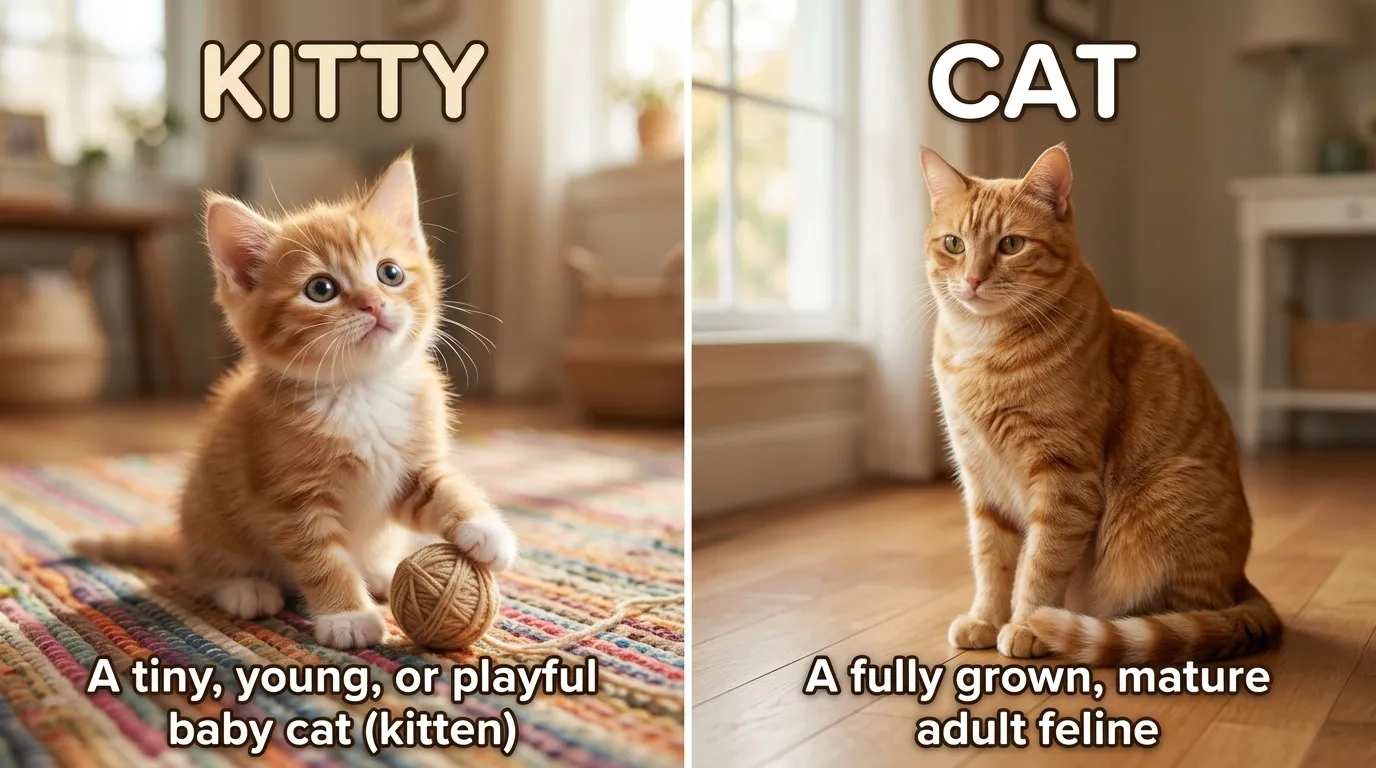
Kitty and cat can both refer to the same animal, but cat is the normal word, while kitty is a cute and informal word.
Imagine a child seeing a small cat sitting near the door. The child may say, “Look at that cute kitty!” An adult may simply say, “There is a cat outside.” Both sentences are correct. The animal has not changed. Only the way we talk about it has changed.
The word cat is the standard name for the animal. It works in everyday speech, school writing, news reports, and formal situations. Kitty is usually softer, friendlier, and more affectionate. People often use it when talking to children or when showing love for a pet. Dictionaries also describe kitty as an informal way to refer to a cat or kitten.
They may also want to know which word sounds more natural. The simple answer is that a kitty is still a cat. The main difference is tone, age, and context.
Pronunciation
Cat
- US: /kæt/
- UK: /kæt/
- Sounds like: kat
Kitty
- US: /ˈkɪti/
- UK: /ˈkɪti/
- Sounds like: KIT-ee
The pronunciation is almost the same in British and American English.
Now let us look at the differences in a simple way.
Read more about:https://gatherword.com/kitten-is-male-or-female/
Difference Between Kitty and Cat
1. Basic Meaning
Cat is the standard word for the animal.
Kitty is an informal and affectionate word for a cat or kitten.
Examples:
- The cat is sleeping on the sofa.
- Look at that cute kitty!
2. Formality
Cat is neutral. You can use it almost anywhere.
Kitty is informal. It sounds friendly and warm.
Examples:
- The vet examined the cat.
- My little sister loves her kitty.
3. Age
A cat can be young, adult, or old.
Kitty often suggests a young, small, or cute cat, but it can also mean an adult cat.
Examples:
- Our cat is ten years old.
- The child picked up the little kitty.
4. Emotional Tone
Cat is usually neutral.
Kitty often shows affection.
Examples:
- I saw a cat near the shop.
- Come here, kitty!
5. Use With Children
Children often use kitty because it sounds soft and easy.
Adults may also use it when speaking kindly to children.
Examples:
- “Can I touch the kitty?”
- “Look, a kitty is sitting there!”
6. Use With Pets
Both words can describe a pet.
However, kitty often sounds more loving.
Examples:
- My cat likes sleeping on my bed.
- My kitty waits for me every morning.
7. Use in Formal Writing
Cat is better for formal writing.
Kitty is usually too casual unless it is part of a name, quote, story, or informal context.
Examples:
- Cats are common household pets.
- The story is about a friendly kitty.
8. Use in Everyday Speech
Both words are common in casual conversation.
The choice depends on the speaker’s tone.
Examples:
- Where is the cat?
- Here, kitty, kitty, kitty!
9. Plural Form
The plural of cat is cats.
The plural of kitty is kitties.
Examples:
- Three cats are playing outside.
- The shelter has several kitties.
10. Standard vs Affectionate Word
Cat is the standard animal name.
Kitty is a pet name or affectionate form.
Examples:
- A cat needs food and water.
- The little kitty is hungry.
Nature and Behaviour of Kitty and Cat
Nature of a Cat
A cat is a small domesticated mammal. Cats can be playful, quiet, curious, and independent. They may enjoy sleeping, climbing, exploring, and chasing toys.
The word cat does not tell us anything about the animal’s personality.
A cat can be friendly or shy. It can be young or old.
Nature of a Kitty
A kitty is still a cat. The word simply gives the animal a softer or more affectionate image.
When people say “kitty,” they may imagine a small, cute, playful animal.
For example:
- “The cat is under the table.” This sounds neutral.
- “The kitty is under the table.” This sounds warmer and cuter.
Why People Get Confused About Kitty and Cat
The confusion is easy to understand.
People sometimes think kitty means only a baby cat. That is not always true.
A kitten is specifically a young cat. Kitty, however, is an informal term for a cat or kitten. Cambridge defines kitty as “a cat or kitten,” while Oxford describes it as an informal way of referring to a cat.
So these words are related but are not exact equivalents in every situation:
- Cat = standard animal name
- Kitten = young cat
- Kitty = informal or affectionate word for a cat or kitten
The Origin of Kitty
The word kitty has been used in English for centuries. One source dates this use to about 1719 and connects it with kitten.
Over time, kitty became a friendly word for cats. It is now widely understood in English.
The word also has other meanings. For example, kitty can mean a shared amount of money. This is a completely different meaning from the animal-related word.
British vs American English
Both varieties use:
- cat
- cats
- kitty
- kitties
The pronunciation of kitty is also very similar in both varieties.
American English
Americans commonly use kitty as an affectionate word for a cat.
Example:
- “Come here, kitty!”
British English
British speakers also use kitty as an affectionate or informal term.
Example:
- “The kitty is sleeping in the garden.”
Which One Should You Use?
Use cat when you want a safe, standard word.
Use kitty when you want to sound friendly, cute, playful, or affectionate.
For US English
Both are natural.
- Formal: “The cat needs medical care.”
- Informal: “Our kitty is sleeping.”
For UK English
Both are also understood and used.
- “There is a cat in the garden.”
- “Look at that little kitty.”
For Global English
Cat is the best choice when you want maximum clarity.
English learners should learn cat first. Then learn kitty as an informal alternative.
Common Mistakes
Mistake 1: Thinking kitty is a different animal
Incorrect idea:
- A kitty and a cat are completely different animals.
Correct:
- A kitty is an informal term for a cat or kitten.
Mistake 2: Using kitty in every formal sentence
Less suitable:
- The scientist studied the behavior of the kitty.
Better:
- The scientist studied the behavior of the cat.
Mistake 3: Thinking kitty always means kitten
Not always.
A kitty can be an adult cat too.
Mistake 4: Using “kittys” as the plural
Incorrect:
- I saw two kittys.
Correct:
- I saw two kitties.
Mistake 5: Confusing kitty with kitten
A kitten is specifically a young cat.
A kitty is an informal or affectionate word for a cat or kitten.
Everyday Usage Examples
In Emails
Formal:
- “Please keep the cat indoors during the treatment.”
Informal:
- “Our kitty is feeling much better now.”
On Social Media
- “My kitty loves sleeping in boxes.”
- “Look at this cute cat!”
In News
News writing normally prefers cat because it is neutral.
Example:
- “A cat was rescued from a house fire.”
In Formal Writing
Use cat:
- “Domestic cats are popular companion animals.”
In Conversation
Both are natural:
- “Where is the cat?”
- “Where is my kitty?”
Usage Trends
Cat remains the standard word. It is useful in education, science, news, websites, and everyday conversation.
Kitty is more emotional. It appears often in conversations about pets, children, social media posts, pet names, and playful speech.
The growth of online pet content has also made friendly terms such as kitty easy to see in casual digital English.
However, context still matters. A professional veterinary article will normally use cat, while a social media post about a beloved pet may use kitty.
Metaphors and Similes
The word cat appears in many figurative expressions.
Cat-like
This can describe someone who moves quietly or carefully.
- “He moved like a cat through the dark room.”
Curiosity
Cats are often linked with curiosity.
- “She explored the new place like a curious cat.”
Cool as a cat
This can suggest calm behavior.
- “He stayed as cool as a cat during the difficult interview.”
Kitty is less common in formal metaphors. It is usually used to create a cute or playful feeling.
Example:
- “The child was as gentle as a little kitty.”
Connotative Meaning
Cat
The word cat is usually neutral.
It can also suggest independence, cleverness, or mystery depending on context.
Example:
- “The cat watched the room quietly.”
Kitty
The word kitty often has a positive and warm feeling.
It may suggest:
- Cuteness
- Small size
- Affection
- Playfulness
- Innocence
Example:
- “The little kitty followed the child home.”
Negative Meaning
Neither word is automatically negative.
A negative meaning usually comes from the sentence or context.
Example:
- “That cat scratched me.”
The word cat itself is still neutral.
Idioms and Proverbs
English has many expressions with cat, but far fewer with kitty.
Let the cat out of the bag
This means to reveal a secret.
Example:
- “He let the cat out of the bag about the surprise party.”
Curiosity killed the cat
This proverb warns that too much curiosity can cause trouble.
Example:
- “Don’t keep asking about the secret. Curiosity killed the cat.”
When the cat’s away, the mice will play
This means people may behave freely when the person in charge is absent.
Example:
- “The students became noisy when the teacher left. When the cat’s away, the mice will play.”
Literature and Movies
Cats have a long history in English literature and popular culture.
One notable literary example is The Tale of Kitty-in-Boots by Beatrix Potter. Potter wrote the story in 1941, although it was not published as a book until 2016. It features a serious young black cat called Kitty-in-Boots.
Movies have also used cats as major characters. For example, The Aristocats is a 1970 American animated film centered on a family of cats. The film helped keep cat-related words and characters popular in children’s culture.
Another example is The Cat, a 2011 South Korean horror film. The movie uses a cat as an important part of its story.
Why This Difference Matters
Understanding kitty or cat helps English learners choose the right tone.
If you are writing an academic paper, use cat.
If you are writing a friendly social media post, kitty may sound more natural.
Learning such differences makes your English more natural.
It also helps you understand native speakers. When someone says “kitty,” they may be showing affection rather than giving a scientific name.
Usefulness in Daily Life
You may use cat when:
- Talking to a doctor or vet
- Writing a school assignment
- Reading a news report
- Writing a formal email
- Describing an animal clearly
- Talking about animals in general
You may use kitty when:
- Talking to a child
- Talking about your pet
- Writing a cute social media post
- Calling a cat
- Showing affection
- Using playful language
For example:
- “My cat needs food.”
- “Come here, kitty!”
- “Cats are independent animals.”
- “My little kitty is sleeping.”
Situational Preference
Choose cat when clarity and a neutral tone matter. It is the best choice for school work, formal writing, science, news, and professional communication. Choose kitty when you want a warmer and more personal tone. It works well with children, pets, casual conversations, and social media. If you are unsure which word to use, choose cat. It is always clear and widely accepted. If the situation is friendly and informal, kitty can make your sentence sound softer and more affectionate. Remember that kitty does not name a different animal. It mainly changes the feeling of the sentence.
Possible asked questions
Is a kitty the same as a cat?
Yes. Kitty is an informal or affectionate word for a cat or kitten.
Is a kitty always a baby cat?
No. Kitty can refer to an adult cat too. Kitten is the more exact word for a young cat.
Is cat more formal than kitty?
Yes. Cat is neutral and works well in formal writing. Kitty is informal and affectionate.
Can I use kitty in American English?
Yes. Kitty is common and natural in American English.
Can I use kitty in British English?
Yes. British English also uses kitty as an affectionate name for a cat.
What is the plural of kitty?
The plural is kitties.
Example:
- “The shelter has five kitties.”
Which word should English learners use?
Start with cat because it is the standard and most flexible word. Learn kitty as a friendly, informal alternative.
Conclusion
Kitty and cat can refer to the same animal, but they do not have exactly the same tone. Cat is the standard English word. It is neutral and works in almost every situation. Kitty is informal and affectionate. People often use it when talking about pets, children, or cute animals.
You can use cat in school writing, professional communication, science, news, and everyday speech. You can use kitty when you want your language to sound warmer, softer, or more playful.
Remember the simple rule: cat is the standard word, while kitty is the friendly word.
Also, do not confuse kitty with kitten. A kitten is a young cat, while kitty can refer to a cat of any age. Dictionaries describe kitty as an informal way of referring to a cat or kitten.
So, if you are unsure, choose cat. If you are speaking with affection, kitty may be the better choice.
Both words are correct. The best choice depends on your audience, situation, and tone.