A roach and a waterbug may look alike, but the names do not always mean the same insect.
Imagine you see a dark bug running across your kitchen floor. You may call it a waterbug because it looks large and moves fast. Your friend may call it a roach. Now, you both wonder which name is right.
The words roach or waterbug often cause this kind of confusion. A roach is a short name for a cockroach. They often seek food, water, and shelter.
The word waterbug has more than one meaning. Some people use it for large cockroaches, such as the American cockroach. Others use it for true water bugs. These insects live in or near water and belong to a different group.
So, the difference between a roach and a waterbug depends on the insect you see and how the word is used. This guide will help you understand both terms. You will learn how to tell them apart, when to use each word, and why their names can be confusing.
Pronunciation
- Roach
- US English: /roʊtʃ/
- UK English: /rəʊtʃ/
- Waterbug
- US English: /ˈwɔːtərˌbʌɡ/
- UK English: /ˈwɔːtəˌbʌɡ/
The main difference is not just the name. The insect’s body, habitat, and behavior can also help you identify it.
Read more about:https://gatherword.com/pigeon-or-dove/
Difference Between Roach and Waterbug
1. Basic Meaning
A roach is a cockroach. A waterbug may mean a true aquatic insect or a large cockroach.
- Example 1: A roach ran under the fridge.
- Example 2: The child found a waterbug near the pond.
2. Scientific Group
Cockroaches belong to the order Blattodea. True water bugs belong to the order Hemiptera.
- Example 1: A roach is part of the cockroach group.
- Example 2: A giant water bug belongs to a different insect group.
3. Usual Habitat
Roaches often live in warm, dark places. True water bugs live in water or near it.
- Example 1: The roach hid behind the kitchen cabinet.
- Example 2: The waterbug rested near the edge of a pond.
4. Body Shape
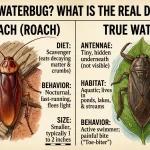
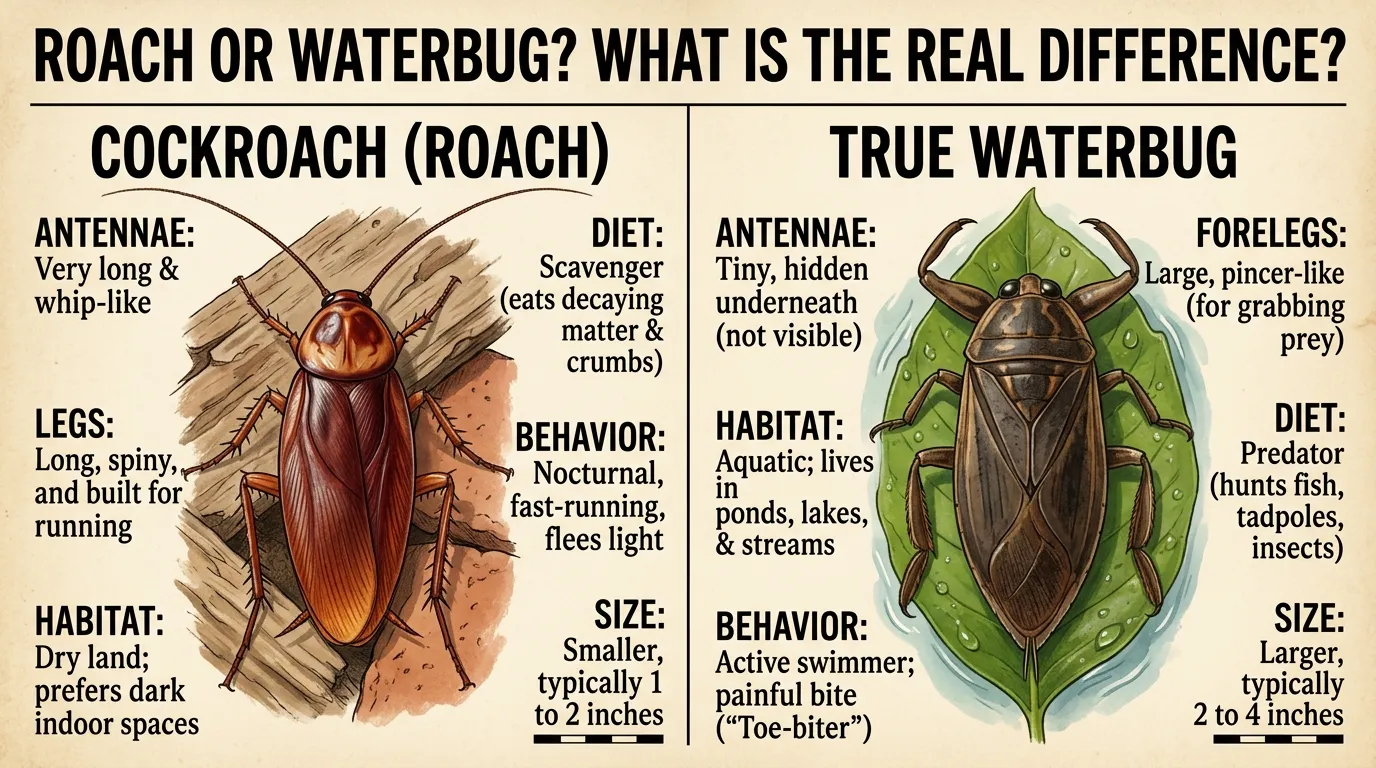
Roaches often have flat bodies, long antennae, and spiny legs. True water bugs often have strong front legs that help them catch prey.
- Example 1: The roach had long antennae.
- Example 2: The waterbug used its front legs to hold its prey.
5. Food
Many roaches eat a wide range of foods. True water bugs often hunt small animals in the water.
- Example 1: The roach ate crumbs near the bin.
- Example 2: The waterbug caught a small insect in the pond.
6. Movement
Roaches often run quickly across floors and walls. True water bugs may swim, dive, or move across the water.
- Example 1: The roach ran behind the stove.
- Example 2: The waterbug swam below the pond’s surface.
7. Relationship With Homes
Some roaches live inside homes and may become pests. True water bugs are more often found in ponds, lakes, and other water habitats.
- Example 1: Roaches appeared in the apartment kitchen.
- Example 2: A waterbug was found in a garden pond.
8. Risk to People
Some roaches can spread germs through contaminated surfaces. True water bugs may bite if handled, and some large species have painful bites.
- Example 1: The family cleaned the area where roaches had walked.
- Example 2: The child left the waterbug alone to avoid a bite.
9. Appearance
Roaches often have long antennae and a shield-like plate behind the head. True water bugs may have a broad body and front legs shaped for catching prey.
- Example 1: The roach had long, thin antennae.
- Example 2: The waterbug had strong front legs.
10. Correct Word Choice
Use roach when you mean a cockroach. Use waterbug when you mean a true water bug or when the local name clearly refers to a cockroach.
- Example 1: I saw a roach in the bathroom.
- Example 2: We spotted a giant water bug in the pond.
Nature and Behaviour of Roach and Waterbug
Nature and Behaviour of Roaches
Roaches are insects that can live in many places. Many species prefer warm, damp, and dark areas. They often hide during the day and search for food at night.
Some roaches live outdoors. Others can enter homes through cracks, drains, or gaps around doors. They may feed on crumbs, food waste, and other organic matter.
Not every roach lives in a house. Many species live outside and play a role in breaking down dead plant material.
Nature and Behaviour of Water Bugs
True water bugs are often found in ponds, lakes, streams, and other freshwater habitats. Many are predators. They catch small insects and other animals.
Some species swim well. Others wait for prey near plants or the water’s edge. Large water bugs may bite if people pick them up.
A true water bug is not simply a cockroach that happens to be near water. It belongs to a different insect group.
Why People Get Confused About Roach and Waterbug
People confuse these words for several reasons.
First, both insects may have dark bodies. Some are also similar in size and shape.
Second, people use local names. Third, both insects may appear in damp places. A person may see a large insect near a drain and assume it must be a waterbug.
Finally, pictures on the internet may use these names loosely. The best way to identify an insect is to look at its body, legs, habitat, and behavior.
The two terms can overlap in everyday speech. A large cockroach may be called a waterbug, but that does not make it a true water bug.
The Origin of the Keywords
Origin of Roach
The word roach is a shortened form of cockroach. The word cockroach entered English through Spanish cucaracha. English speakers changed the sound and spelling over time.
Today, roach is a common informal word for a cockroach. It appears in daily speech, pest-control advice, and news reports.
Origin of Waterbug
The word waterbug combines water and bug. The spelling water bug, with two words, is also common. Scientific names are more exact because common names can vary from place to place.
British vs American English
Both British and American English use the word roach. The spelling is the same in both forms.
The term waterbug also appears in both varieties of English. However, its meaning may depend on local habits and the type of insect being discussed.
Examples:
- American English: There is a roach behind the fridge.
- British English: There is a cockroach behind the fridge.
- American English: Some people call this large cockroach a waterbug.
- British English: A water bug may refer to an insect that lives in water.
Which One Should You Use?
Your choice depends on what you mean.
For US readers: Use roach in casual speech. Use cockroach in formal writing. If you use waterbug, explain which insect you mean.
For UK readers: Cockroach is clear and widely understood. Use water bug for an insect that lives in or near water, where that meaning fits.
For global readers: Use cockroach when you mean a cockroach. Use true water bug when you mean an aquatic insect from a different group.
If you are unsure about the insect, avoid guessing from its size or color alone. A clear photo or expert identification can help.
Common Mistakes
- Mistake: Every waterbug is a cockroach. Correction: True water bugs and cockroaches belong to different insect groups.
- Mistake: A cockroach becomes a waterbug when it lives near a drain. Correction: Its scientific group does not change because of its location.
- Mistake: All roaches live inside homes. Correction: Many species live outdoors.
- Mistake: All water bugs live in clean water. Correction: Their habitats vary by species.
- Mistake: Every large, dark insect is a waterbug. Correction: Size and color alone are not enough to identify it.
- Mistake: The words always have one fixed meaning in everyday speech. Correction: Common names can vary by region.
Everyday Usage Examples
In Emails
- “We found a roach in the kitchen. Could you arrange pest control?”
- “I saw a water bug near the pond during our school visit.”
On Social Media
- “I spotted a huge roach in my garage last night!”
- “Look at this water bug swimming in the pond.”
In News Reports
- “Residents reported cockroaches in several apartment buildings.”
- “Researchers studied water bugs in a local freshwater habitat.”
In Formal Writing
- “The cockroach was identified as a species commonly found in urban areas.”
- “The water bug was observed hunting small insects in a freshwater pond.”
This avoids confusion between common names.
Usage Trends
The words roach and waterbug are both used in everyday English. Their use varies by place and context.
Roach often appears in casual talk about cockroaches, home pests, and pest control. Cockroach is common in educational, scientific, and formal writing.
Waterbug may appear in home pest discussions, nature articles, and searches for insects found near water. In some US regions, people use it for a large cockroach. In other contexts, it refers to a true aquatic insect.
Search re.
Metaphors and Similes
The words roach and waterbug do not have many standard figurative meanings, but people may use them creatively.
Roach
- “He hid like a roach in the dark.” This suggests someone who avoids attention.
- “The room was full of roaches after the storm.” This is a direct description, not a metaphor.
Waterbug
- “He moved across the pond like a water bug.” This simile suggests quick movement on the water.
- “The tiny boat skimmed like a water bug.” This compares the boat’s movement to that of an insect.
These examples are creative comparisons, not fixed idioms.
Connotative Meaning
A word’s connotation is the feeling or idea it brings to mind.
Roach
Negative meaning: The word may suggest dirt, an infestation, or an unpleasant surprise.
Example: “A roach ran across the kitchen floor.”
Neutral meaning: It can simply name an insect.
Example: “The guide showed us a roach species found in forests.”
Positive meaning: Positive uses are rare, but a roach may appear in a story about survival or nature.
Example: “The roach survived in a harsh environment.”
Waterbug
Negative meaning: The word may make people think of a large insect in a bathroom or kitchen.
Example: “A waterbug startled me near the sink.”
Neutral meaning: It can name a true water insect.
Example: “The class observed a waterbug in its habitat.”
Positive meaning: In nature writing, it can suggest the variety of life in a pond.
Example: “The waterbug added to the rich life of the pond.”
The feeling linked to either word depends on the setting and the reader.
Idioms and Proverbs
- “The roach came out of hiding.” This means the insect left its hiding place. It can also describe a person who stops hiding.
- “Like a waterbug on a pond.” This is a creative simile for something moving quickly across water.
- “The roach was hard to catch.” This is a literal statement, though it could describe a person who is hard to find in a story.
These are examples of creative language, not established proverbs. Use them carefully in formal writing.
Literature and Movies
Roaches and water bugs appear in nature writing, horror stories, comedy, and films about insects. Their meaning depends on the story.
Literature
- The Metamorphosis — Franz Kafka, 1915, a German-language novella. It features a man who wakes up transformed into a strange insect-like creature. The creature is often linked to cockroach imagery, though Kafka does not clearly identify it as a cockroach.
- The Cockroach — Ian McEwan, 2019, a satirical novella from the United Kingdom. It uses a cockroach as part of a political and social satire.
Movies
- Joe’s Apartment — 1996, United States. This comedy features cockroaches as major characters.
- Mimic — 1997, United States. This science-fiction horror film features insects that imitate human appearance.
These works use insects to create humor, fear, or deeper ideas. They do not establish a strict difference between the everyday words roach and waterbug.
Why This Difference Matters
Knowing the difference helps you use the right word and understand what others mean.
For English learners, it builds vocabulary and improves reading. A person reading about a waterbug in a pond should know that it may not be a cockroach.
For homeowners, correct identification can help with pest control.
For students and writers, accurate terms make reports and articles clearer. A scientific report should not use a loose common name when the species can be identified.
The difference also matters for nature education. True water bugs play a role in aquatic food webs.
Usefulness in Daily Life
You may need these words in several everyday situations.
- At home: Use roach or cockroach when discussing a suspected cockroach problem.
- At school: Use cockroach for a lesson about insects and their habitats.
- In a garden: Use water bug if you are discussing a true insect found in a pond.
- When reporting a pest: Describe the insect’s size, color, location, and behavior.
- When speaking with an expert: Share a photo if you can do so safely.
The most useful rule is simple: identify the insect first, then choose the name.
Situational Preference
Use roach when speaking casually about a cockroach, especially in the United States. Choose waterbug when the insect is a true water bug or when you are explaining a local name for a large cockroach. In the UK, cockroach is often the clearest word for a household pest. In science, use the insect’s exact name when known. If you cannot identify it, describe where you found it and what it looks like. This helps avoid mistakes.
Possible asked questions
1. Is a roach the same as a waterbug?
Not always. A roach is a cockroach. A true water bug belongs to a different insect group. However, some people call large cockroaches waterbugs.
2. Are waterbugs just big roaches?
No. Some insects called waterbugs are true aquatic bugs. Others are large cockroaches given that common name in everyday speech.
3. Can waterbugs live in a house?
Some insects called waterbugs may enter buildings. True water bugs usually live in or near water. A cockroach called a waterbug may live in damp areas of a house.
4. Do roaches and waterbugs bite?
Cockroaches rarely bite people. Some true water bugs can deliver painful bites, especially if handled or threatened.
5. Which insect is more harmful?
It depends on the species and situation. Cockroaches can contaminate food and surfaces. Some true water bugs can bite, but they are not usually household pests.
6. How can I tell a roach from a true water bug?
Look at its body, legs, habitat, and behavior. Roaches often have long antennae and run across land. True water bugs often have front legs adapted for catching prey and live in or near water. A photo or expert can help confirm the identity.
7. Should I use “roach” or “waterbug” in an article?
Use roach or cockroach for a cockroach. Use waterbug for a true water bug, or explain the local meaning if you use it for a cockroach.
Conclusion
A roach is a cockroach. A true water bug belongs to a different insect group and often lives in or near freshwater.
These insects may look alike, but their bodies, habitats, and behavior can help you tell them apart. Roaches often run across floors and hide in dark places. True water bugs often hunt small animals in water.
If you are speaking casually, roach is a common short form of cockroach. For schoolwork, science, or formal writing, cockroach is usually clearer. Use waterbug when you mean a true water bug, or explain what you mean if the name is used locally for a cockroach.
When you are unsure, do not rely on color or size alone. Check the insect’s features, take a photo from a safe distance, and seek expert help if needed.