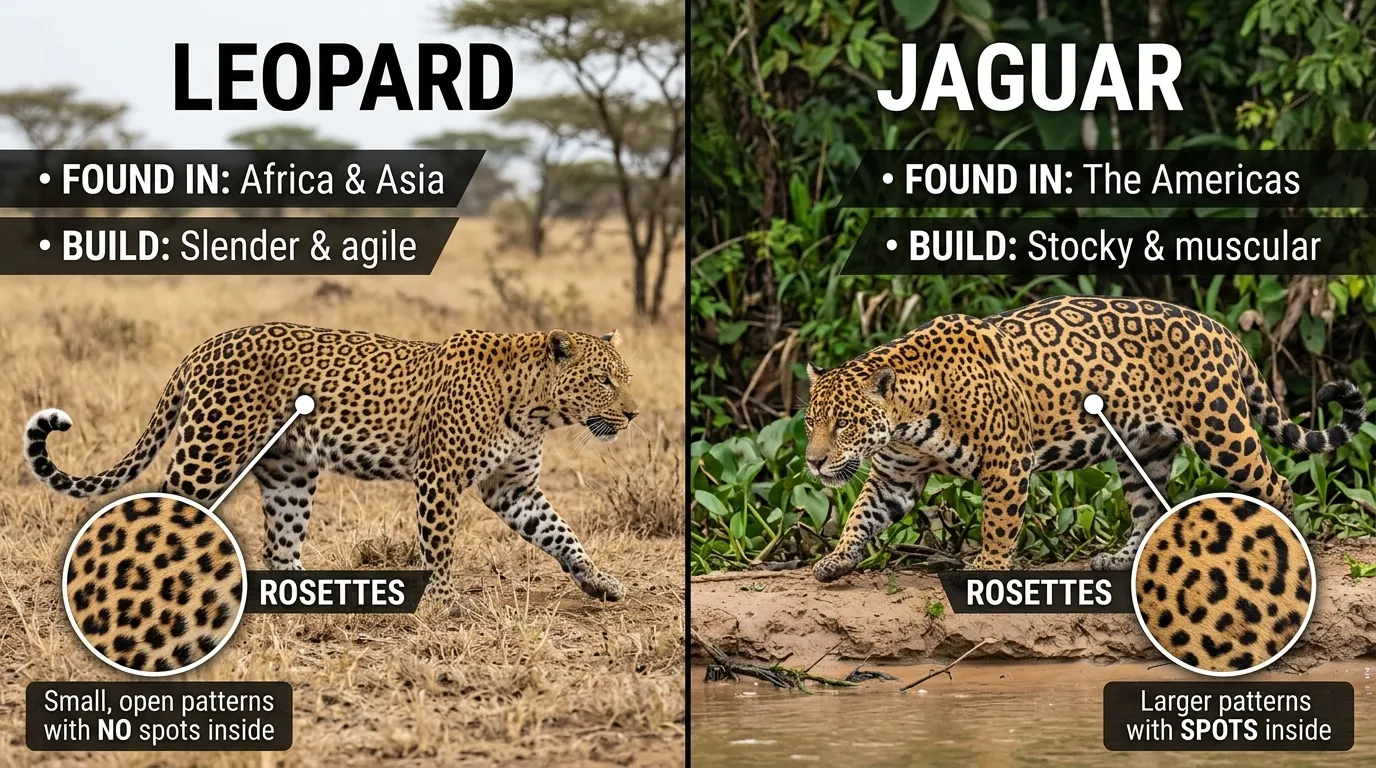
A leopard lives mainly in Africa and Asia, while a jaguar lives in Central and South America.
Imagine you are watching a wildlife video. You see a large spotted cat moving quietly through thick trees. At first, you may think it is a leopard. Then you notice its body looks very strong, and its spots seem different. Could it be a jaguar? This is where the leopard or jaguar question often starts.
Both animals are large wild cats and golden or yellow-brown coats. similarly they have black markings called rosettes. However, they are different animals with different homes, body shapes, and hunting styles. A leopard or jaguar can be hard to identify from a quick picture because both look similar. Learning the main differences makes identification much easier.
Pronunciation
The two words sound different in American and British English.
WordUS PronunciationUK PronunciationLeopard/ˈlep.ɚd//ˈlep.əd/Jaguar/ˈdʒæɡ.wɑːr//ˈdʒæɡ.ju.ər/
Cambridge lists these US and UK forms for both words.
Easy guide:
- Leopard: LEP-erd
- Jaguar, US: JAG-wahr
- Jaguar, UK: JAG-yoo-uh
Now let us look at the differences that make these two big cats easier to recognize.
Read more about:https://gatherword.com/kitten-is-male-or-female/
Difference Between Leopard and Jaguar
1. Geographic Range
The biggest difference is where they live.
Leopards are found mainly in Africa and parts of Asia. Jaguars live mainly in Central and South America.
Examples:
- A safari in Kenya may show a leopard.
- A rainforest trip in Brazil may show a jaguar.
2. Body Shape
Jaguars usually have a shorter, stockier, more muscular body.
Leopards often look slimmer and more graceful.
Examples:
- The leopard looks built for climbing and moving quickly.
- The jaguar has a strong, heavy-looking body.
3. Head and Jaws
A jaguar usually has a broader head and very powerful jaws.
A leopard has a smaller-looking head and a more slender face.
Examples:
- The jaguar has a wide face.
- The leopard often looks more narrow-faced.
4. Rosettes
Both cats have rosette patterns. However, their patterns can help you tell them apart.
Jaguar rosettes often contain small black spots inside them. Leopard rosettes usually do not have those central spots.
Examples:
- Look closely at the side of a jaguar.
- Look at the center of its rosettes for small spots.
5. Size
Jaguars are generally heavier and more heavily built.
Leopards are often lighter and more slender.
Size can vary by sex, region, and individual animal, so body shape is usually more useful than size alone.
Examples:
- A large jaguar can look extremely powerful.
- A leopard can look long and athletic.
6. Habitat
Leopards can live in many habitats. They may be found in forests, grasslands, mountains, and dry areas.
Jaguars are strongly linked with forests, wetlands, and other areas with water.
Examples:
- A leopard may live in a dry African landscape.
- A jaguar may move through a wet tropical forest.
7. Relationship With Water
Jaguars are strong swimmers and often spend time around rivers, wetlands, and other water sources.
Leopards can swim too, but they are not as closely associated with water as jaguars are.
Examples:
- A jaguar may cross a river while hunting.
- A leopard may avoid water when it can.
8. Hunting Style
Leopards are famous for stealth. They often approach prey quietly and can carry kills into trees.
Jaguars also use stealth, but their powerful jaws give them a different hunting style. They can deliver an extremely strong bite.
Examples:
- A leopard may drag prey into a tree.
- A jaguar may use its strong bite to kill prey.
9. Climbing Ability
Leopards are excellent climbers.
They may climb trees to rest, hide, or protect food from other predators.
Jaguars can climb, but tree climbing is not as important to their daily life.
Examples:
- A leopard resting on a tree branch is a common wildlife sight.
- A jaguar is more often seen on the ground or near water.
10. Scientific Name
The leopard is Panthera pardus.
The jaguar is Panthera onca.
Both belong to the genus Panthera, which also includes lions, tigers, and snow leopards.
Examples:
- Scientists call the leopard Panthera pardus.
- Scientists call the jaguar Panthera onca.
Nature and Behaviour of Leopard and Jaguar
Leopard Nature and Behaviour
Leopards are usually solitary animals. They are patient hunters and are very good at staying hidden.
They can adapt to many environments. This flexibility helps them survive in different parts of Africa and Asia.
Leopards are also known for climbing trees. A leopard may take its food into a tree to keep it away from competing animals.
They are often active at night or around dawn and dusk.
Jaguar Nature and Behaviour
Jaguars are also usually solitary.
They are powerful hunters and can live in forests, wetlands, and areas near rivers.
Jaguars are strong swimmers. They may hunt animals in or near water.
Their powerful jaws make them one of the strongest predators among the big cats.
Why People Get Confused About Leopard and Jaguar
The confusion is easy to understand.
Both animals:
- Have spotted coats.
- Have rosette-shaped markings.
- Belong to the cat family.
- Can be golden or yellow-brown.
- Are skilled hunters.
- Are usually solitary.
- Can climb trees.
- Are members of the genus Panthera.
Pictures can make the confusion even worse. A leopard and a jaguar can look almost identical when you see only the face or coat.
The easiest clues are location, body shape, and rosette pattern.
If the animal is in South or Central America, think jaguar.
If it is in Africa or Asia, think leopard.
The Origin of the Words
The word leopard has a long history. English received it through older European forms that trace back to Latin leopardus and Greek roots.
The word jaguar comes from a word used in Indigenous languages of South America. It entered European languages through contact with the peoples and languages of the Americas.
So, the two names have very different language histories.
The animals also come from different parts of the world. This is another reason the words developed in different cultural settings.
British vs American English
There is no major spelling difference between British and American English.
Both use:
- leopard
- jaguar
The main difference is pronunciation.
Leopard
British English: /ˈlep.əd/
American English: /ˈlep.ɚd/
Jaguar
British English: /ˈdʒæɡ.ju.ər/
American English: /ˈdʒæɡ.wɑːr/
Cambridge gives these forms in its pronunciation and dictionary entries.
Examples:
- British: “We saw a jaguar.”
- American: “We saw a jaguar.”
The spelling stays the same.
Which One Should You Use?
Use leopard when you mean the African or Asian big cat.
Use jaguar when you mean the Central or South American big cat.
For US readers, jaguar is commonly pronounced like “JAG-wahr.”
For UK readers, it is commonly pronounced closer to “JAG-yoo-uh.”
There is no need to change the spelling for British or American English.
For global writing, use the exact animal name. If you are writing about wildlife in Africa, leopard is normally the correct word. If you are writing about wildlife in the Amazon, jaguar is normally the correct word.
Common Mistakes
Mistake 1: Calling Every Spotted Big Cat a Leopard
Wrong: “The Amazon leopard is hunting.”
Correct: “The Amazon jaguar is hunting.”
Mistake 2: Calling a Jaguar an American Leopard
This can cause confusion.
Better: Use the standard name jaguar.
Mistake 3: Thinking the Two Names Mean the Same Animal
They do not.
Correct: A leopard and a jaguar are different species.
Mistake 4: Looking Only at Color
Both can have golden coats.
Better: Check the location, body shape, and rosettes.
Mistake 5: Assuming Every Black Panther Is a Different Species
“Black panther” can refer to a melanistic leopard or jaguar. It is not a separate species.
Everyday Usage Examples
In Emails
“Please add a picture of a jaguar to the wildlife presentation.”
“The students are learning about leopard habitats.”
On Social Media
“Just saw an amazing jaguar documentary!”
“Leopards are such beautiful animals.”
In News
“Conservation teams are studying jaguar populations.”
“Wildlife experts are monitoring leopard habitats.”
In Formal Writing
“The leopard is widely distributed across parts of Africa and Asia.”
“The jaguar is an important predator in many American ecosystems.”
Usage Trends
Both words are common in global English.
Leopard often appears in writing about African and Asian wildlife, safaris, conservation, and nature documentaries.
Jaguar often appears in writing about the Amazon, Latin American wildlife, rainforests, conservation, and Indigenous cultures.
Both words are also used outside zoology.
Metaphors and Similes
Both animals are often used as symbols of power and speed.
Leopard
- “He moved like a leopard.”
- “She was as quiet as a leopard.”
These sentences suggest stealth, speed, or careful movement.
Jaguar
- “He attacked like a jaguar.”
- “The athlete was strong like a jaguar.”
These examples suggest strength, power, or aggression.
These are figurative uses. They do not mean that the person is literally a big cat.
Connotative Meaning
Leopard
The word leopard can have positive meanings such as:
- Grace
- Speed
- Beauty
- Stealth
- Independence
It can also have negative meanings when used to suggest danger or aggression.
Jaguar
The word jaguar can suggest:
- Strength
- Power
- Speed
- Courage
- Wildness
It may also suggest danger when used in a negative context.
The meaning depends on the sentence.
Idioms and Proverbs
The best-known expression connected with the leopard is:
“A leopard can’t change its spots.”
It means that a person may find it hard to change their basic nature or behavior.
Example:
“Tom promised he would stop lying, but he lied again. A leopard can’t change its spots.”
There is no equally common traditional English proverb built around jaguar.
However, writers may use jaguar in creative comparisons.
Example:
“She moved through the crowd like a jaguar.”
Literature and Movies
Literature
One famous literary work is The Leopard, a historical novel by Italian writer Giuseppe Tomasi di Lampedusa. It was published in 1958 and is known by its Italian title Il Gattopardo.
Movies
The novel was adapted into the Italian-French film The Leopard (Il Gattopardo) in 1963. It was directed by Luchino Visconti and starred Burt Lancaster, Alain Delon, and Claudia Cardinale.
The jaguar has also appeared in many wildlife films and documentaries. These works often focus on the animal’s life in Central and South American forests.
A 2024 nature documentary, Living with Leopards, follows leopard cubs and their development in South Africa.
Why This Difference Matters.
It helps you understand nature articles, documentaries, school books, and news reports.
It also prevents simple factual mistakes.
For students, learning the difference can improve vocabulary and general knowledge. For writers, the correct word makes an article more accurate.
The difference also matters for conservation. Leopards and jaguars live in different parts of the world. Their habitats face different local problems.
Usefulness in Daily Life
You may read about a leopard in:
- Safari guides
- School books
- Wildlife websites
- Nature documentaries
- News reports
You may see jaguar in:
- Rainforest articles
- Amazon wildlife reports
- Conservation projects
- Children’s books
- Animal documentaries
Knowing the difference helps you understand the meaning from context.
Situational Preference
Use leopard when the animal is from Africa or Asia. Use jaguar when the animal is from Central or South America, especially the Amazon region. In US English, both spellings remain the same. The main difference is the pronunciation of jaguar. For school work, use the scientific or geographic details when possible. For casual speech, simply remember this easy rule: leopard = Africa and Asia; jaguar = Central and South America. This rule will solve most everyday identification problems.
Possible asked questions
Is a jaguar a leopard?
No. A jaguar and a leopard are different species. Jaguars live in Central and South America, while leopards are found mainly in Africa and Asia.
Which is stronger, a leopard or a jaguar?
Jaguars are generally more heavily built and have very powerful jaws. However, strength varies between individual animals.
Can a leopard and jaguar have the same spots?
They can look similar, but their rosette patterns are different. Jaguar rosettes often have small spots inside them.
Which animal is bigger?
Jaguars are generally heavier and more muscular. Leopards often have a slimmer body.
Do leopards and jaguars live in the same place?
Normally, no. Their natural ranges are separated by geography. Leopards are mainly in Africa and Asia, while jaguars are in Central and South America.
Can both animals climb trees?
Yes. Both can climb. Leopards are especially well known for their tree-climbing skills.
How do you remember the difference?
Think about the continent. Leopard = Africa and Asia. Jaguar = Central and South America. Then look at body shape and rosettes for extra clues.
Conclusion
Leopards and jaguars are two amazing big cats, but they are not the same animal. The easiest way to remember the difference is by location. Leopards live mainly in Africa and Asia, while jaguars live in Central and South America.
Their bodies also give useful clues. Jaguars are usually shorter, heavier, and more muscular. Leopards often look slimmer and are famous for climbing trees.
The two animals also have different relationships with their habitats. Jaguars are strongly linked with forests, wetlands, and water. Leopards can survive in a wider range of environments.
So, when you see a spotted big cat, check its location first. Africa or Asia usually means leopard. Central or South America usually means jaguar. This simple rule can help you avoid most mistakes.

I am M.Phil-qualified professional with a strong interest in education, English language, and knowledge sharing. I am passionate about learning, research, and creating useful content that helps people improve their English skills and understanding.