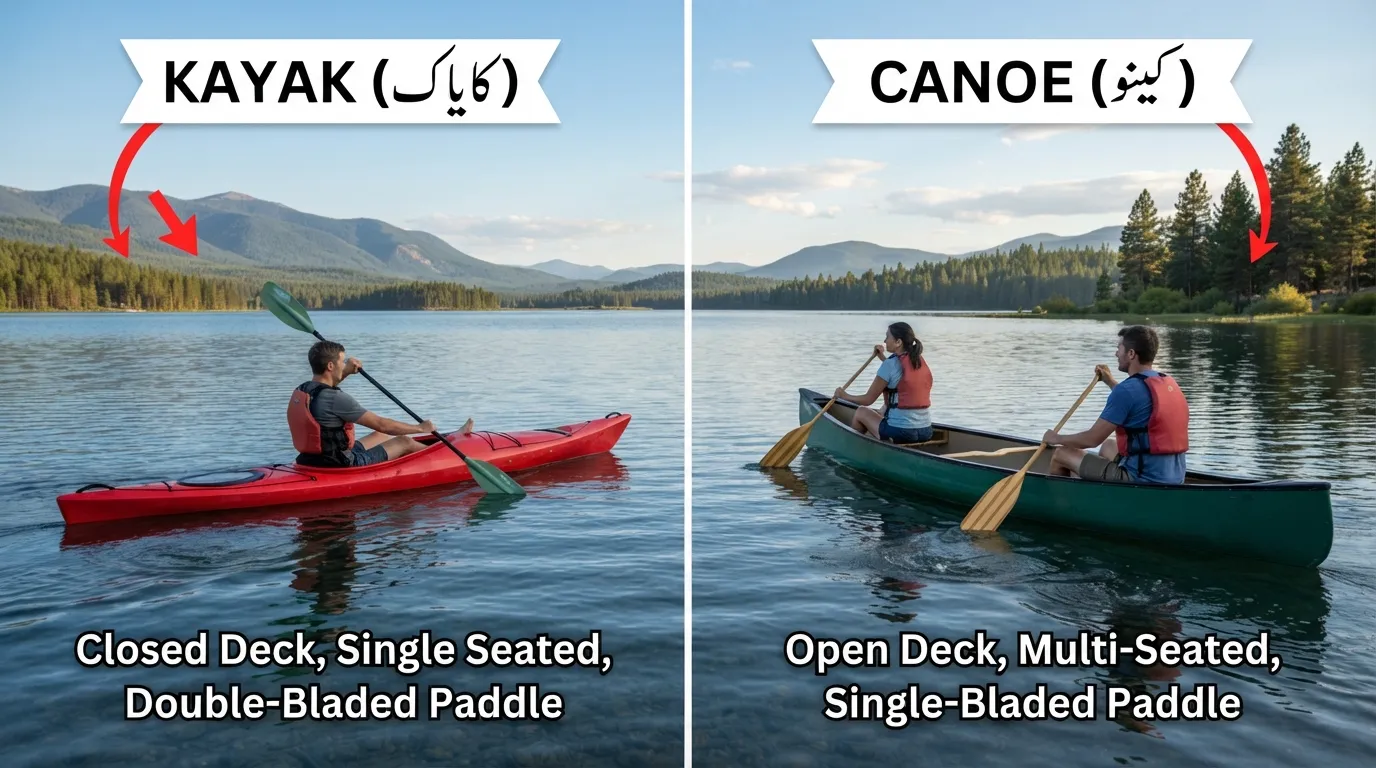
A kayak is usually a narrow boat with a double-bladed paddle, while a canoe is usually an open boat with a single-bladed paddle.
Imagine you are planning a day on a calm lake. You want to rent a small boat, but you see two choices: a kayak and a canoe. Both can take you across the water. Both are fun. Yet they do not feel the same. This is why many people search for kayak or canoe when they plan a trip, buy a boat, or learn about water sports.
A kayak is a small, narrow boat. The paddler often sits inside the boat with the legs stretched forward. A kayak normally uses a double-bladed paddle. A canoe is usually wider and more open. The paddler often sits or kneels and uses a single-bladed paddle.
The main kayak or canoe question is about shape, seating, paddle style, and use. Learning the difference makes it easier to choose the right boat.
Pronunciation
Kayak
- US: /ˈkaɪ.æk/
- UK: /ˈkaɪ.æk/
- Sounds like: KY-ak
Canoe
- US: /kəˈnuː/
- UK: /kəˈnuː/
- Sounds like: kuh-NOO
Now, let us look at the main differences in a simple way.
Read more about:https://gatherword.com/is-piglet-a-boy-or-girl/
Difference Between Kayak or Canoe
1. Boat Shape
A kayak is usually long and narrow. Its shape helps it move quickly through the water.
A canoe is often wider and has more open space.
Examples:
- The kayak moved quickly through the narrow river.
- We carried a wide canoe to the lake.
2. Top Design
Most kayaks have a closed or partly closed top. The paddler sits inside the boat.
Most canoes have an open top. You can easily see the inside of the boat.
Examples:
- Water stayed outside the kayak as we paddled.
- We placed our bags inside the open canoe.
3. Paddle Type
A kayak normally uses a double-bladed paddle. There is a blade on both ends.
A canoe normally uses a single-bladed paddle.
Examples:
- She used a double-bladed paddle in her kayak.
- He pushed the canoe with a single-bladed paddle.
4. Seating Position
Kayak users usually sit on a low seat with their legs in front.
Canoe users may sit on a raised seat or kneel on the bottom.
Examples:
- I sat low inside the kayak.
- The child sat on the canoe seat.
5. Speed
A kayak is often faster for one person. Its narrow body can move well through water.
A canoe can also be fast, but it is often chosen for comfort and carrying space.
Examples:
- The kayak reached the other side first.
- The canoe moved slowly along the lake.
6. Stability
A canoe can feel very stable because it is often wider.
A kayak can also be stable, but some narrow kayaks are designed for speed rather than beginner comfort.
Examples:
- The wide canoe felt stable.
- The beginner chose a stable recreational kayak.
7. Storage Space
Canoes often have more open space for bags, food, and camping gear.
Kayaks have less open space, although some models have storage compartments.
Examples:
- We put our camping bags in the canoe.
- He stored his phone in the kayak compartment.
8. Best Water Conditions
Kayaks are popular on lakes, rivers, and even coastal waters. Some are made for rough water.
Canoes are common on calm lakes and rivers. They are also useful for camping trips.
Examples:
- They used kayaks on the coastal trip.
- We took a canoe onto the quiet lake.
9. Number of Paddlers
A kayak is often designed for one person, although two-person kayaks are available.
Canoes can carry one, two, or more people, depending on the design.
Examples:
- She rented a single kayak.
- Two friends shared one canoe.
10. Main Purpose
Kayaks are popular for recreation, fishing, touring, racing, and adventure sports.
Canoes are popular for family trips, fishing, camping, touring, and carrying gear.
Examples:
- He bought a kayak for fishing.
- They used a canoe for a camping trip.
Nature and Behaviour of Kayak and Canoe
Kayak
A kayak is narrow, light, and easy to control. It is often linked with speed and adventure. Many kayaks are made for one person. Sea kayaks, fishing kayaks, touring kayaks, and recreational kayaks are common types.
A kayak can turn quickly. Some designs are made for strong waves and fast rivers.
Canoe
A canoe is usually open, wider, and spacious. It is often linked with family trips and outdoor travel. It can carry more equipment than many small kayaks.
A canoe is useful for camping because you can place bags and supplies inside it.
Why People Get Confused About Kayak and Canoe
People get confused because both are small boats moved by paddles. Both can be used on lakes and rivers. Both can be used for fishing, travel, and fun.
The biggest clues are the shape, seating, and paddle.
A kayak is usually narrow and uses a double-bladed paddle. A canoe is usually open and uses a single-bladed paddle.
The words can also be confusing because boat designs have changed over time. Modern kayaks and canoes come in many shapes.
The Origin of Kayak
The kayak has a very old history. Indigenous peoples of the Arctic developed early kayaks thousands of years ago. These boats were used for hunting and travel.
Traditional kayaks were often made from wood frames covered with animal skins. Their narrow design helped hunters move quietly through cold water.
The word kayak comes from languages connected with the Indigenous peoples of the Arctic. Modern kayaks use materials such as plastic, fiberglass, and carbon fiber.
The Origin of Canoe
Canoes also have a very long history. Many Indigenous peoples in North America used canoes for travel, fishing, hunting, and trade.
Traditional canoes were made from materials such as wood and bark. The birchbark canoe became especially important in parts of North America.
The word canoe entered English through European contact with Indigenous peoples of the Caribbean. Modern canoes can be made from plastic, aluminum, fiberglass, wood, and other materials.
British vs American English
The words kayak and canoe are used in both American and British English.
There is no major spelling difference.
American English:
- I rented a kayak.
- We took a canoe onto the lake.
British English:
- I rented a kayak.
- We took a canoe onto the lake.
The pronunciation is also very similar.
British speakers may use terms connected with canoeing and kayaking in sports settings. American speakers use the same basic terms.
Which One Should You Use?
Choose a kayak if you want speed, easy solo travel, fishing, or an adventure on the water.
Choose a canoe if you want more open space, camping gear, or a trip with another person.
For US readers, both words are common. For UK readers, both are also standard.
If you are a beginner, try both before buying one. Comfort and balance can feel different for each person.
Common Mistakes
Mistake 1: Calling Every Paddle Boat a Kayak
Incorrect idea: Every small paddle boat is a kayak.
Correction: A kayak has its own shape and paddle style.
Mistake 2: Saying Canoes Always Have Two Paddlers
Incorrect: A canoe must have two people.
Correct: Canoes can be designed for one or several paddlers.
Mistake 3: Thinking Kayaks Always Have Closed Tops
Incorrect: Every kayak is fully enclosed.
Correct: Kayaks come in different designs, including sit-on-top models.
Mistake 4: Using a Single-Bladed Paddle for a Typical Kayak
Incorrect: He paddled the kayak with a normal canoe paddle.
Correct: Most kayaks use double-bladed paddles.
Everyday Usage Examples
In an Email
We are planning a lake trip this weekend. Would you prefer a kayak or a canoe?
On Social Media
Beautiful morning on the lake! The kayak was perfect for a quiet paddle.
In News Writing
Local visitors can rent kayaks and canoes during the summer season.
In Formal Writing
Kayaks and canoes are commonly used for recreational water activities.
In Daily Conversation
“Should we take the kayak?”
“No, let’s take the canoe. We have more bags.”
Usage Trends
The words kayak and canoe are both widely used around the world.
Kayak is strongly linked with adventure sports, sea travel, fishing, and recreational boating. The word is also common in travel websites and outdoor sports content.
Canoe is often linked with camping, family trips, nature travel, and traditional boating.
Both terms are common in tourism, sports, outdoor education, and leisure activities.
Online searches for both words often focus on questions such as which boat is easier for beginners, which is faster, and which is better for fishing or camping.
Metaphors and Similes
Kayak Simile
“He moved through the crowd like a kayak through a narrow stream.”
This suggests smooth and quick movement.
Canoe Simile
“The small group moved together like people sharing a canoe.”
This can suggest teamwork and cooperation.
Kayak Metaphor
“Life became his kayak, and every wave was a new challenge.”
This presents life as a journey with obstacles.
Canoe Metaphor
“Their family was a canoe moving through the changing waters of life.”
This suggests that people work together during difficult times.
Connotative Meaning
Kayak
Positive: Adventure, freedom, speed, skill, and exploration.
Negative: It may suggest risk or difficulty when used in extreme-water settings.
Neutral: A small boat used for travel or sport.
Example: “Kayaking gave her a feeling of freedom.”
Canoe
Positive: Nature, peace, family, teamwork, and outdoor fun.
Negative: It may suggest slow travel in some contexts.
Neutral: A paddle boat used for recreation or travel.
Example: “The canoe gave the family a peaceful way to explore the lake.”
Idioms and Proverbs
There are no major traditional English idioms that use kayak or canoe in the same way as common words such as “boat” or “ship.”
However, boating phrases can be used creatively.
“In the same boat”
This is a common English idiom.
Meaning: To be in the same situation as another person.
Example: “We are all in the same boat, so we need to solve the problem together.”
“Rock the boat”
This is another common idiom.
Meaning: To cause trouble or disturb a situation.
Example: “He did not want to rock the boat during the meeting.”
These idioms use boat in a general sense. They do not mean a specific kayak or canoe.
Literature and Movies
Kayaks and canoes often appear in outdoor, travel, adventure, and nature writing.
Literature
The Canoe and the Saddle is a travel book by Theodore Winthrop, published in 1863. It describes travel in the American West and reflects the importance of outdoor travel in 19th-century American writing.
Movies
Boats and canoe trips appear in many adventure and outdoor films. One well-known example is Deliverance (1972), an American film that features a canoe journey on a remote river.
Such stories often use rivers and boats to show adventure, danger, nature, and personal challenge.
Why This Difference Matters
If you understand the terms, you can read outdoor guides more easily. You can also choose the right boat when renting one.
The difference matters in sports, tourism, education, and safety. A person who knows the boat type can better understand instructions.
It also helps learners build useful vocabulary. Many English words are close in meaning but have different uses. Learning these small differences makes communication clearer.
For outdoor lovers, the difference is even more practical. The right boat can make a trip safer and more comfortable.
Usefulness in Daily Life
You may see these words in many places.
- Travel websites: Kayak and canoe tours.
- Sports shops: Kayaks, canoes, paddles, and safety gear.
- Tourism: Canoe trips and kayak tours.
- Schools: Outdoor education and water activities.
- Social media: Photos from kayaking and canoeing trips.
- News: Reports about boating events and river activities.
- Camping: Canoes are often used to carry equipment.
- Fishing: Fishing kayaks and fishing canoes are both available.
Knowing the terms helps you understand what a trip or product includes.
Situational Preference
A kayak is often better for solo trips, speed, fishing, and adventure. It can be a good choice when you want a narrow boat that is easy to move through the water. A canoe is often better for family trips, camping, and carrying more gear. Its open design gives you more space. On calm lakes, both can work well. For rough water, the right boat depends on its design and your skill level. Beginners should consider stability, comfort, and safety. There is no single best boat for every situation. Your activity, water conditions, experience, and number of people should guide your choice.
Possible asked questions
Is a kayak or canoe easier for beginners?
It depends on the design. A stable recreational kayak can be easy for beginners. A wide canoe can also feel stable.
Is a kayak faster than a canoe?
Often, yes. Many kayaks are narrow and designed for efficient movement. However, speed depends on the boat, paddler, and water.
Can two people use a kayak?
Yes. Tandem kayaks are made for two people.
Can one person use a canoe?
Yes. Some canoes are designed for solo paddling.
Which is better for fishing?
Both can be good. A fishing kayak is useful for one person and can reach narrow areas. A canoe gives more open space.
Which has more storage space?
A canoe often has more open storage space. However, larger touring kayaks can also have useful storage areas.
Is a kayak safer than a canoe?
Neither is automatically safer. Safety depends on the boat, water conditions, weather, equipment, and paddler’s skill.
Conclusion
A kayak and a canoe are both useful paddle boats, but they are not the same. A kayak is usually narrow and uses a double-bladed paddle. The paddler often sits low inside the boat. A canoe is usually wider and open. It normally uses a single-bladed paddle.
The best choice depends on what you want to do. A kayak can be a strong choice for solo travel, fishing, speed, and adventure. A canoe can be better for camping, family trips, and carrying extra gear.
For English learners, the key is simple: kayak and canoe are both boats, but their shape, seating, paddle style, and common uses are different. Once you learn these points, the kayak or canoe question becomes much easier.