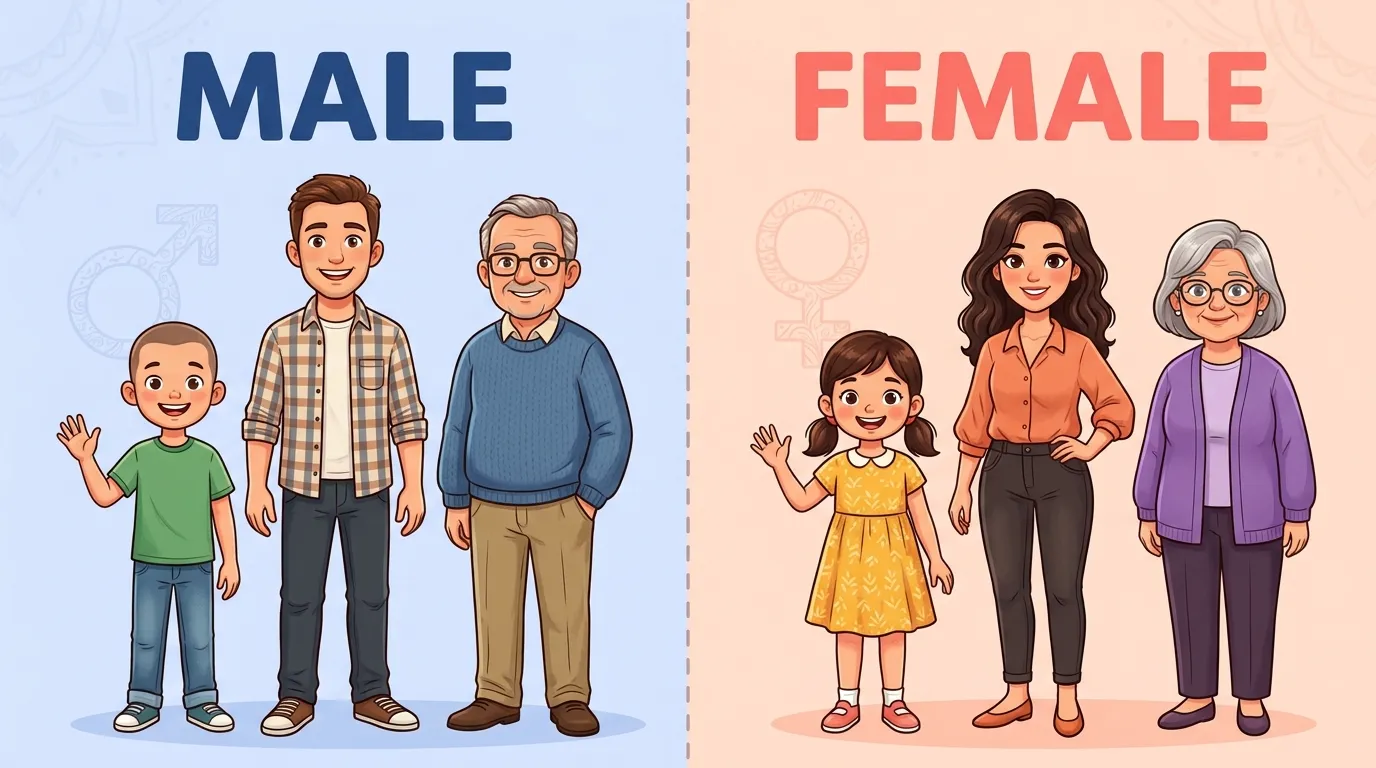
Male and female are terms used to describe sex, with male usually referring to a person or animal that produces sperm while female usually referring to one that produces eggs.
Imagine you are filling out a school form, medical form, or survey. You see a box that asks, “Male or female?” You may know what the words mean, but you may still wonder which word fits the situation. These two words are common in daily English. They are used in science, health, education, animals, forms, and general speech. Male or female can describe biological sex in people and animals. The words can also work as nouns or adjectives. For example, we can say “a male student” or “a female student.” We can also say “the male is larger” or “the female is caring for her young.”
Pronunciation
- Male
- US: /meɪl/
- UK: /meɪl/
- Sounds like: mail
- Female
- US: /ˈfiːmeɪl/
- UK: /ˈfiːmeɪl/
- Sounds like: fee-male
Now, let us look at the key differences in a simple way.
Difference Between Male and Female
1. Basic Meaning
Male usually describes a person or animal of the sex that produces sperm.
Female usually describes a person or animal of the sex that produces eggs.
Examples:
- The male lion has a large mane.
- The female lion is caring for her cubs.
2. Use for People
The words can describe people.
Male can mean a boy or man.
Female can mean a girl or woman.
Examples:
- The school has 500 male students.
- The school has 480 female students.
In everyday speech, man and woman are often more natural for adults.
3. Use for Animals
Male and female are very common when talking about animals.
Examples:
- The male dog is sleeping outside.
- The female dog has four puppies.
Animal breeding and veterinary texts often use these terms.
4. Biological Difference
In biology, males and females can have different reproductive roles.
Examples:
- The male bird may produce sperm.
- The female bird may produce eggs.
The exact biological traits differ across species.
5. Grammar
Both words can be adjectives and nouns.
Examples:
- She adopted a female cat.
- The female is eating.
Examples:
- He owns a male horse.
- The male is running.
6. Adult Humans
For adults, man and woman are often preferred in normal conversation.
Examples:
- A man entered the room.
- A woman entered the room.
“Male” and “female” are more common in medical, legal, scientific, or statistical contexts.
7. Children
For children, people usually say boy and girl.
Examples:
- The boy is playing football.
- The girl is reading a book.
“Male child” and “female child” are possible but sound more formal.
8. Forms and Records
Official forms may use male and female as sex categories.
Examples:
- Select your sex: male or female.
- The medical record lists the patient as female.
Such wording is common in surveys, records, and official documents.
9. Social and Scientific Context
The meaning can change with context.
In biology, male and female usually refer to reproductive sex.
In social discussions, the words may be used in a wider way.
Examples:
- The study compares male and female mice.
- The survey compares male and female participants.
10. Common Word Pair
Male and female are natural opposites when talking about sex.
Examples:
- The researchers studied male and female birds.
- The zoo has both male and female elephants.
So, when the question is about biological sex, male and female are usually the matching terms.
Nature and Behaviour of Male and Female
Male
The word male describes the sex that, in many species, produces sperm. In humans, males usually have male reproductive anatomy and typical male sex characteristics.
However, behavior is not determined by the word itself. Not every male person acts in the same way.
Female
The word female describes the sex that, in many species, produces eggs. In humans, females usually have female reproductive anatomy and typical female sex characteristics.
Female behavior also varies from person to person and species to species.
It is important not to assume that every male or female has the same personality or behavior.
Why People Get Confused About Male and Female
People often confuse these words because they can be used in several ways.
First, they can describe humans and animals. Second, they can work as nouns or adjectives. Third, the words may appear in scientific, medical, and everyday contexts.
Another reason is that male/female, man/woman, and boy/girl are not always interchangeable.
For example:
- “A female doctor” is grammatically correct.
- “A woman doctor” is also possible, but less common in some contexts.
- “A female child” is formal.
- “A girl” is more natural in everyday English.
Knowing the situation helps you choose the best word.
The Origin of Male and Female
The word male has a long history in English. It came into English through Old French masle, which came from Latin masculus, meaning male or masculine.
The word female also has a long history. It came through Old French and Middle English. Its history is linked to words used for women and the female sex.
Over time, both words became standard terms in English.
Today, they are widely used in biology, medicine, education, law, animal science, and everyday language.
British vs American English
There is no major spelling difference between American and British English for male and female.
Both varieties use:
- male
- female
The pronunciation is also very similar.
American English:
- male student
- female student
British English:
- male student
- female student
The main difference is often about style rather than spelling.
For example:
- American: “A woman called the office.”
- British: “A woman called the office.”
The same sentence works in both varieties.
Which One Should You Use?
Use male when you need to describe the male sex. Use female when you need to describe the female sex.
For people, choose words based on the situation.
In casual English, use man and woman for adults. Use boy and girl for children when appropriate.
In science, medicine, surveys, statistics, and animal studies, male and female are often better choices.
Common Mistakes
Mistake 1: Using Male and Man as Exact Synonyms
Incorrect idea: Male always means man.
Better: Male can describe people of different ages, while man normally means an adult human male.
Mistake 2: Using Female and Woman as Exact Synonyms
Better: Female can describe a girl or woman, while woman normally means an adult human female.
Mistake 3: Saying “A Male Man”
This is usually unnecessary.
Better:
- He is a man.
- He is male.
Mistake 4: Saying “A Female Woman”
This is also usually unnecessary.
Better:
- She is a woman.
- She is female.
Mistake 5: Ignoring Context
“Female” may sound formal when used as a noun for a person.
Instead of:
- “A female came into the shop.”
Natural everyday English is often:
- “A woman came into the shop.”
Everyday Usage Examples
In Emails
- “We need the number of male and female participants.”
- “The study included both male and female employees.”
On Social Media
- “Is the puppy male or female?”
- “The new bird is female.”
News
- “Police reported that the victim was female.”
- “The team included both male and female athletes.”
Formal Writing
- “The researchers studied male and female participants.”
- “The sample included equal numbers of male and female students.”
Daily Conversation
- “Is your cat male or female?”
- “The baby is a girl.”
The last example sounds more natural when talking about a human baby.
Usage Trends
Male and female remain common English words around the world.
They are especially common in scientific and formal writing. They also appear in surveys, medical records, research papers, animal care, and statistics.
In casual conversation, people often choose more specific words.
For example:
- man instead of male
- woman instead of female
- boy instead of male child
- girl instead of female child
This does not mean male and female are disappearing. Their formal and scientific use remains strong.
Metaphors and Similes
Male and female are not usually metaphorical words. Their main meaning is about sex.
Still, writers may use them in figurative comparisons.
Examples:
- “The male side of the debate was strong.”
- “The female voice in the poem represents nature.”
These uses depend on the writer’s style and context.
A simile may also use male or female in a creative way:
- “The male lion stood like a king.”
- “The female bird moved like a careful mother.”
These examples compare behavior rather than changing the basic meaning of the words.
Connotative Meaning
Male
The word male is usually neutral.
In science and medicine, it is a simple descriptive term.
Example:
- “The study included 100 male participants.”
In some contexts, it can suggest ideas such as strength or masculinity. However, those meanings depend on culture and context.
Female
The word female is also normally neutral.
Example:
- “The researchers studied female athletes.”
In some contexts, it may suggest ideas linked with motherhood, care, or femininity. These are cultural ideas, not fixed meanings of the word.
Idioms and Proverbs
There are few common idioms that directly use the exact pair male and female.
“A man’s world”
This phrase describes a situation where men have more power or influence.
Example: “Some people believe the industry is still a man’s world.”
“Woman of the world”
This can describe a woman with wide experience of life.
Example: “She is a woman of the world and has traveled widely.”
These expressions are about social ideas, not biological definitions.
Literature and Movies
The ideas of male and female roles appear often in literature.
One famous example is Jane Austen’s Pride and Prejudice (1813).
Another example is William Shakespeare’s Macbeth (1606), which presents strong ideas about gender, power, courage, and social expectations.
Movies also explore male and female roles.
For example, Mulan (1998) is an American animated film that explores gender expectations through its main character.
Another example is Barbie (2023), an American film that explores ideas about gender, identity, society, and expectations.
Why This Difference Matters
Understanding male and female is useful for English learners.
It also helps you choose natural words.
For example, saying “a woman” may sound more natural than “a female” in casual conversation.
Good word choice also prevents confusion. The words male, female, man, woman, boy, and girl have related but different uses.
Learning these differences makes your English clearer and more natural.
Usefulness in Daily Life
You may see these words in many places.
You can find them in:
- School records
- Medical forms
- Surveys
- Research papers
- Animal records
- Job statistics
- Sports reports
- News articles
- Government documents
- Online forms
For example, a veterinarian may ask whether a dog is male or female.
A researcher may compare male and female participants.
A form may ask for sex.
Knowing the terms makes these situations easier to understand.
Situational Preference
Use male and female when the topic is scientific, medical, statistical, or biological. They are also useful when talking about animals. For adults in normal conversation, man and woman often sound more natural. For children, boy and girl are usually better. In formal writing, male and female can be useful because they are clear and direct. In global English, always consider your audience. If you are speaking with friends, more specific human terms may sound warmer and more natural.
Possible asked questions
Is male the opposite of female?
Yes. In common biological and English usage, male and female are paired terms used to describe sex.
What is the difference between male and man?
Male describes sex and can be used as an adjective or noun. Man normally means an adult human male.
What is the difference between female and woman?
Female describes sex and can be used as an adjective or noun. Woman normally means an adult human female.
Can male and female describe animals?
Yes. They are very common for animals.
For example:
- a male dog
- a female cat
Is “female student” correct?
Yes. “Female student” is grammatically correct. It is often used in formal, academic, or statistical writing.
Is “male or female” grammatically correct?
Yes. It is a common phrase when asking about sex.
For example:
- “Is the kitten male or female?”
Which sounds more natural: female or woman?
It depends on context. Woman is often more natural in everyday conversation. Female is common in scientific, medical, statistical, and formal contexts.
Conclusion
Male and female are common English words used to describe sex. In simple terms, male usually refers to the sex associated with sperm production, while female usually refers to the sex associated with egg production. The terms are widely used for people and animals.
The main point is that male/female and man/woman are related but not always interchangeable. Male and female are especially useful in science, medicine, research, statistics, animal care, and formal records.
For English learners, knowing this difference can improve both speaking and writing. It can also help you understand forms, news reports, research papers, and everyday questions. When choosing between the words, always think about the context. The best word is not only grammatically correct. It should also sound natural for the situation and the people you are talking to.










2 thoughts on “Male or Female? Simple Difference, Meaning, and Usage Guide”