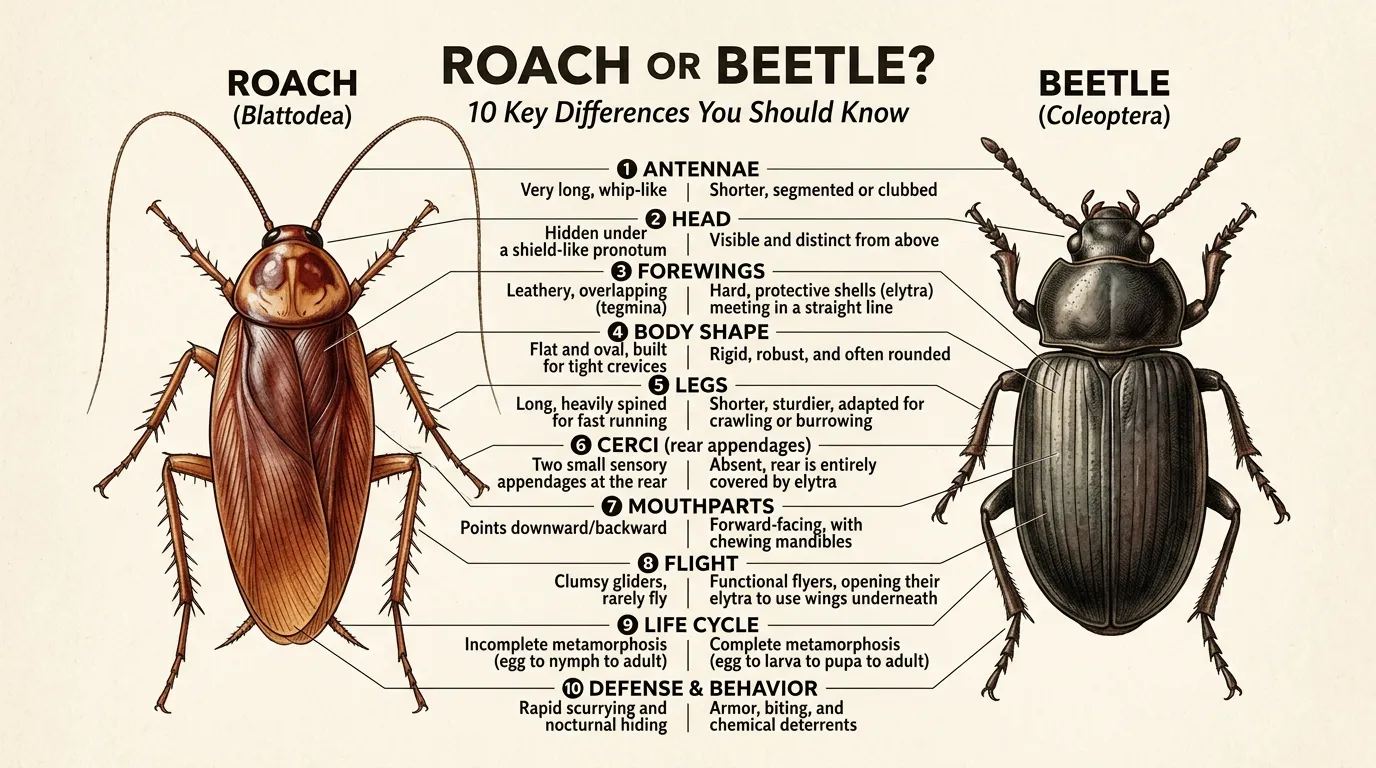
A roach is usually a cockroach, while a beetle is a different insect with hard wing covers.
Imagine you see a small brown insect in your kitchen. It runs under the fridge, and you wonder, “Is it a roach or beetle?” Both insects can be brown or black. Both have six legs. Some can also fly. So, it can be hard to tell them apart at first.
The main difference between a roach or beetle is their body shape and wing covers. Roaches often have flat bodies, long feelers, and fast movements. Beetles usually have hard wing covers that protect their flying wings. Many beetles also have a round or oval body.This helps them understand its habits and decide what to do next. Some insects can damage food or plants, while others help nature.
Learning these simple differences can help you identify both insects. You do not need special tools. Just look at the body, feelers, wings, and movement.
Read more about:https://gatherword.com/male-or-female/
Pronunciation
Here is how to say each word in American and British English.
WordAmerican EnglishBritish EnglishRoach/roʊtʃ/ — rohch/rəʊtʃ/ — rohchBeetle/ˈbiːtəl/ — BEE-tuhl/ˈbiːtəl/ — BEE-tuhl
The word roach has one syllable. The word beetle has two syllables.
Now, let us look at ten clear ways to tell these insects apart.
Difference Between Roach or Beetle
1. Body Shape
A roach often has a flat, wide body. Its shape helps it hide in small spaces.
A beetle often has a round or oval body. Some beetles are long and thin.
Examples:
- A roach slips under a kitchen cabinet.
- A round beetle crawls across a garden leaf.
2. Wing Covers
Roaches may have wings that lie flat over their backs. Their wings are not like the hard covers of beetles.
Beetles have hard front wings. These covers protect the thin wings underneath.
Examples:
- A roach rests with its wings flat on its back.
- A beetle closes its hard wing covers after flying.
3. Feelers
Roaches usually have long, thin feelers. These help them sense things around them.
Beetles also have feelers, but their shape and length vary by type. Some have short or club-shaped feelers.
Examples:
- A roach uses its long feelers to sense a wall.
- A beetle moves its feelers while walking on a plant.
4. Legs and Movement
Roaches have spiny legs that help them run fast. Many can move quickly when they sense danger.
Beetles also have six legs. Some run fast, while others move slowly or dig in the soil.
Examples:
- A roach runs under a sink when a light turns on.
- A beetle walks slowly across a flower.
5. Color
Roaches are often brown, reddish-brown, or black.
Beetles come in many colors. They may be black, green, red, yellow, or shiny blue.
Examples:
- A brown roach hides behind a cupboard.
- A green beetle rests on a garden leaf.
6. Food
Many roaches eat many kinds of food. They may feed on crumbs, scraps, and other organic matter.
Beetles have varied diets. Some eat plants, some hunt other insects, and some feed on dead matter.
Examples:
- A roach feeds on food crumbs near a bin.
- A ladybird beetle eats aphids on a plant.
7. Where They Live
Roaches often live in warm, sheltered places. Some live inside homes, while others live outdoors.
Beetles live in many places. You may find them in gardens, forests, soil, wood, or homes.
Examples:
- A roach hides in a dark kitchen gap.
- A beetle lives under tree bark.
8. Life Cycle
Roaches hatch from eggs. Their young look like small, wingless versions of adults. They grow through several stages.
Beetles also hatch from eggs, but their young usually look like larvae. Many beetle larvae look like worms or grubs.
Examples:
- A young roach grows and changes as it molts.
- A beetle larva grows before becoming a pupa and then an adult.
9. Effect on People
Some roaches can spread germs when they move between dirty areas and food surfaces. Their waste and shed body parts may also trigger allergies.
Many beetles are useful. Some control pests or help break down dead matter. However, a few beetle species damage stored food, wood, or crops.
Examples:
- A roach near food storage may raise hygiene concerns.
- A ladybird beetle helps protect garden plants from aphids.
10. Number of Species
Roaches belong to the insect order Blattodea. Scientists have described thousands of cockroach species, and most live outdoors.
Beetles belong to the order Coleoptera.
Examples:
- A home may have a German cockroach problem.
- A garden may contain several kinds of beetles.
Nature and Behaviour of Roaches and Beetles
Nature and Behaviour of Roaches
Roaches often hide during the day and become active at night. Many prefer warm, dark places with food and water nearby.
They use their feelers to sense their surroundings. Some can run very fast. Others can glide or fly.
Not all roaches live in houses. Many species live outdoors and play a role in breaking down dead plants and other matter.
Nature and Behaviour of Beetles
Beetles show many kinds of behavior. Some fly from flower to flower. Others hunt insects, dig in soil, or live inside wood.
Many beetles use their hard wing covers for protection. Some are active during the day, while others come out at night.
Their habits depend on their species. A ladybird beetle, for example, hunts small pests. A carpet beetle may feed on natural fibers.
Why People Get Confused About Roaches and Beetles
People often confuse these insects because they can look alike. Both have six legs, feelers, and a hard outer body. Some are also similar in color and size.
Young roaches can be mistaken for beetles. Small beetles may also look like roaches from a distance.
The best way to tell them apart is to look at their wing covers and body shape. Beetles have hard front wings that meet along the middle of the back. Roaches do not have these hard, shell-like covers.
Do not judge an insect by color alone. A black insect is not always a roach, and a brown insect is not always a beetle.
Both groups have six legs, feelers, and a life cycle that begins with an egg. Both also include many species that live outside human homes.
The Origin of the Words
Origin of “Roach”
The word roach is an old English word linked to the name for a cockroach. It is a short form of cockroach.
The word cockroach came into English through Spanish cucaracha. English speakers changed the sound of the word over time.
Origin of “Beetle”
The word beetle comes from Old English bitela. It is linked to the verb bītan, which means “to bite.”
Over time, the word became the common English name for insects in the order Coleoptera.
The word now covers a huge range of insects, from tiny beetles to large species with strong jaws.
British vs American English
The words roach and beetle mean the same things in British and American English. Their spelling does not change between the two forms of English.
UseAmerican EnglishBritish EnglishCockroachRoach or cockroachRoach or cockroachBeetleBeetleBeetleSpellingSameSameGeneral meaningSameSame
Examples:
- US: “I saw a roach in the kitchen.”
- UK: “I saw a cockroach in the kitchen.”
- US: “A beetle landed on my car.”
- UK: “A beetle landed on my car.”
Both countries use roach and beetle. The word choice may depend on local habits and the type of insect being discussed.
Which One Should You Use?
Use roach when you mean a cockroach, especially in casual speech. Use cockroach when you want to be clear or write in a formal report. If you know the species, use its exact name, such as ladybird beetle or carpet beetle.
In the United States, roach is common in daily speech. For global readers, use cockroach when you mean that specific insect. Use beetle for a member of the beetle group. If you are unsure, describe the insect’s shape and color rather than guessing its name.
Common Mistakes
- Mistake: Calling every brown insect a roach. Correct: Check its body shape and wing covers.
- Mistake: Saying that all beetles are harmless. Correct: Some beetles damage crops, wood, or stored food.
- Mistake: Saying that all roaches live indoors. Correct: Many roach species live outdoors.
- Mistake: Thinking roaches have no wings. Correct: Many adult roaches have wings, though some cannot fly well.
- Mistake: Thinking all beetles can fly. Correct: Some beetles cannot fly, even though they have wing covers.
- Mistake: Using roach for every crawling insect. Correct: Use roach for a cockroach and beetle for a beetle.
- Mistake: Identifying an insect by color alone. Correct: Look at its body, wings, feelers, and movement.
Everyday Usage Examples
In Emails
- “I found a roach near the kitchen sink. Please arrange a pest inspection.”
- “A beetle was found near the office window. Please check the area.”
On Social Media
- “Is this a roach or a beetle? Can anyone identify it?”
- “Found a shiny green beetle in my garden today!”
In News Reports
- “Residents reported cockroaches in several kitchen areas.”
- “Local experts identified a beetle that can damage stored grain.”
In Formal Writing
- “The insect was identified as a cockroach based on its body shape and other features.”
- “The beetle was examined to determine its species and possible effect on nearby plants.”
These examples show how both words fit everyday and formal settings. Use the word that best matches the insect you mean.
Usage Trends
The words roach and beetle are used around the world. Their use depends on the topic and the setting.
The word roach often appears in searches about home pests, cleaning, and pest control. People may search for it when they find an insect in a kitchen or bathroom.
The word beetle appears in many topics. These include gardening, farming, forests, wildlife, and science. Some people search for beetles to identify a garden insect. Others want to learn about pests that damage plants or wood.
Online searches for both words may rise when people see more insects in their homes or gardens. Weather and local insect activity can also affect interest.
There is no single rule for which word is more popular in every country. The topic and location matter. Use cockroach for clear, formal writing about that insect. Use beetle for the beetle group.
Metaphors and Similes
People sometimes use insect names to make their writing more vivid. These uses may not describe a real insect.
Roach Metaphors and Similes
A roach may suggest survival because some species can live in hard conditions.
- Metaphor: “He is a roach who never gives up.” This suggests that he keeps going through hard times.
- Simile: “He ran like a roach when the lights came on.” This describes someone moving away very fast.
These expressions are informal. Calling a person a roach can sound rude.
Beetle Metaphors and Similes
A beetle may suggest strength, protection, or a small but tough creature.
- Metaphor: “Her helmet was a beetle shell.” This suggests that the helmet was hard and protective.
- Simile: “The little machine moved like a beetle.” This describes a small object moving along the ground.
These examples are creative comparisons. They are not fixed meanings of the words.
Connotative Meaning
A word can give a feeling as well as name something. This feeling is called its connotation.
Roach: Negative Meaning
The word roach often brings thoughts of dirt, pests, and poor hygiene. This is common when people talk about roaches in homes.
Example: “The sight of a roach made everyone leave the kitchen.”
Here, the word creates a feeling of disgust or worry.
Roach: Positive or Neutral Meaning
In some creative writing, a roach can stand for survival. In science, the word may simply name an insect.
Example: “The roach survived in a difficult place.”
The sentence focuses on survival rather than fear.
Beetle: Positive Meaning
The word beetle can bring thoughts of nature, beauty, and useful insects.
Example: “A bright beetle added color to the garden.”
The word creates a pleasant picture.
Beetle: Negative or Neutral Meaning
Some beetles are pests. They can harm crops, furniture, or stored food.
Example: “The beetle damaged the wooden shelf.”
In science, however, beetle is a neutral name. It does not mean that the insect is good or bad.
Idioms and Proverbs
There are no widely used English idioms or proverbs that are common to both roach and beetle. However, writers may use these insects in creative expressions.
1. Tough as a Beetle
This is a creative expression, not a standard English idiom. It suggests that someone or something is strong.
Example: “The little toy was tough as a beetle.”
2. Survive Like a Roach
This is an informal phrase. It suggests that someone can keep going through hard times.
Example: “He managed to survive like a roach during the difficult year.”
3. A Bug in the System
This is a real, common expression, though it is not about roaches or beetles. It means a problem or fault in a system.
Example: “There was a bug in the computer system, so the report did not open.”
Use standard idioms when writing formal English. Use creative expressions when the context makes their meaning clear.
Literature and Movies
Roaches and beetles appear in stories, poems, films, and other works. Writers often use insects to explore fear, change, survival, or the natural world.
Literature
1. The Metamorphosis — Franz Kafka (1915)
This famous work of fiction tells the story of Gregor Samsa, who wakes up changed into a strange creature. The creature is often described as insect-like, though the exact species is not clearly named. The story explores family life, isolation, and human identity.
2. James and the Giant Peach — Roald Dahl (1961)
This children’s fantasy novel features a boy who travels inside a giant peach with a group of large insects. The story includes a ladybird, which is a type of beetle, along with other insect characters.
These works show how insects can play a role in stories about human life and adventure.
Movies
1. A Bug’s Life (1998, United States)
This animated film follows an ant named Flik and other insects as they face a group of grasshoppers. It explores teamwork, courage, and standing up to unfair treatment.
2. The Ant Bully (2006, United States)
This animated film tells the story of a boy who becomes very small and enters the world of ants and other insects. It explores kindness and seeing the world from another point of view.
Why This Difference Matters
Knowing the difference between a roach and a beetle is useful for several reasons.
First, correct identification helps you understand what you see. Second, not every beetle is a pest. Ladybird beetles can help control plant pests. Other beetles may damage crops, stored food, or wood. Knowing which insect you have can help you choose the right action.
Third, the difference matters in school and science. Students learn to group animals by their features. The body shape and wing covers of these insects help show how they differ.
The difference also helps writers and English learners choose the right word. Using roach for a beetle can confuse readers.
A quick look at the body and wings can often help. If you are unsure, a clear photo or advice from a pest expert can help you identify the insect.
Usefulness in Daily Life
You may use these words in many daily situations.
- At home: Identify an insect found near food or water.
- In the garden: Tell a useful beetle from a plant pest.
- At school: Explain the features of two insect groups.
- At work: Report an insect problem in a kitchen or storage room.
- In writing: Choose the correct word for a report or story.
- Online: Ask others to identify an insect from a photo.
For example, you could say, “I found a roach near the kitchen bin.” If you find a small, shiny insect on a flower, you might say, “I found a beetle in the garden.”
Correct identification can save time and prevent the use of the wrong pest treatment. If an insect is difficult to identify, avoid touching it with bare hands. Take a clear photo from a safe distance.
Situational Preference
Choose roach when you are talking about a cockroach in casual speech. In formal writing, cockroach is often clearer. Choose beetle when you mean an insect with hard front wing covers.
In the United States, people often say roach in daily conversation. British speakers also use the word, though cockroach may be clearer in some settings. The word beetle has the same meaning in both countries.
For readers around the world, use the full word cockroach if you want to avoid confusion. If you are writing about an unknown insect, do not guess. Describe its body and wings or ask an expert to identify it.
Possible asked questions
1. What is the main difference between a roach and a beetle?
A roach is a type of cockroach. A beetle belongs to a different insect group. Beetles have hard front wings that protect the wings underneath. Roaches do not have these hard, shell-like covers.
2. Can a roach look like a beetle?
Yes. Some roaches and beetles have similar colors and sizes. Their body shape and wing covers can help you tell them apart.
3. Are beetles more harmful than roaches?
Not in every case. Some beetles damage crops, wood, or stored food. Some roaches can spread germs or trigger allergies. The risk depends on the species and where it lives.
4. Do all roaches have wings?
No. Some adult roaches have full wings, while others have short wings or no wings. Having wings does not always mean an insect can fly.
5. Do all beetles fly?
No. Many beetles can fly, but some cannot. Their hard front wings protect the body and the flying wings underneath, when present.
6. How can I tell if an insect is a roach or beetle?
Look at its body shape and wings. Roaches often have a flat body and long feelers. Beetles usually have hard front wings that meet along the middle of the back. A clear photo can help with identification.
7. Which word is correct in American and British English?
Both roach and beetle are correct in American and British English. Use roach for a cockroach and beetle for an insect in the beetle group. The spelling is the same in both countries.
Conclusion
Roaches and beetles may look alike, but they are different insects. The main difference is their body shape and wings. A roach often has a flat body and long feelers. A beetle usually has hard front wings that protect the wings underneath.
Both insects have six legs and many species. They can live in homes, gardens, forests, and other places. Their food and behavior also vary. Some roaches become household pests, while many beetles help nature. Other beetles can damage plants, wood, and stored food.
If you see an unknown insect, do not judge it by color alone. Look at its body, feelers, and wings. A clear photo can also help you identify it.
The words roach and beetle have the same meanings in American and British English. Use roach when you mean a cockroach. Use beetle when you mean a beetle. In formal writing, the word cockroach may be clearer.
Learning this simple difference can help you speak and write with more care. It can also help you make better choices when dealing with insects at home, school, or work.








1 thought on “Roach or Beetle: 10 Key Differences You Should Know”