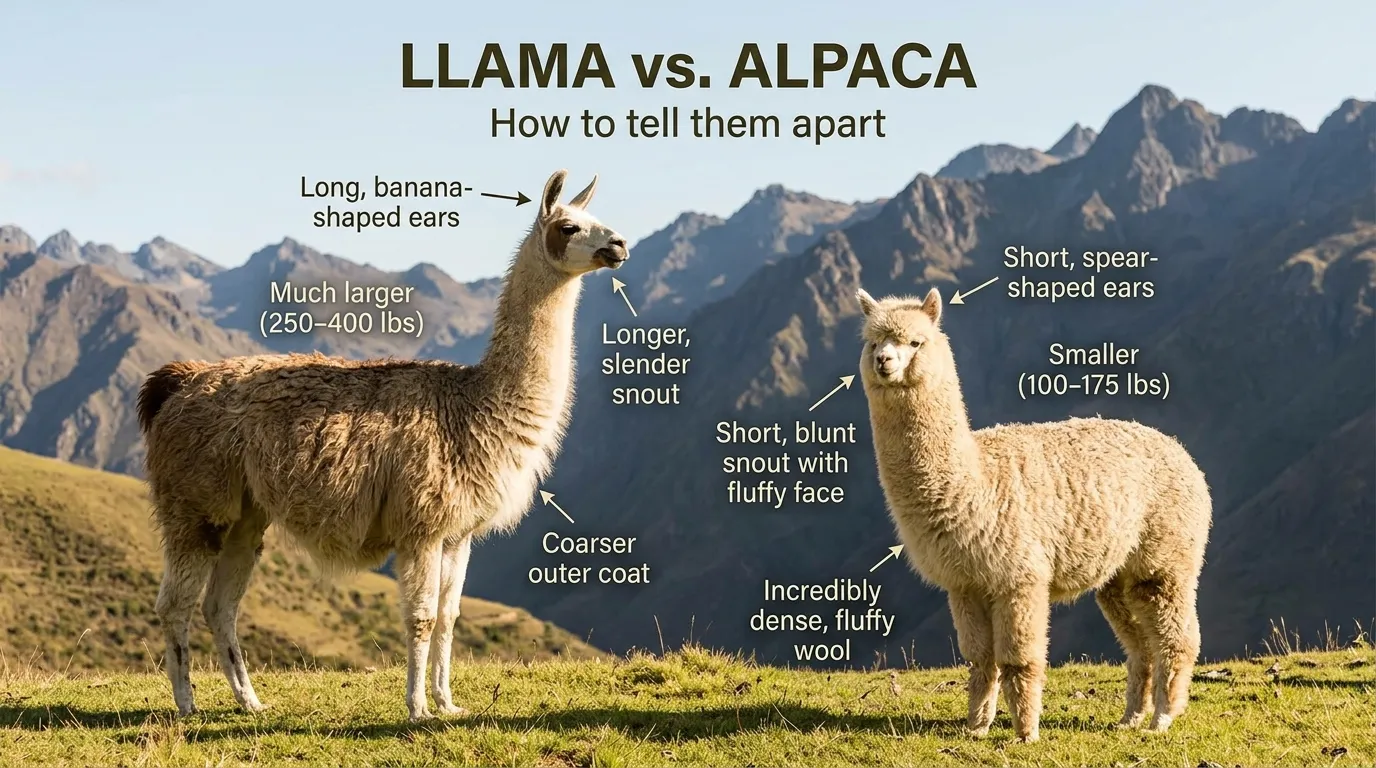
A llama is larger and stronger, while an alpaca is smaller and mainly raised for its soft wool.
Imagine visiting a farm in South America. You see two fluffy animals standing near each other. Both have long necks, soft coats, and friendly faces. At first, they look almost the same. You may ask, “Is that a llama or alpaca?” This is a common question. The two animals are related, but they are not the same.
A llama is a larger member of the camel family. It has a long face, large ears, and a strong body. People have used llamas as pack animals for many years. An alpaca is smaller and has a softer, thicker coat. It is mainly raised for fiber.
People search for llama or alpaca because the animals look similar. They want to know which one is bigger, which has better wool, and which makes a better pet. In this guide, we will compare llama or alpaca in simple English.
Pronunciation
Llama
- US: /ˈlɑːmə/ — “LAH-muh”
- UK: /ˈlɑːmə/ — “LAH-muh”
Alpaca
- US: /ælˈpækə/ — “al-PACK-uh”
- UK: /ælˈpækə/ — “al-PACK-uh”
So, llama begins with a “lah” sound. Alpaca has stress on the second part: “PACK.”
Let us now look at the main differences.
Read more about:https://gatherword.com/is-cinnamoroll-a-boy-or-girl/
Difference Between Llama and Alpaca
1. Size
Llamas are usually larger than alpacas.
A llama can stand about 5 to 6 feet tall at the head. An alpaca is much smaller.
Examples:
- The llama looked tall beside the alpaca.
- The alpaca was easier for the child to approach.
2. Body Shape
Llamas have a longer and stronger body. Alpacas have a smaller and more compact body.
Examples:
- The llama has a strong body for carrying loads.
- The alpaca has a smaller body covered with thick fiber.
3. Face
Llamas usually have a longer face. Alpacas have shorter and rounder-looking faces.
Examples:
- The llama had a long face.
- The alpaca had a small, soft-looking face.
4. Ears
Llamas have long, curved ears. Their ears are sometimes called banana-shaped ears. Alpaca ears are shorter and more pointed.
Examples:
- The llama moved its long ears.
- The alpaca had short, pointed ears.
5. Wool and Fiber
Both animals produce useful fiber. Alpaca fiber is famous for being very soft and warm. Llama fiber is often coarser.
Examples:
- Alpaca fiber is used to make soft clothing.
- Llama fiber can be used for rugs and other products.
6. Main Purpose
Llamas have traditionally been used as pack animals. Alpacas are mainly raised for their fiber.
Examples:
- Farmers used llamas to carry goods.
- Farmers raised alpacas for their fiber.
7. Temperament
Both can be calm, but llamas may be more confident and protective. Alpacas often stay together in groups.
Examples:
- The llama watched the other animals.
- The alpacas stayed close together.
8. Weight
Llamas are generally heavier. Alpacas are lighter and easier to handle.
Examples:
- The large llama carried a load.
- The smaller alpaca walked beside the farmer.
9. Fiber Quality
Alpaca fiber is often valued for its softness and fine texture. Llama fiber can vary more in texture.
Examples:
- The sweater was made from alpaca fiber.
- The rug used llama fiber.
10. Appearance
Both animals have long necks and thick coats. However, llamas look more athletic and tall, while alpacas look smaller and fluffier.
Examples:
- The llama looked tall and strong.
- The alpaca looked round and fluffy.
Nature and Behaviour of Llama and Alpaca
Llama Behaviour
Llamas are social animals. They can be alert and confident. They can also protect smaller livestock from some predators. A well-trained llama can carry loads.
Llamas may spit when they feel threatened or annoyed. However, this behavior is not their normal response to people.
Alpaca Behaviour
Alpacas are gentle herd animals. They usually feel safer in groups. They communicate through sounds and body movements.
Alpacas can also spit. This is more common during fights or when they feel stressed.
Both animals need proper care, food, space, and social contact.
Why People Get Confused About Llama and Alpaca
The confusion is easy to understand. Both animals belong to the camel family.Pictures can make them look even more alike. Their colors can also be similar. Both may be white, brown, black, gray, or mixed.
The easiest clues are size, ears, face, and purpose. A large animal with long, curved ears is more likely to be a llama. A smaller, very fluffy animal is more likely to be an alpaca.
The Origin of Llama and Alpaca
Both animals have deep roots in South America.
Llamas were important in the Andes long before modern transportation. Indigenous peoples used them to carry goods across difficult mountain areas. They also used their fiber, meat, and other resources.
Alpacas were also domesticated in the Andes. They were mainly valued for their high-quality fiber.
Both animals are part of the camelid family. Their close relatives include the guanaco and vicuña.
Today, llamas and alpacas are found in many countries. They are especially associated with Peru, Bolivia, Chile, and other parts of South America.
British vs American English
Both use:
- llama
- alpaca
The pronunciation is also very similar.
American English:
- “I saw a llama at the farm.”
- “She bought an alpaca wool scarf.”
British English:
- “We saw a llama on holiday.”
- “The alpaca had very soft fleece.”
The main difference may come from general vocabulary around farming and clothing. The animal names themselves do not change.
Which One Should You Use?
Use llama when you mean the larger animal with a strong body and long ears.
Use alpaca when you mean the smaller, fluffy animal that is well known for its soft fiber.
For US readers, UK readers, and global readers, the same spellings are correct.
If you are describing a farm animal that carries loads, llama is usually the better word.
If you are talking about soft fiber or luxury wool products, alpaca is often the better choice.
Common Mistakes
Mistake 1: Treating them as the same animal
Wrong: A llama and alpaca are exactly the same.
Correct: Llamas and alpacas are related but different animals.
Mistake 2: Assuming every fluffy animal is an alpaca
Wrong: That large animal must be an alpaca.
Correct: Check its size, face, and ears first.
Mistake 3: Thinking llamas cannot spit
Wrong: Llamas never spit.
Correct: Llamas can spit when stressed or threatened.
Mistake 4: Thinking alpacas are only pets
Wrong: Alpacas are kept only as pets.
Correct: Alpacas are also raised for their valuable fiber.
Mistake 5: Using “wool” for every fiber
Wrong: All llama and alpaca fiber is wool.
Correct: It is more accurate to call it animal fiber or fleece.
Usage Trends
The words llama and alpaca are both widely used in English.
The word alpaca often appears in discussions about clothing, fiber, fashion, farms, and animal tourism.
The word llama often appears in discussions about farms, trekking, transport, pets, and South American culture.
Both words are also popular in children’s books, online videos, toys, and social media. Their unusual appearance makes them popular subjects for photos and educational content.
Metaphors and Similes
These animals can also appear in playful comparisons.
Llama
- “He stood like a llama, looking over the fence.”
- “The tall animal moved like a mountain traveler.”
Alpaca
- “She was as fluffy as an alpaca.”
- “The child looked at the alpaca with wide eyes.”
These are informal and creative uses. They are not fixed English idioms.
Connotative Meaning
Llama
Positive: Llama can suggest strength, adventure, confidence, or a fun farm animal.
Example: “The llama looked strong and confident.”
Negative: In jokes, a llama may suggest silliness or stubborn behavior.
Neutral: “The zoo has two llamas.”
Alpaca
Positive: Alpaca often suggests softness, warmth, comfort, and cuteness.
Example: “She bought a soft alpaca sweater.”
Negative: There is little common negative meaning.
Neutral: “The farm raises alpacas for fiber.”
Idioms and Proverbs
they are often used in humorous expressions online.
For example:
- “That is a llama moment.” — A playful way to describe a strange or funny moment.
- “Fluffy as an alpaca.” — A creative comparison for something very soft.
These are informal expressions, not traditional English idioms.
Literature and Movies
Llamas and alpacas appear in children’s literature, educational books, comedy, animation, and documentaries.
Literature
Llama Llama Red Pajama is a famous children’s picture book by Anna Dewdney, published in 2005. It helped make the character Llama Llama well known among young readers.
Movies
Llamas and alpacas have appeared in family films, documentaries, and animated productions. They are often used as funny or memorable animals.
The 2000 American animated film The Emperor’s New Groove is especially notable because its main character, Emperor Kuzco, is transformed into a llama.
This movie helped make the llama familiar to a large global audience.
Why This Difference Matters
Knowing the difference helps you describe animals correctly.
The difference also matters in farming and animal care. A llama and an alpaca have different sizes, body needs, and common uses.
For shoppers, the difference can help when reading labels such as “alpaca fiber.”
A small vocabulary difference can improve both communication and understanding.
Usefulness in Daily Life
You may see alpaca on a clothing label. You may see llama in a travel article. A zoo sign may explain the difference between them.
Parents may use these animals to teach children about mammals. Teachers may use them in science lessons. Travelers may need the words when visiting farms or animal parks.
Knowing the basic difference is enough for most daily situations:
Llama = larger and stronger.
Alpaca = smaller and softer.
Situational Preference
Choose llama when you are talking about a larger South American camelid, especially one linked to carrying loads, trekking, or farm work. Choose alpaca when you are talking about a smaller, fluffy animal or its soft fiber. For clothing and textiles, “alpaca” is usually the more useful term. For hiking trips, farms, and pack animals, “llama” is often more suitable. In casual conversation, use the animal’s actual name rather than guessing from color. If you are unsure, compare the size, ears, and face. For US, UK, and international English, both spellings are correct.
Possible asked questions
Is a llama bigger than an alpaca?
Yes. Llamas are generally larger and heavier than alpacas.
Are llamas and alpacas the same animal?
No. They are different but closely related members of the camel family.
Which has softer fiber, a llama or an alpaca?
Alpacas are especially known for their fine, soft fiber.
Can llamas and alpacas spit?
Yes. Both can spit, usually as a defensive or social behavior.
Are alpacas friendly?
Alpacas can be gentle and calm, especially when properly handled. They are social herd animals.
Can llamas carry people?
Llamas can carry loads, but they are not normally used like horses for carrying adult riders.
Which animal is better for fiber?
Alpacas are widely valued for their fine fiber. Llamas also produce useful fiber, but their fiber can be coarser.
Conclusion
Llamas and alpacas may look similar, but they have clear differences. A llama is usually larger, taller, and stronger. It has long, curved ears and has traditionally been used as a pack animal. An alpaca is smaller and more compact. It is famous for its soft and valuable fiber.
Both animals come from South America and belong to the camel family. Both are social animals, and both can spit when they feel stressed or threatened. Their similar appearance is the main reason people often confuse them.
A simple way to remember the difference is this: think big and strong for a llama, and small and fluffy for an alpaca. If you are talking about carrying loads or trekking, llama is often the right word. If you are talking about soft fiber, clothing, or a smaller fluffy animal, alpaca is usually the better choice.
Once you learn these simple clues, telling a llama and an alpaca apart becomes much easier.










1 thought on “Llama or Alpaca: Key Differences, Similarities, and Uses”