Imagine you are walking in a park. You see a large gray bird eating seeds near a bench. A few steps away, you see a small white bird sitting on a tree. You may call the first bird a pigeon and the second a dove. But are they really different birds?
The words pigeon and dove both refer to birds in the same bird family, called Columbidae. This family includes many kinds of pigeons and doves. Some are large, while others are small. Some have gray feathers, and others have white, brown, or colorful feathers.
People often search for pigeon or dove because they want to know which word is correct. They may also want to identify a bird, understand a symbol, or improve their English.
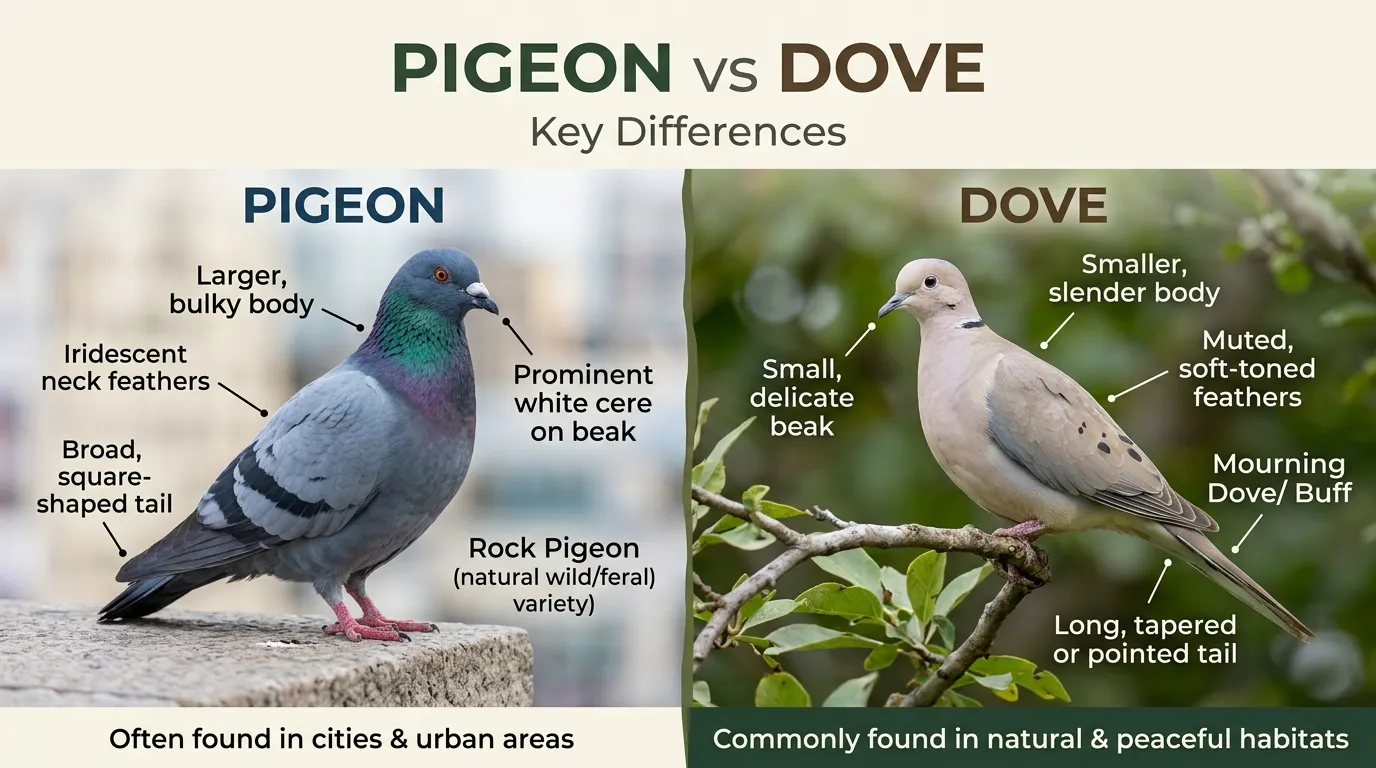
The main difference is often in size, common use, and meaning. People tend to use pigeon for larger birds, such as those seen in city squares. They often use dove for smaller birds or birds linked with peace and love. However, these are common patterns, not strict rules.
Pronunciation
WordUS PronunciationUK PronunciationPigeon/ˈpɪdʒən//ˈpɪdʒən/Dove (the bird)/dʌv//dʌv/
Easy pronunciation guide:
- Pigeon: PIJ-un
- Dove: DUV, rhyming with “love”
Both words have nearly the same pronunciation in American and British English.
Now, let’s look at their differences, behavior, meanings, and everyday use.
Read more about:https://gatherword.com/llama-or-alpaca-2/
Difference Between Pigeon and Dove
1. Size
Pigeons are often larger than doves. However, size varies across species.
Examples:
- A large pigeon walked across the town square.
- A small dove sat on the garden wall.
2. Body Shape
Many common pigeons have thick bodies and broad chests. Some doves have slimmer bodies and smaller heads.
Examples:
- The pigeon had a strong body and a short neck.
- The dove had a slim body and a long tail.
3. Color
City pigeons are often gray, with darker wing marks and shiny neck feathers. Doves may be white, gray, brown, or mixed in color.
Examples:
- A gray pigeon landed on the roof.
- A white dove flew over the garden.
Note: Color alone cannot tell you whether a bird is a pigeon or a dove.
4. Common Habitat
Many pigeons live in cities, towns, parks, and farms. Many doves live in gardens, forests, fields, and other natural areas. Some species live in both places.
Examples:
- Pigeons gathered near the busy train station.
- Doves rested in the trees behind the house.
5. Human Contact
Pigeons often live close to people. They may find food near buildings, streets, and public squares. Some doves also live near homes and farms.
Examples:
- The pigeon searched for crumbs near a café.
- A dove visited the bird feeder each morning.
6. Common Names
The words do not follow one fixed size rule. Some birds called doves are large, and some birds called pigeons are small.
Examples:
- The rock pigeon is a common city bird.
- The mourning dove is a familiar bird in North America.
7. Symbolic Meaning
A dove often stands for peace, hope, love, and kindness. A pigeon is often linked with city life, messages, and everyday survival.
Examples:
- The artist painted a white dove as a sign of peace.
- The story showed a pigeon carrying a message.
8. Sound
Both birds can coo. Their calls vary by species. Many people know the soft, repeated coo of a dove, while city pigeons may make low coos and other sounds.
Examples:
- The pigeon cooed on the balcony.
- A mourning dove made a soft call from a tree.
9. Breeding and Young Birds
Both pigeons and doves lay eggs and care for their young. Their young are often called squabs, especially in the context of pigeons.
Examples:
- The pigeon fed its young in the nest.
- The dove kept its chicks warm under its body.
10. Everyday Use of the Words
People often say pigeon when talking about city birds. They often say dove when talking about peace, ceremonies, or certain wild species.
Examples:
- We watched pigeons eating seeds in the park.
- The couple released white doves at their ceremony.
Remember that these differences are common patterns. The exact species matters more than the name alone.
Nature and Behaviour of Pigeon and Dove
Nature and Behaviour of Pigeons
Pigeons are social birds. Many live in groups and look for food together. They can learn routes and return to familiar places. Some types, such as homing pigeons, can find their way home over long distances.
City pigeons often eat seeds, grains, and food scraps. They may build nests on ledges, roofs, and other sheltered places.
Pigeons can adapt well to places where people live. This is one reason they are common in many cities around the world.
Nature and Behaviour of Doves
Doves also show social behavior. Some live in pairs, while others gather in groups. Many eat seeds, grains, and small fruits.
Doves may build nests in trees, shrubs, or buildings, depending on the species. Their calls can be soft and repeated. Many people enjoy hearing these calls in gardens and quiet outdoor spaces.
Some doves are known for their gentle appearance. However, they are wild birds with natural needs and behaviors, just like pigeons.
Important: Pigeons and doves belong to the same bird family. Their behavior can overlap a great deal.
Why People Get Confused About Pigeon and Dove
People get confused because the two words describe birds from the same family. They also look alike and share many habits.
Here are the main reasons:
- Similar appearance: Both may have round bodies, short necks, and small heads.
- Shared family: Both belong to the Columbidae family.
- Different names: A bird called a dove in one place may have a name that includes pigeon elsewhere.
- Color confusion: People may think all white birds are doves and all gray birds are pigeons.
- Cultural meaning: The dove is often linked with peace, while the pigeon is often seen as a city bird.
The best way to understand the difference is to look at the species and its accepted name. Do not depend only on size, color, or location.
Similarity: Both are birds in the same family, and both can fly, coo, build nests, lay eggs, and care for their young.
The Origin of the Words
The Origin of “Pigeon”
The word pigeon came into English through French. Its history goes back to older forms of the word used for this kind of bird. English speakers have used it for many centuries.
Today, the word often brings to mind the rock pigeon, a bird that has lived near people for a long time. People have kept pigeons for food, sport, breeding, and carrying messages.
The Origin of “Dove”
The word dove comes from Old English dūfe. It has Germanic roots and has been used in English for many centuries.
The word has long been linked with birds that appear in stories, poems, and religious texts. Over time, the dove became a well-known symbol of peace and hope.
Both words have old histories. Their meanings overlap because they refer to members of the same bird family.
British vs American English
British and American English use the words pigeon and dove in much the same way. There is no major spelling difference between the two varieties.
British English examples:
- A pigeon was sitting on the pavement.
- A white dove appeared in the garden.
American English examples:
- A pigeon was sitting on the sidewalk.
- A white dove appeared in the yard.
The words pavement and sidewalk, and garden and yard, show common vocabulary differences. The names of the birds remain the same.
Which One Should You Use?
Use pigeon when you mean a bird commonly known by that name, especially a rock pigeon seen in towns and cities.
Use dove when you mean a species commonly called a dove, or when you are writing about peace, hope, love, or a ceremony.
For readers in the United States, the mourning dove is a familiar example. In the United Kingdom, people often use wood pigeon for a common, larger wild pigeon.
For global English, the safest choice is to use the bird’s full common name when you know it. For example, write rock pigeon, wood pigeon, or mourning dove.
Do not assume that every dove is white or that every pigeon is gray. Both groups include birds with different colors and sizes.
Common Mistakes
Mistake 1: Thinking Every Dove Is White
Incorrect: All doves are white.
Correct: Doves can be white, gray, brown, or other colors.
Mistake 2: Thinking Pigeons and Doves Are Unrelated
Incorrect: Pigeons and doves belong to different bird families.
Correct: Both belong to the Columbidae family.
Mistake 3: Using Color to Identify a Bird
Incorrect: This bird is white, so it must be a dove.
Correct: Check the species and its features before identifying it.
Mistake 4: Treating the Words as Exact Synonyms in Every Context
Incorrect: The words always mean exactly the same thing.
Correct: They overlap in meaning, but common names and cultural uses differ.
Mistake 5: Calling Every City Bird a Dove
Incorrect: A flock of doves filled the town square.
Correct: A flock of pigeons filled the town square.
The second sentence is more natural if the birds are common city pigeons. The first is not always wrong, but the species and context matter.
Mistake 6: Using “Dove” as the Only Word for Peace
Incorrect: A dove can only mean peace.
Correct: A dove is a real bird, and it can also be a symbol of peace.
Everyday Usage Examples
In Emails
Example 1: Subject: Birds Near the School
Hello,
Several pigeons have been gathering near the school entrance. Please remind students not to leave food scraps on the ground.
Thank you.
Example 2: Subject: Peace Day Activity
Dear Students,
We will draw a white dove for our Peace Day display. Please bring your art supplies tomorrow.
On Social Media
- “A beautiful pigeon enjoying the morning sun.”
- “A white dove is a lovely symbol of peace.”
- “Nature is full of surprises. Look at these birds!”
In News Reports
- “A large group of pigeons gathered in the city square.”
- “A local event used the image of a dove to promote peace.”
In Formal Writing
- “The rock pigeon is well adapted to many urban environments.”
- “The dove has appeared as a symbol of peace in art and culture.”
Use the name of the species when scientific accuracy is important.
Usage Trends
The use of pigeon and dove depends on the topic, region, and type of writing.
The word pigeon is common in reports about city birds, wildlife, transport problems caused by bird droppings, and pigeon racing. It is also used in the names of many species.
The word dove appears often in writing about peace, faith, art, weddings, and nature. It is also used in the names of wild birds, such as the mourning dove.
These are general patterns, not strict rules. Both words appear in everyday speech, books, news reports, and scientific writing.
Search interest can also change with the season, local events, and school assignments. Without current search data, it would not be accurate to claim that one word is always more popular worldwide.
For SEO writers, it helps to use the main keyword naturally and answer the reader’s question clearly. Include related terms such as bird species, rock pigeon, mourning dove, and difference between pigeon and dove where they fit.
Metaphors and Similes
Both birds appear in figurative language. A metaphor describes something as another thing, while a simile compares two things using words such as like or as.
Dove as a Metaphor
A dove often stands for peace, hope, or a fresh start.
Example: “The dove became a sign of peace after the long conflict.”
Here, the dove represents an idea, not just a bird.
Dove in a Simile
Example: “She moved as gently as a dove.”
This compares her movement with the gentle image people often connect with a dove.
Pigeon as a Metaphor
A pigeon may represent city life, survival, or someone who is often overlooked.
Example: “He was a city pigeon, always finding a way to survive.”
This is a creative comparison, not a fixed expression.
Pigeon in a Simile
Example: “The children scattered like pigeons when the bell rang.”
This compares the children’s quick movement with a flock of birds taking flight.
These examples show how the birds can carry meanings beyond their literal names.
Connotative Meaning
A word’s connotation is the feeling or idea it brings to mind.
Positive Meaning
Dove: Often suggests peace, love, hope, and kindness.
Example: “The white dove stood for hope.”
Pigeon: Can suggest loyalty, homecoming, and the ability to find a way home.
Example: “The homing pigeon returned safely after its long flight.”
Negative Meaning
Pigeon: In some city settings, the word may remind people of dirt, noise, or unwanted bird droppings.
Example: “The shop owner was tired of pigeons gathering above the entrance.”
Dove: The word is less often used negatively, but a dove can still be part of a sad or dark story.
Example: “The lonely dove called out in the empty garden.”
Neutral Meaning
Both words can simply name a bird.
Examples:
- “A pigeon landed on the fence.”
- “A dove rested on a branch.”
The meaning depends on the sentence and the writer’s purpose. A pigeon is not always negative, and a dove is not always a symbol of peace.
Idioms and Proverbs
There are fewer common English idioms about pigeons and doves than there are about many other animals. Still, both birds appear in familiar expressions and sayings.
“A Sitting Duck”
This expression means someone or something is easy to attack or harm. It uses a different bird, but it is useful when learning bird-related expressions.
Example: “Without a plan, the team was a sitting duck.”
“Like a Dove”
This is usually a comparison rather than a fixed idiom. It may suggest a peaceful or gentle nature.
Example: “She spoke like a dove, with a calm and kind voice.”
“A Peace Dove”
This phrase refers to a dove used as a symbol of peace. It is a common symbolic phrase rather than a traditional proverb.
Example: “The students painted a peace dove on the classroom wall.”
“Pigeon Post”
This term refers to the use of trained pigeons to carry messages.
Example: “Before modern communication, pigeon post could carry news over long distances.”
These expressions show how birds can become part of language, culture, and history.
Literature and Movies
Pigeons and doves have appeared in stories, poems, films, and art for many years.
Literature
1. The Doves and Other Bird Poetry
Writers have often used doves to express peace, love, loss, and hope. The exact meaning depends on the poem and its period. When studying a poem, check its title, author, and publication date rather than assuming that every dove has the same meaning.
2. The Wind in the Willows — Kenneth Grahame, 1908
This British children’s novel features animals as characters and explores friendship, home, and adventure. It is useful as a wider example of how animal characters can reflect human behavior, though it is not specifically a book about pigeons and doves.
3. Bird Imagery in Poetry
In poetry, a dove may suggest peace or innocence. A pigeon may show ordinary city life or the struggle to survive. These meanings depend on the writer’s choices.
Movies
1. Valiant (2005, United Kingdom)
This animated film follows pigeons trained to carry messages during World War II. It offers a popular example of pigeons as brave messengers.
2. The Pigeon (1970, United States)
Films with pigeons in their titles or stories may use the bird to explore city life, human relationships, or humor. Check the film’s full title and credits when using it in formal research.
3. Films About Peace
White doves often appear in scenes about peace, hope, or a new beginning. In many cases, the bird is a visual symbol rather than the main character.
Bird names in literature and film may be literal or symbolic. Always consider the story’s context.
Why This Difference Matters
First, it helps you describe birds more clearly. If you see a rock pigeon in a city square, using its correct name gives the reader a clearer picture.
Second, it improves your English vocabulary. The two words have similar meanings, but they do not always fit the same context. Learning their common uses helps you choose better words.
Third, it supports nature education. Children can learn that birds in the same family may have different names, sizes, colors, and habitats.
The difference also matters in art and culture. A dove may represent peace in a poster, while a pigeon may show ordinary city life in a story.
Usefulness in Daily Life
The difference between these birds is useful in many everyday situations.
- At school: Students can use the correct names in science projects and essays.
- In a park: Birdwatchers can record which species they see.
- In writing: Bloggers can describe birds more accurately.
- In art: A dove can help express peace or hope.
- In news: Reporters can identify birds clearly.
- In conversation: People can explain what they saw without causing confusion.
For example, if you see a gray bird eating crumbs near a bus stop, you might call it a pigeon. If you are describing a mourning dove in a nature report, use its full name.
You do not need to memorize every bird species. Start with the common names, then check a reliable bird guide when accuracy matters.
Situational Preference
Choose pigeon when you are talking about common city birds, homing pigeons, pigeon racing, or a species whose accepted name includes pigeon. Choose dove when you mean a bird commonly called a dove, such as a mourning dove, or when you discuss peace, love, and hope. In American English, mourning dove is a familiar species name. In British English, wood pigeon is a common name for a familiar wild bird. For science, schoolwork, and global writing, use the full species name if you know it. If you are unsure, describe the bird’s color, size, and location, then check a trusted bird guide.
Possible asked questions
1. Are pigeons and doves the same bird?
They are closely related birds in the same family, Columbidae. The words overlap, but different species have different common names.
2. Is a dove just a white pigeon?
No. Doves are not all white. Many have gray, brown, or other colors. White pigeons also exist.
3. Which bird is bigger, a pigeon or a dove?
Pigeons are often larger than doves, but this is not a strict rule. Size depends on the species.
4. Why is a dove a symbol of peace?
Doves have a long history in art, religion, and cultural stories. Over time, the dove became a widely used symbol of peace and hope.
5. Do pigeons and doves eat the same food?
Their diets overlap. Many eat seeds and grains, while some also eat fruits and other plant foods.
6. Can pigeons and doves live in cities?
Yes. Many species live near people. Some pigeons are especially common in cities, while certain doves live in gardens and urban green spaces.
7. Which word should I use in an English essay?
Use the accepted name of the species if you know it. Otherwise, choose the word that fits the context. Pigeon often refers to city birds, while dove often appears in writing about peace or certain wild species.
Conclusion
Pigeon and dove are two names used for birds in the same family. They share many features, including their body shape, diet, calls, nesting habits, and care for their young. Yet the words are not always used in the same way.
People often use pigeon for birds seen in city streets and public squares. They often use dove for certain wild birds or as a symbol of peace, love, and hope. These are common patterns, not strict rules. Some pigeons are small, some doves are large, and both can have many feather colors.
The best way to tell them apart is to learn the bird’s species and accepted name. This is especially helpful in school projects, nature studies, news writing, and SEO articles. It also helps English learners choose words with greater care.
Remember this simple tip: use pigeon or dove based on the species and context, not only on color or size. When you are unsure, check a trusted bird guide. With this knowledge, you can describe these birds more clearly and understand why both names are common in English.








1 thought on “Pigeon or Dove: What Is the Difference?”