Afterpay and Klarna both let people buy things now and pay later, but their payment plans, fees, and features can differ.
Imagine you want to buy a new pair of shoes online. You have enough money to pay part of the cost today, but you would rather spread the rest over time. You see two options at checkout: Afterpay and Klarna. Which one should you choose?
Afterpay is a buy now, pay later (BNPL) service. It lets eligible shoppers split the cost of a purchase into smaller payments. Klarna is also a BNPL service.
People search for Afterpay or Klarna because they want to know which service is easier to use, costs less, and fits their budget. They may also wonder about late fees, refunds, credit checks, and payment dates.
Both services can make shopping more flexible. However, neither makes a purchase free. You still need to pay the full amount under the agreed terms.
Pronunciation
- Afterpay
- US English: /ˈæf.tɚ.peɪ/
- UK English: /ˈɑːf.tə.peɪ/
- Simple guide: AF-ter-pay.
- Klarna
- US English: commonly /ˈklɑːr.nə/
- UK English: commonly /ˈklɑː.nə/
- Simple guide: KLAR-nuh.
Pronunciation can vary by speaker and accent.
Now, let us compare the two services in simple terms.
Read more about:https://gatherword.com/affirm-or-klarna/
Difference Between Afterpay and Klarna
1. Main Purpose
Both services help shoppers spread the cost of a purchase. However, their available payment options can differ.
Afterpay: It is widely known for splitting purchases into installments.
- Example 1: You buy a shirt and pay in four installments.
- Example 2: You purchase shoes and pay each installment on its due date.
Klarna: It offers different payment options in supported markets.
- Example 1: You choose to pay for an eligible order in installments.
- Example 2: You use a supported pay-later option at an online store.
2. Payment Plans
The payment plan depends on the country, purchase, and account.
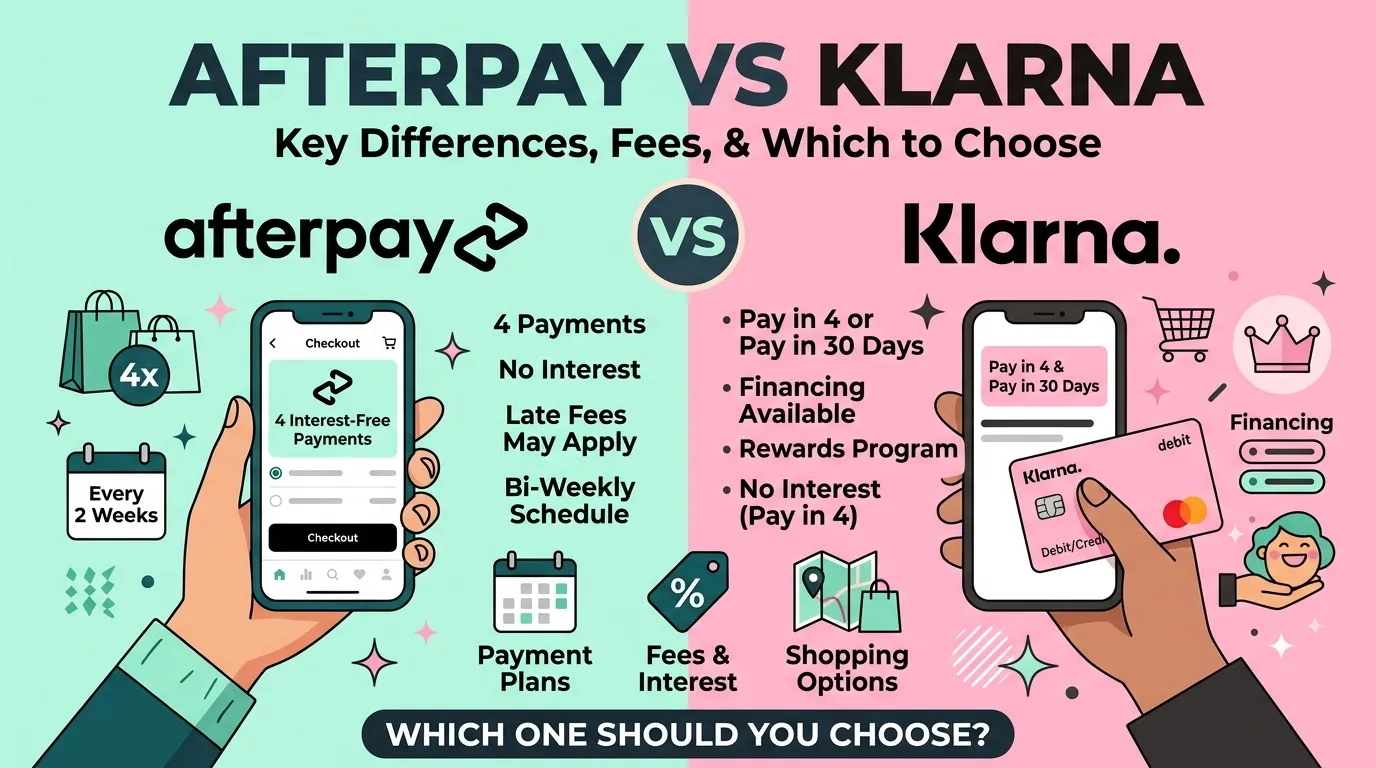
Afterpay: Its common Pay in 4 plan splits an eligible purchase into four payments, often with the first payment due at checkout.
- Example 1: A $100 purchase may be split into four $25 payments.
- Example 2: A $200 purchase may be split into four $50 payments.
Klarna: It may offer Pay in 4, Pay in 30 days, or longer financing in certain markets.
- Example 1: An eligible $100 purchase may be split into four payments.
- Example 2: An eligible order may allow payment after 30 days.
These examples show possible plans, not a promise that every shopper or purchase will qualify.
3. Fees and Interest
The cost depends on the payment plan and local terms.
Afterpay: Its standard Pay in 4 plan is often interest-free when payments are made on time. Late fees may apply under local rules and the plan terms.
- Example 1: You make all payments on time and avoid late fees.
- Example 2: You miss a due date and may face a late fee.
Klarna: Some short-term plans are interest-free, while longer financing may charge interest.
- Example 1: You use an eligible interest-free installment plan.
- Example 2: You choose a financing plan with an advertised interest rate.
Always check the total amount payable before you agree.
4. Payment Schedule
Each service sets a schedule for the selected plan.
Afterpay: Its common Pay in 4 plan usually divides the purchase into four payments over about six weeks.
- Example 1: You pay the first installment at checkout.
- Example 2: You plan your budget around the next scheduled installment.
Klarna: The schedule depends on whether you choose installments, delayed payment, or financing.
- Example 1: You pay in four scheduled installments.
- Example 2: You use an eligible plan that allows you to pay later.
5. Shopping Options
The stores that support each service may differ.
Afterpay: It is available through participating stores and supported shopping channels.
- Example 1: You select Afterpay at a participating clothing store.
- Example 2: You check whether a beauty shop accepts Afterpay.
Klarna: It works with participating retailers and offers shopping features in supported markets.
- Example 1: You select Klarna at an eligible online checkout.
- Example 2: You check the Klarna app for supported shopping options.
6. Approval and Spending Limits
Neither service guarantees approval for every purchase.
Afterpay: Approval and spending limits can depend on account history, payment behavior, and other checks.
- Example 1: A shopper may be approved for a small order.
- Example 2: Another order may be declined.
Klarna: Approval can also depend on the shopper, purchase, and payment plan.
- Example 1: You may qualify for one payment option but not another.
- Example 2: Your request for a larger purchase may be declined.
7. Credit Checks and Credit Reporting
Credit rules can vary by country and plan.
Afterpay: Some transactions may use checks that differ from traditional credit applications. Reporting practices can vary by market.
- Example 1: You check the local terms before applying.
- Example 2: You do not assume that every Afterpay plan has the same credit rules.
Klarna: Some plans may involve credit checks or credit reporting, especially for longer financing.
- Example 1: You review the terms before selecting financing.
- Example 2: You check whether an application may affect your credit record.
Do not assume that either service is always free of credit checks.
8. Late Payments
Missing a payment can cause problems with either service.
Afterpay: Late fees or account limits may apply under the terms of your plan.
- Example 1: You miss a payment and check your account for the amount due.
- Example 2: You set a reminder to pay before the due date.
9. Returns and Refunds
The retailer’s return policy matters with both services.
Afterpay: A refund from the retailer may change your remaining balance or lead to a refund under the plan terms.
- Example 1: You return a shirt and wait for the retailer to process the refund.
- Example 2: You check your Afterpay account to see the updated balance.
Klarna: A return may change the amount due once the retailer processes it and Klarna updates the order.
- Example 1: You return shoes and follow the store’s return process.
- Example 2: You check the order status before paying an amount you believe is under review.
Do not assume a return automatically cancels a payment. Follow the official process.
10. International Availability
Neither service is available in every country.
Afterpay: Its availability and name can vary by market. In some markets, it is known as Clearpay.
- Example 1: A shopper checks whether Afterpay is offered in their country.
- Example 2: A UK shopper looks for Clearpay at a participating store.
Klarna: Its services and payment plans are available in supported markets, with local conditions.
- Example 1: A US shopper checks the payment options shown at checkout.
- Example 2: A shopper in another country checks Klarna’s local website.
Nature and Behaviour of Afterpay and Klarna
Afterpay
Afterpay focuses on helping shoppers divide a purchase into scheduled payments. Its familiar Pay in 4 model can make the cost easier to plan.
Its main features include:
- Smaller scheduled payments.
- Access through participating retailers.
- Approval rules and spending limits.
- Possible late fees if payments are missed.
- Terms that vary by market.
Klarna
Klarna offers several ways to pay in supported markets. The available options may include installments, delayed payment, and longer financing.
Its main features include:
- More than one payment option in some markets.
- Access through participating retailers.
- Approval checks that depend on the plan.
- Possible interest on certain financing plans.
- Account tools for viewing purchases and payments.
Klarna may suit a shopper who wants to compare different payment schedules. The shopper should read the terms of each option before choosing.
Why People Get Confused About Afterpay and Klarna
People often confuse Afterpay and Klarna because both belong to the buy now, pay later market. Both can appear at online checkout, and both can split a purchase into smaller payments.
Their names may appear beside similar offers. This can make the services seem identical.
However, their plans, approval rules, fees, and supported stores may differ. A plan that works for one shopper may not be available to another.
Another source of confusion is the phrase “interest-free.” It does not always mean that every plan has no fees. A late payment may still lead to charges, and a longer financing plan may have interest.
The easiest way to compare Afterpay or Klarna is to check the exact offer at checkout. Look at the total cost, payment dates, late-payment rules, and refund terms. These details matter more than the brand name alone.
The Origin of Afterpay and Klarna
History of Afterpay
Afterpay began in Australia in 2014. Its founders were Nick Molnar and Anthony Eisen. The company grew by offering shoppers a way to split eligible purchases into smaller payments.
It later expanded into other markets. In the United Kingdom, the service became known as Clearpay. In 2022, Block, Inc. completed its acquisition of Afterpay.
The service became part of a wider trend in digital payments. More shoppers began looking for alternatives to paying the full purchase price at once.
History of Klarna
Klarna was founded in Sweden in 2005 by Sebastian Siemiatkowski, Niklas Adalberth, and Victor Jacobsson.
The company started with a focus on making online payments easier. Over time, it expanded into shopping tools and buy now, pay later services.
Klarna grew across several countries and developed different payment options for different markets. Today, its offers depend on local rules, retailers, and the payment plan.
Both companies helped make installment payments a common feature of online shopping. Their services have also raised questions about debt, spending habits, and consumer protection.
British vs American English
Afterpay and Klarna are brand names, not ordinary English words. Their spelling does not change between British and American English.
However, the names used for their services can differ by market.
American English
In the United States, shoppers may see Afterpay and Klarna at participating stores.
Examples:
- “Can I use Afterpay for this order?”
- “Does this store accept Klarna?”
American English commonly uses words such as “store,” “installment,” and “program.”
British English
In the United Kingdom, shoppers may see Clearpay, the local name associated with Afterpay, as well as Klarna.
Examples:
- “Does this shop accept Clearpay?”
- “Can I pay with Klarna?”
British English often uses “shop,” “instalment,” and “programme” in the relevant contexts.
The brand names stay the same. What changes is the local service name, spelling conventions, and availability.
Which One Should You Use?
For US Shoppers
Compare the options shown at checkout. Check the payment dates, total cost, and any late fees. Choose the plan that fits your budget rather than the one that offers the largest spending limit.
For UK Shoppers
Check whether a retailer offers Clearpay or Klarna. Compare the terms of the exact plan, including the dates and amount of each payment.
For Global Shoppers
Start by checking availability in your country. Do not assume that a service available in the US or UK will also work where you live.
If neither option is available, look for a trusted local payment method instead.
The best choice is the one you understand, can use legally in your location, and can repay on time.
Common Mistakes
Mistake 1: Thinking Both Services Are Identical
Incorrect: Afterpay and Klarna have exactly the same rules.
Correct: They offer similar services, but their terms can differ.
Mistake 2: Assuming Every Plan Is Interest-Free
Incorrect: Klarna never charges interest.
Correct: Interest depends on the plan and market.
Mistake 3: Thinking Late Payments Do Not Matter
Incorrect: I can pay whenever I want.
Correct: You should follow the payment dates in your agreement.
Mistake 4: Assuming Everyone Gets Approved
Incorrect: Anyone can use Afterpay or Klarna.
Correct: Approval depends on eligibility and other checks.
Mistake 5: Confusing the Brand Names
Incorrect: Clearpay and Afterpay are always separate companies.
Correct: Clearpay is the name used for Afterpay in the UK market.
Mistake 6: Believing a Refund Cancels Everything at Once
Incorrect: Returning an item means I can ignore the next payment.
Correct: Wait for the retailer and payment provider to update the order and balance.
Mistake 7: Ignoring the Total Cost
Incorrect: Small payments always mean a cheap purchase.
Correct: Add up every payment and any possible charges before you buy.
Everyday Usage Examples
In Emails
Example 1: Asking a retailer
“Hello, do you accept Afterpay or Klarna for online orders?”
Example 2: Asking about a payment
“Hello, I returned my order. Could you tell me when my Klarna balance will be updated?”
On Social Media
Example 1: Shopping question
“Does anyone know if this store accepts Afterpay?”
Example 2: Payment options
“I’m comparing Klarna and Afterpay before placing my order.”
In News
Example 1: Business news
“The retailer added Klarna as a payment option for eligible online orders.”
Example 2: Consumer news
“Consumer groups continue to discuss the risks of buy now, pay later services.”
These are sample sentences, not quotations from published news reports.
In Formal Writing
Example 1: A report
“Afterpay and Klarna are examples of buy now, pay later services.”
Example 2: A research paper
“This study examines how installment payment options may affect online shopping habits.”
Usage Trends
Afterpay and Klarna are part of the growth of digital payments and online shopping.
The services are often discussed in three areas:
- Online shopping: Customers look for flexible ways to pay.
- Personal finance: People compare payment schedules and possible fees.
- Consumer protection: Researchers and regulators study the risks of missed payments and overspending.
The popularity of either service also varies by country. A service may be common in one market but unavailable in another.
There is no single global answer to which service is used more. A fair comparison needs current data for a specific country and time period.
Metaphors and Similes
Afterpay and Klarna are brand names, so they do not have standard figurative meanings like ordinary words. Still, writers may use metaphors and similes to explain how their services work.
Metaphors
1. A payment bridge
“An installment plan can act as a payment bridge between shopping today and paying over time.”
This means the shopper divides the cost across several dates.
2. A financial calendar
“Afterpay can feel like a financial calendar for an eligible purchase.”
This means the shopper follows a set schedule.
3. A spending tool
“Klarna is a spending tool, not extra income.”
This reminds shoppers that the money still has to be paid back.
Similes
1. Like splitting a cake
“Paying in installments is like splitting a cake into four pieces.”
Each payment covers part of the total.
2. Like a scheduled train
“A payment plan is like a scheduled train; you need to be ready at the right time.”
This shows why payment dates matter.
3. Like a monthly budget
“Tracking several payment plans is like managing a busy calendar.”
This shows why shoppers should keep a record of their due dates.
These comparisons are creative examples, not official descriptions used by either company.
Connotative Meaning
Connotation is the feeling or idea a word brings to mind. Afterpay and Klarna are brand names, but people may connect them with different ideas.
Positive Meaning
Some shoppers connect these services with choice, ease, and flexibility.
Examples:
- “Afterpay helped me plan the cost of my purchase.”
- “Klarna gave me another way to pay at checkout.”
These sentences show a positive view of payment choice.
Negative Meaning
Other shoppers may connect BNPL services with debt, missed payments, or spending too much.
Examples:
- “Several payment plans made my budget hard to manage.”
- “I missed a due date and had to deal with the payment terms.”
These examples focus on possible risks.
Neutral Meaning
In neutral writing, the names simply identify payment providers.
Examples:
- “The store accepts Afterpay.”
- “Klarna offers payment options in supported markets.”
The meaning depends on the context and the writer’s point of view. Neither brand name is automatically positive or negative.
Idioms and Proverbs
Afterpay and Klarna do not have established English idioms or proverbs of their own. However, common sayings about money can help explain how to use payment plans wisely.
1. Live Within Your Means
Meaning: Spend only what you can afford.
Example: “Before choosing Afterpay or Klarna, remember to live within your means.”
2. Look Before You Leap
Meaning: Think before you act.
Example: “Look before you leap, and read the payment terms before using Klarna.”
3. A Penny Saved Is a Penny Earned
Meaning: Saving money helps protect your budget.
Example: “Compare the total cost before buying. A penny saved is a penny earned.”
4. Don’t Count Your Chickens Before They Hatch
Meaning: Do not rely on something before it is certain.
Example: “Do not plan a purchase around an approval you have not received.”
These sayings are not specific to either brand. They offer general advice about spending and planning.
Literature and Movies
Afterpay and Klarna are modern financial brands, so they are not common themes in classic literature.
Literature
1. The Psychology of Money
- Writer: Morgan Housel
- Year: 2020
- Genre: Personal finance
- Connection: The book explores how people think about money, risk, and financial choices.
2. Shopaholic series
- Writer: Sophie Kinsella
- First book: 2000
- Genre: Comedy and popular fiction
These works do not serve as official histories of Afterpay or Klarna.
Movies
1. Confessions of a Shopaholic
- Year: 2009
- Country: United States
- Genre: Romantic comedy
- Connection: The film explores shopping, debt, and spending habits.
2. The Big Short
- Year: 2015
- Country: United States
- Genre: Financial drama and comedy
- Connection: The film explores financial risk and the wider effects of lending practices.
Neither film is specifically about Afterpay or Klarna. They offer broader ways to think about money and financial decisions.
Why This Difference Matters
Understanding the difference between Afterpay and Klarna can help shoppers make better choices.
First, it helps people compare payment terms. One service may offer a plan that is not available through the other. The shopper should compare the exact terms rather than choose based on the name.
Second, it helps people avoid surprise costs. A missed payment or a financing plan with interest can make a purchase more expensive.
Third, it supports better budgeting. Several small payments may seem easy to manage, but they can add up when a person makes many purchases.
The difference also matters for English learners. Reading about Afterpay and Klarna introduces useful terms such as “installment,” “due date,” “refund,” “interest,” and “credit check.” Clear information helps people understand both the benefits and the risks.
The goal is not to avoid every payment service. It is to understand the agreement and make a choice that fits your needs.
Usefulness in Daily Life
Knowing how these services work can help in everyday shopping.
- Before buying: Compare the total cost and payment dates.
- At checkout: Check which service the retailer accepts.
- When budgeting: Add future installments to your spending plan.
- When returning an item: Follow the store’s refund process.
- When facing a missed payment: Contact the provider and review the available options.
- When shopping abroad: Check local availability and eligibility.
For example, imagine that you want to buy a $120 item. If an eligible plan divides the amount into four equal payments, each payment would be $30 before any applicable fees or other charges.
You should still ask yourself whether you can afford all four payments. You should also consider rent, food, bills, and other needs.
A payment service is useful only when its terms fit your budget. Do not borrow simply because the checkout makes it easy.
Situational Preference
Afterpay may suit shoppers who want a simple, short installment plan at a retailer that supports it. Klarna may suit shoppers who want to compare several payment options, where those options are available. For US shoppers, compare the actual offers at checkout. In the UK, check whether the retailer offers Clearpay or Klarna. For global shoppers, local availability matters most. In Pakistan, confirm eligibility before planning to use either service. Do not choose based on brand popularity alone.
Possible asked questions
1. What is the main difference between Afterpay and Klarna?
Both are buy now, pay later services. Afterpay is widely known for its Pay in 4 plan, while Klarna may offer several payment choices in supported markets. Their exact terms can differ.
2. Is Afterpay better than Klarna?
Neither service is always better. The right choice depends on your country, the retailer, the available plan, and the total cost.
3. Is Klarna always interest-free?
No. Some Klarna plans may be interest-free, while certain longer financing plans may charge interest. Read the terms before accepting an offer.
4. Can Afterpay or Klarna affect my credit score?
They may involve credit checks or credit reporting, depending on the country and plan. Check the local rules and terms before applying.
5. Can I use Afterpay or Klarna in Pakistan?
Availability may be limited. Check the official service website and the retailer’s checkout terms to confirm whether your location and payment method are supported.
6. What happens if I miss a payment?
You may face late fees, account restrictions, or other consequences under the applicable terms. Contact the provider if you think you cannot pay on time.
7. Can I get a refund after returning an item?
Yes, if the retailer approves the return under its policy. The provider then updates the payment plan or balance according to its process. Check your account before assuming the refund is complete.
Conclusion
Afterpay and Klarna are two well-known names in the buy now, pay later market. Both can help eligible shoppers split a purchase into smaller payments, but their plans and terms are not always the same.
Afterpay is widely known for its Pay in 4 plan. Klarna may offer installment payments, delayed payment, and longer financing in some markets. The options you can use depend on your country, the retailer, and your eligibility.
When comparing Afterpay or Klarna, look beyond the brand name. Check the total amount you will pay, the due dates, any interest or late fees, the refund process, and the rules for approval. These details can make a real difference to your budget.
For US and UK shoppers, the available checkout options can help guide the choice. For shoppers in other countries, including Pakistan, the first step is to confirm local availability.
Most of all, remember that smaller payments are still payments you must make. A buy now, pay later service is not extra income. Use one only when you understand its terms and can afford the full cost without harming your budget.