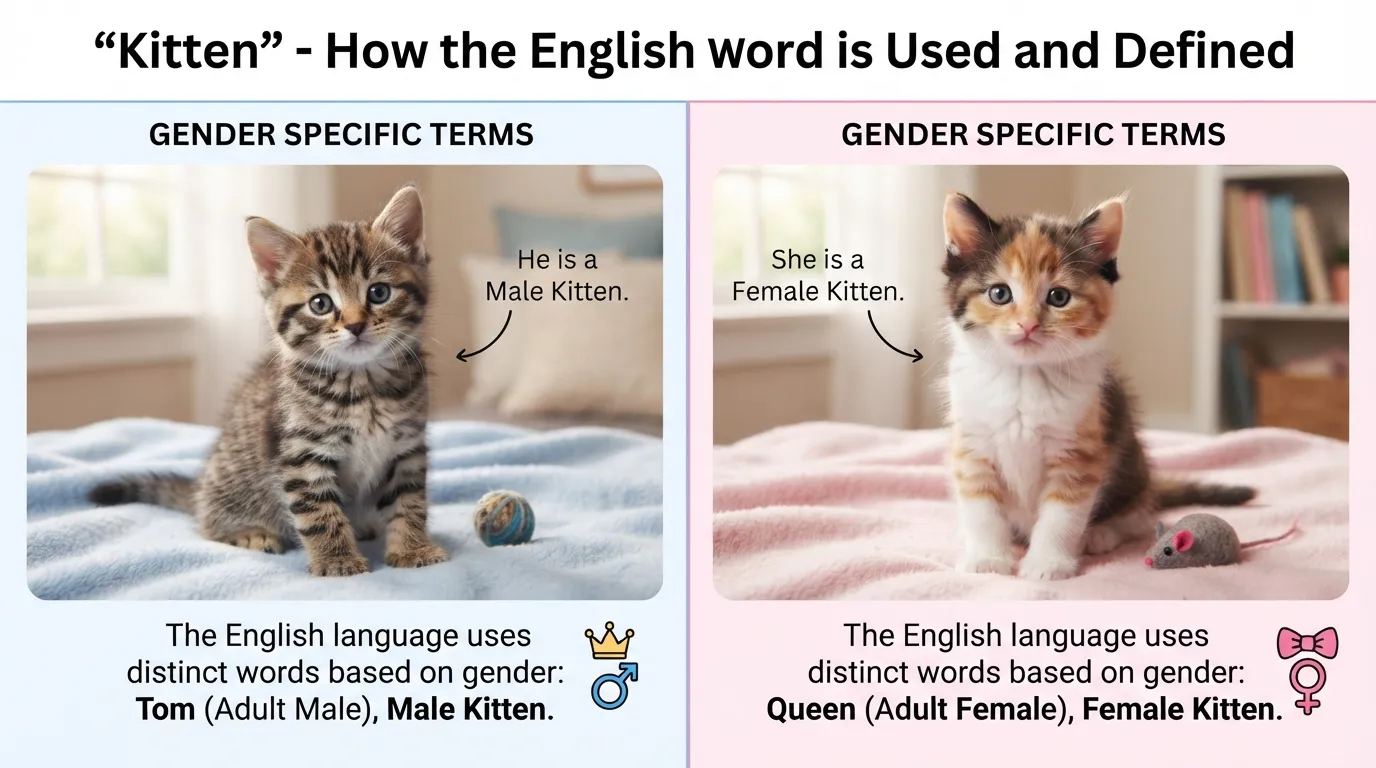
A male kitten usually has a larger gap between the anus and genital opening, while a female kitten has two openings that are much closer together.
Imagine bringing home a tiny kitten. You choose a cute name, buy food, and make a soft bed. Then you stop and wonder, “Is my kitten a boy or a girl?” This is a common question for new cat owners. People search this phrase because fur, face shape, and behavior can be confusing.
Some owners also think coat color can always tell them the answer, but this is not reliable. The safest method is to gently check the shape and space between the openings. If you are unsure, a veterinarian can confirm it. Knowing how to tell if kitten is male or female can also help when choosing a name, planning neutering, and caring for more than one kitten. In this guide, you will learn how to tell if kitten is male or female in a simple way.
Pronunciation
The search phrase is pronounced:
- US English: /haʊ tə tel ɪf ˈkɪtən ɪz meɪl ɔr ˈfiːmeɪl/
- UK English: /haʊ tə tel ɪf ˈkɪtən ɪz meɪl ɔː ˈfiːmeɪl/
Key words:
- Male: US /meɪl/, UK /meɪl/
- Female: US /ˈfiːmeɪl/, UK /ˈfiːmeɪl/
- Kitten: US /ˈkɪtən/, UK /ˈkɪtən/
The main clue is under the kitten’s tail, so let’s look at it step by step.
Read more about:https://gatherword.com/hawk-or-eagle/
Difference Between Male and Female Kittens
1. Distance Between the Two Openings
This is one of the best clues.
In a male kitten, the anus and genital opening are farther apart. In a female kitten, they are much closer together.
Examples:
- Male: There is a clear space between the two openings.
- Female: The two openings look close together.
2. Shape of the Genital Opening
The shape can also help.
A male kitten’s lower opening often looks more round. A female kitten’s opening usually looks like a small vertical line.
Examples:
- Male: The openings may look like two small dots.
- Female: The openings may look like an upside-down exclamation mark.
3. Male Kittens May Have a Small Scrotum
Male kittens can have a small scrotum between the anus and penis opening. However, it may be difficult to see in a very young kitten.
Examples:
- Male: You may notice a small space or developing scrotum.
- Female: There is no scrotum.
4. Female Kittens Have a Shorter Gap
The genital area of a female kitten is close to the anus.
Examples:
- Female: The two openings look almost connected.
- Male: The two openings have more visible space between them.
5. The Penis Is Usually Not Easy to See
Do not expect to see a clear penis when checking a young male kitten. It can be very small and hidden.
Examples:
- A male kitten may look female if you only search for a visible penis.
- A kitten without an obvious penis is not automatically female.
6. Testicles Are Not Always Easy to Feel
Young male kittens may have testicles that are too small to identify easily. Therefore, do not depend only on this sign.
Examples:
- You may not feel testicles in a young male kitten.
- A missing visible scrotum does not always prove the kitten is female.
7. Coat Color Can Give a Clue
Some colors are more common in one sex. However, coat color alone cannot confirm sex. Rare male tortoiseshell or calico cats can occur.
Examples:
- A calico kitten is very likely to be female.
- An orange kitten may be male, but it can also be female.
8. Age Makes Identification Easier
Very young kittens can be harder to identify. As kittens grow, their reproductive features become easier to see. PetMD notes that sexing kittens under eight weeks can be more difficult.
Examples:
- A newborn kitten may be difficult to identify.
- An older kitten may have clearer physical signs.
9. Behavior Is Not a Reliable Test
Do not decide sex only from behavior. Male and female kittens can both be playful, quiet, friendly, or active.
Examples:
- A playful kitten can be male or female.
- A quiet kitten can also be male or female.
10. A Vet Can Confirm the Sex
If you cannot tell, ask a veterinarian. This is especially useful when the kitten is very young or the anatomy is unusual.
Rare reproductive differences can also make sex difficult to identify from appearance alone.
Examples:
- A vet can check a kitten during a normal health visit.
- A vet can help if two kittens look different from expected patterns.
Nature and Behaviour of Male and Female Kittens
Male Kittens
Young male and female kittens often behave in very similar ways. A male kitten may be playful, curious, sleepy, friendly, or active.
But behavior is not a good way to identify the sex of a very young kitten.
Female Kittens
Female kittens can also be playful, loving, active, and curious.
As they mature, an unspayed female may come into heat. She may become more vocal, restless, or affectionate.
These later behaviors should not be used to identify a small kitten.
Why People Get Confused About Male and Female Kittens
People often get confused because kittens are tiny.
Their genital areas are small. Fur can also hide important details. In very young kittens, the reproductive organs may not be fully developed.
Another problem is the belief that behavior tells the sex. It does not. A gentle kitten can be male. A rough-and-tumble kitten can be female.
Coat color can offer a clue, but it is not a perfect test. The best method is to check the openings under the tail and look at their shape and distance.
The Origin of the Keyword
The phrase how to tell if kitten is male or female is a modern natural-language search question.
It combines simple words:
- How to tell means how to identify something.
- Kitten means a young cat.
- Male describes the sex associated with male reproductive anatomy.
- Female describes the sex associated with female reproductive anatomy.
People have identified the sex of animals for centuries. Today, pet owners often ask the question online because they want quick help when adopting or caring for a kitten.
British vs American English
There is very little difference between British and American English for this topic.
The main terms are the same:
- British English: male kitten, female kitten
- American English: male kitten, female kitten
The word kitten is also spelled the same in both forms.
Examples
British English:
“How can I tell whether my kitten is male or female?”
American English:
“How can I tell if my kitten is male or female?”
Both sentences are natural.
The word sex is often more precise than gender when talking about biological reproductive anatomy.
Which One Should You Use?
If you are writing for US readers, male kitten and female kitten are simple and natural.
For example:
“A male kitten usually has a larger gap between the anus and genital opening.”
“A female kitten usually has a smaller gap.”
For SEO, the exact search phrase can be used in the introduction, headings, and body. However, avoid repeating it too much. Natural writing is easier for readers.
Common Mistakes
Mistake 1: Looking Only at the Face
Some people think a kitten’s face can reveal its sex.
Correction: Look under the tail instead.
Mistake 2: Using Personality
A friendly kitten is not always female.
Correction: Personality does not reliably show sex.
Mistake 3: Looking Only at Coat Color
Color can offer clues but cannot prove sex.
Correction: Check the anatomy.
Mistake 4: Searching for a Large Penis
A young male kitten may not have a visible penis.
Correction: Check the distance and shape of the openings.
Mistake 5: Assuming No Testicles Means Female
Testicles may be too small to see or feel in young kittens.
Correction: Use more than one physical clue.
Mistake 6: Handling the Kitten Roughly
A kitten can become frightened or stressed.
Correction: Handle the kitten gently and keep the check brief.
Mistake 7: Being Certain Too Quickly
Sometimes even experienced people can make a mistake.
Correction: Ask a vet if you are unsure.
Everyday Usage Examples
In an Email
“Could you please confirm whether the kitten is male or female before we choose a name?”
On Social Media
“We rescued this little kitten today. Can anyone help us tell if it is male or female?”
In News Writing
“The rescued kittens were examined by a veterinarian, who confirmed their sex.”
In Formal Writing
“The sex of each kitten was determined by examination of the external genital anatomy.”
In Daily Conversation
“Do you know if the kitten is a boy or a girl?”
The last example is very common in everyday speech.
Usage Trends
Online pet information has also made animal-care questions easier to search. People often use natural questions such as “Is my kitten male or female?” instead of technical veterinary terms.
Searchers may also use related phrases such as:
- male or female kitten
- kitten gender
- kitten sex
- boy or girl kitten
- how to sex a kitten
- how to identify kitten gender
Metaphors and Similes
This topic is mainly factual, but simple figurative language can make explanations easier.
“Like Two Tiny Dots”
A male kitten’s openings can look like two small dots from a distance.
Example:
“The male kitten’s markings looked like two tiny dots under his tail.”
“Like a Small Line”
A female kitten’s genital opening can look more like a small vertical line.
Example:
“The female kitten’s openings looked like a tiny exclamation mark.”
These are visual comparisons, not medical terms.
Connotative Meaning
The words male and female are usually neutral when used to describe an animal’s sex.
Positive Meaning
There is no special positive meaning.
Example:
“She adopted a female kitten and gave her a warm home.”
Negative Meaning
The words themselves are not negative.
Example:
“The male kitten needed medical care.”
Neutral Meaning
This is the normal use.
Example:
“The veterinarian confirmed that the kitten was female.”
Idioms and Proverbs
There are no common English idioms specifically about identifying a kitten’s sex.
However, several cat-related expressions can be used in a wider context.
“Curiosity killed the cat”
This means that too much curiosity can cause trouble.
Example:
“I wanted to check every detail, but remember, curiosity killed the cat.”
“Let the cat out of the bag”
This means to reveal a secret.
Example:
“We planned a surprise, but Tom let the cat out of the bag.”
These expressions are about cats, but they do not describe biological sex.
Literature and Movies
Cats and kittens appear often in literature and movies.
Literature
The Tale of Peter Rabbit is a famous children’s book by Beatrix Potter, first published in 1902. It is about a rabbit rather than a cat, but it is an important example of how animals are used as characters in children’s literature.
For a direct cat example, Old Possum’s Book of Practical Cats by T. S. Eliot was published in 1939. It is a collection of humorous poems about cats and later inspired the musical Cats.
Movies
The Aristocats (1970) is an American animated film from Walt Disney Productions. It follows a family of cats and is one of the best-known cat-centered animated movies.
A Street Cat Named Bob (2016) is a British drama film based on the true story of a man whose life changes after meeting a stray cat.
Why This Difference Matters
Knowing a kitten’s sex can be useful for everyday care.
First, it helps you choose an appropriate name if that matters to you.
Second, it becomes important when you have several kittens. Male and female cats can reproduce when they become sexually mature. Cats Protection notes that female cats can become sexually mature from around four months, while males may reach sexual maturity later.
Third, knowing the sex helps when discussing the kitten with a veterinarian.
However, sex should not decide how much love or care a kitten receives. Both male and female cats can make wonderful companions. Personality, health, age, and life experience also matter.
Usefulness in Daily Life
Knowing the sex of a kitten can help with:
- Choosing a name.
- Keeping records.
- Talking with a veterinarian.
- Planning neutering or spaying.
- Managing multiple kittens.
- Preventing unwanted pregnancies.
- Understanding future reproductive changes.
- Keeping male and female kittens safely separated when needed.
If you have more than one kitten, do not rely only on your own guess.
Situational Preference
For a quick home check, look gently under the kitten’s tail. Focus on the distance between the anus and genital opening and the shape of the lower opening. If the gap is larger and the lower opening looks round, the kitten is more likely male. If the openings are close and the lower opening looks like a small line, the kitten is more likely female. For a very young kitten, a nervous kitten, or a kitten with unclear anatomy, a veterinarian is the better choice. Do not force the tail up or handle the kitten for a long time. The goal is a calm, gentle check, not a stressful examination.
Frequently asked questions
1. How can I tell if my kitten is male or female?
Look under the tail. Check the distance between the anus and genital opening. Male kittens usually have a larger gap, while female kittens usually have a smaller gap.
2. What does a female kitten’s private area look like?
The anus and genital opening are close together. The lower opening usually looks more like a small vertical line.
3. What does a male kitten’s private area look like?
A male kitten usually has more space between the anus and genital opening. The lower opening tends to look more round. A small scrotum may also be visible.
4. Can you tell a kitten’s sex by color?
Sometimes color gives a clue, but it cannot confirm the answer. Calico and tortoiseshell cats are usually female, while orange cats are more often male. Rare exceptions exist.
5. Can behavior tell me if a kitten is male or female?
No. Young male and female kittens can have very similar personalities. Behavior becomes less useful than physical anatomy for identifying sex.
6. At what age can you tell a kitten’s sex?
It can be difficult when kittens are very young. The physical differences become easier to see as they grow. PetMD notes that kittens under eight weeks can be harder to sex.
7. What should I do if I still cannot tell?
Ask a veterinarian. This is the safest option when the kitten is very young or the anatomy is unclear. Rare reproductive conditions can also make identification difficult.
Conclusion
Learning to identify a kitten’s sex does not have to be difficult. The most useful clues are found under the tail. Look at the distance between the anus and genital opening. A male kitten usually has a larger gap. The lower opening may also look round. A female kitten usually has a much smaller gap, and the lower opening often looks like a small vertical line.
Do not depend only on coat color, behavior, face shape, or the size of the kitten. These clues can be misleading. Very young kittens can also be difficult to identify because their body parts are tiny and still developing.
Handle the kitten gently and keep the check short. If you are not sure, let a veterinarian confirm the answer. This is especially important when the kitten is very young or looks different from the usual pattern.
Knowing whether a kitten is male or female can help with naming, veterinary care, and planning for future neutering or spaying. Most importantly, both male and female kittens need the same basic things: safe care, good food, warmth, health checks, and plenty of love.

I am M.Phil-qualified professional with a strong interest in education, English language, and knowledge sharing. I am passionate about learning, research, and creating useful content that helps people improve their English skills and understanding.










4 thoughts on “How to Tell If a Kitten Is Male or Female?”