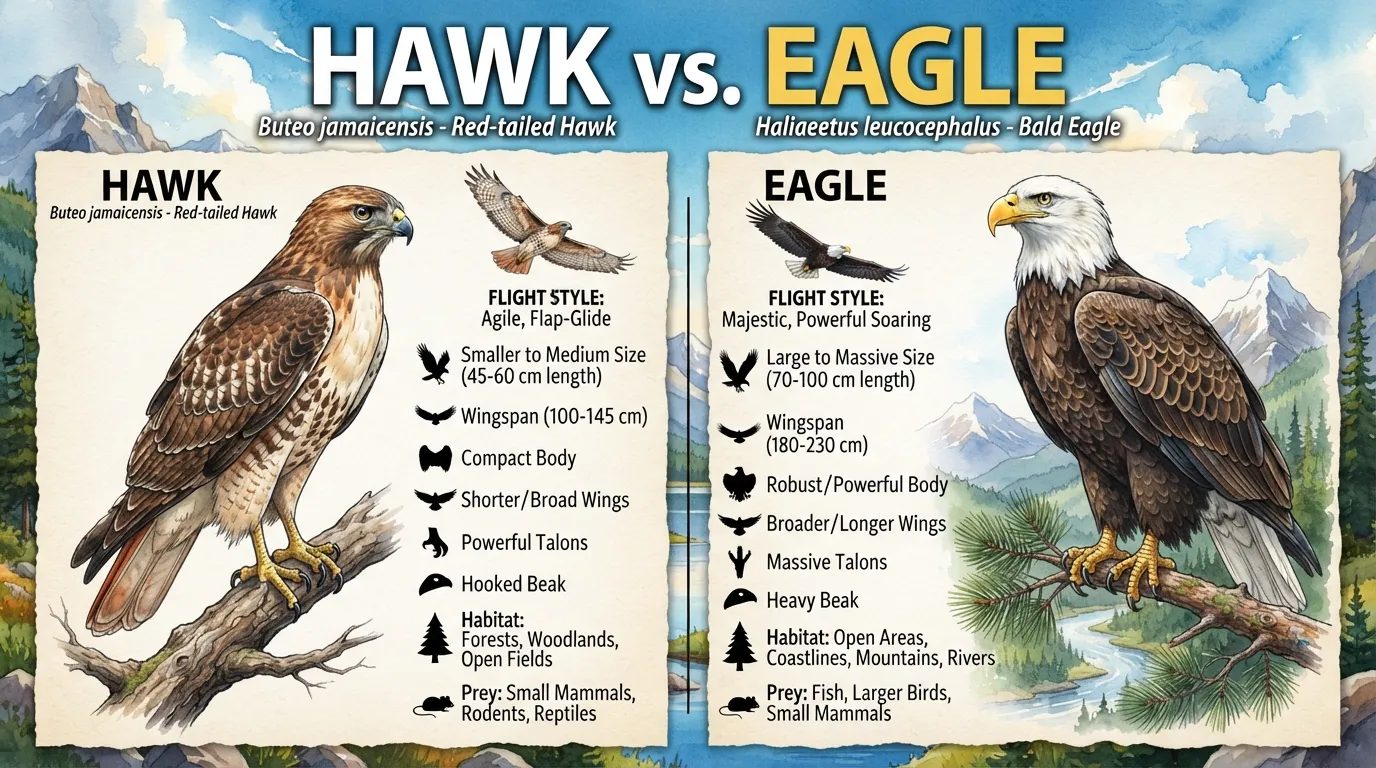
Quick answer: A hawk and an eagle are both birds of prey, but eagles are usually larger and stronger, while hawks are often smaller and more varied.
Imagine you are walking through a park and see a large bird flying high above you. It has wide wings and sharp claws. You may wonder, “Is that a hawk or eagle?” Many people have the same question. These birds can look very similar when they are far away.
A hawk is a bird of prey from several groups of birds in the family Accipitridae. . Both have strong feet, sharp talons, hooked beaks, and excellent eyesight.
People search for hawk or eagle because the two birds can be difficult to identify. Their colors, shapes, and flight styles can sometimes look alike. . In this guide, we will explain the difference in simple words.
Pronunciation
Hawk
- US: /hɔːk/ — sounds like hawk
- UK: /hɔːk/ — sounds like hawk
Eagle
- US: /ˈiːɡəl/ — EE-guhl
- UK: /ˈiːɡəl/ — EE-guhl
The pronunciation of both words is almost the same in American and British English.
Read more about:https://gatherword.com/gopher-or-groundhog/
Difference Between Hawk or Eagle
1. Size
Eagles are generally larger than hawks. They often have longer and broader wings.
Hawks come in many sizes. Some can still be quite large.
Example 1: The eagle looked huge as it flew over the valley. Example 2: The hawk was smaller but moved quickly between the trees.
2. Strength
Eagles are known for their powerful bodies and strong talons. They can catch and carry relatively large prey.
Hawks also have strong claws, but many species usually hunt smaller animals.
Example 1: The eagle used its powerful feet to catch a fish. Example 2: The hawk grabbed a small mouse from the field.
3. Wings
Eagles usually have broad wings. Their wings help them soar for long periods.
Hawks can have different wing shapes. Some have shorter, rounded wings that help them move through forests.
Example 1: The eagle soared on wide wings above the mountains. Example 2: The hawk used its rounded wings to move between trees.
4. Beak
Both birds have hooked beaks. Eagles often have large, powerful beaks.
Hawks usually have smaller beaks, although the exact shape differs by species.
Example 1: The eagle tore its food with its strong beak. Example 2: The hawk used its hooked beak to eat its prey.
5. Talons
Both birds have sharp talons. Eagles usually have very large and powerful feet.
Hawks also use their talons to catch and kill prey.
Example 1: The eagle caught the fish with its talons. Example 2: The hawk caught a rabbit with its strong feet.
6. Hunting Style
Many hawks are fast and agile hunters. They may chase prey or attack from a hidden position.
Eagles often soar and watch the ground or water before making an attack.
Example 1: The hawk suddenly flew between the trees after its prey. Example 2: The eagle circled above the lake before diving down.
7. Diet
Both birds are carnivores. Their diets depend on their species and habitat.
Hawks often eat rodents, birds, reptiles, and insects. Eagles may eat fish, birds, mammals, and other animals.
Example 1: The hawk hunted a field mouse. Example 2: The eagle caught a fish from the river.
8. Habitat
Hawks live in many places. You can find them in forests, grasslands, farms, deserts, and cities.
Example 1: A hawk was sitting on a tree near the farm. Example 2: An eagle built its nest near a large lake.
9. Appearance
Eagles often have a strong and broad appearance. Some species have distinctive white heads or tails.
Hawks show a much wider range of colors and body patterns.
Example 1: The bald eagle has a white head and tail as an adult. Example 2: The red-tailed hawk often has a reddish tail.
10. Scientific Classification
“Eagle” and “hawk” are common names rather than simple scientific groups.
Example 1: A bald eagle belongs to the genus Haliaeetus. Example 2: A red-tailed hawk belongs to the genus Buteo.
Nature and Behaviour of Hawk or Eagle
Hawk
Hawks are skilled hunters. Many species have excellent eyesight. They can see small animals from a distance.
Some hawks spend much of their time alone. Others may gather during migration.
Hawks are often quick and agile. Forest hawks can move rapidly through trees. Open-country hawks may soar above fields.
Eagle
Eagles are also powerful hunters. They often use their excellent eyesight to find prey from high places.
Many eagles soar for long periods. They use rising air to stay in the sky with little effort.
Some eagles live near water because fish are an important part of their diet. Others hunt mammals, birds, and reptiles.
Why People Get Confused About Hawk or Eagle
People often confuse these birds because both have similar features.
Both have:
- Sharp talons
- Hooked beaks
- Strong eyesight
- Large wings
- Feathers
- Hunting skills
- Carnivorous diets
Distance also causes confusion. A bird high in the sky can be hard to identify.
The word “hawk” is also used for many different species. The word “eagle” is used for several different species too.
The best way to identify one is to look at its size, wing shape, tail, color, habitat, and behavior.
The Origin of Hawk or Eagle
The words hawk and eagle are very old English words.
Hawk comes from Old English hafoc. The word has been used for centuries to describe birds of prey.
Eagle comes through Old French from Latin aquila, meaning eagle. The eagle has been an important symbol in many ancient cultures.
Both words have developed over a long period. Today, they are common English names for different kinds of birds of prey.
British vs American English.
Both varieties use:
- hawk
- eagle
- hawks
- eagles
The main difference is not spelling. It is usually related to the species people see in each region.
American English example: “The bald eagle is a famous American bird.”
British English example: “The golden eagle lives in parts of Scotland.”
The names of local species can therefore differ in everyday use.
Which One Should You Use?
Use hawk when you are talking about a hawk species.
Use eagle when you are talking about an eagle species.
For example:
- “I saw a hawk near the road.”
- “An eagle was flying over the mountain.”
For US readers, “bald eagle” is a common and important bird name. In the UK, “golden eagle” is a familiar species.
For global English, simply use the exact bird name when you know the species.
Common Mistakes
Mistake 1: Using “hawk” for every large bird of prey
Incorrect: “Every large bird of prey is a hawk.”
Correct: “Large birds of prey include different species, such as eagles and hawks.”
Mistake 2: Thinking all eagles are huge
Incorrect: “All eagles are exactly the same size.”
Correct: “Eagle species differ in size.”
Mistake 3: Thinking color alone identifies the bird
Incorrect: “A brown bird must be a hawk.”
Correct: “Look at its size, shape, tail, wings, and behavior too.”
Mistake 4: Confusing the words with “falcon”
A falcon is another type of bird of prey. It is not simply another name for a hawk or eagle.
Mistake 5: Using “eagle” as a general name for any bird of prey
Not every bird of prey is an eagle. Hawks, falcons, eagles, kites, and other groups are different.
Everyday Usage Examples
In Emails
“During our school trip, we saw a hawk near the forest.”
On Social Media
“Look at this beautiful eagle flying over the lake!”
In News
“Wildlife experts reported seeing several eagles in the area.”
In Formal Writing
“The species uses its strong talons to capture small mammals.”
In Daily Conversation
“Was that a hawk or an eagle?”
Usage Trends
The words hawk and eagle are widely used around the world.
They appear in:
- Bird guides
- School books
- Wildlife websites
- News reports
- Nature documentaries
- Sports names
- Business names
- Everyday conversation
“Eagle” is also common in symbolic language. It can represent freedom, power, or vision.
“Hawk” can also have symbolic meanings. In some contexts, it represents speed, sharp vision, or a strong attitude.
The exact meaning depends on the sentence.
Metaphors and Similes
These birds are often used in figurative language.
Hawk
“He watched the crowd like a hawk.”
This means he watched very carefully.
“She has hawk-like eyes.”
This means she notices small details.
Eagle
“He has an eagle eye for detail.”
This means he is very good at noticing things.
“She rose like an eagle above the competition.”
This gives the idea of strength or success.
These expressions do not mean that the person is actually a bird.
Connotative Meaning
Hawk
The word hawk can have a positive meaning when it suggests sharp vision, speed, or careful attention.
Example: “She watches the children like a hawk.”
Eagle
The word eagle often has positive associations.
It can suggest:
- Freedom
- Strength
- Power
- Vision
- Independence
- Leadership
Example: “He has an eagle eye for mistakes.”
The meaning depends on context.
Idioms and Proverbs
Watch Like a Hawk
Meaning: To watch something very carefully.
Example: “The teacher watched the students like a hawk during the test.”
Eagle Eye
Meaning: Very good eyesight or the ability to notice small details.
Example: “Her eagle eye found the spelling mistake.”
Eagle-Eyed
Meaning: Very observant.
Example: “An eagle-eyed reader noticed the error.”
There are fewer common English idioms with “hawk” than with “eagle.”
Literature and Movies
Literature
The Eagle — Alfred, Lord Tennyson, 1851
This famous short poem describes an eagle high above the earth. It uses the bird to create a powerful image of height and strength.
The Hawk in the Rain — Ted Hughes, 1957
This poetry collection includes strong images from nature. Hughes often used animals and birds to explore power, fear, and survival.
Movies
The Eagle — 2011, United States/United Kingdom
This historical adventure film uses the eagle as part of its title and story.
The Eagle Huntress — 2016, United Kingdom/Mongolia/United States
This documentary follows a young Mongolian girl training to become an eagle hunter. It shows the close relationship between people and eagles.
Why This Difference Matters
Knowing the difference between a hawk and an eagle is useful for English learners and nature lovers.
It helps students use the correct words. It also helps writers describe animals more accurately.
For bird watchers, the difference is even more useful.
The difference also matters because these birds are important parts of ecosystems. They help control populations of other animals.
Usefulness in Daily Life
You may use these words when:
- Talking about birds
- Writing school assignments
- Reading wildlife articles
- Watching documentaries
- Visiting nature parks
- Posting wildlife photos
- Learning English vocabulary
- Describing a bird
- Reading news about wildlife
If you see a large bird in the sky, do not guess only from its size. Look at several features.
Situational Preference
The choice depends on the bird you are describing. Use hawk when the bird belongs to a hawk group or is commonly known by a hawk name. Use eagle when it is an eagle species. In school writing, use the exact species name when possible. In everyday conversation, a general. For global readers, adding the species name gives the clearest information.
Frequently asked questions
Is an eagle a type of hawk?
Not in the simple everyday sense. Eagles and hawks are different common groups of birds of prey, although many are related and belong to the same broader family.
Which is bigger, a hawk or an eagle?
Eagles are generally larger than hawks. However, size varies between species.
Can a hawk carry a human?
No. Hawks are not large or strong enough to carry an adult human.
Can an eagle carry a dog?
Eagles are powerful birds, but claims that they regularly carry large dogs are often exaggerated. Their ability to carry weight depends on the species and circumstances.
Are hawks and eagles dangerous?
They are wild predators, but they normally avoid people. They can defend themselves if they feel threatened, especially near a nest.
Do hawks and eagles eat the same food?
Their diets can overlap. Both may eat mammals, birds, reptiles, or other animals. Some eagles eat a lot of fish, while many hawks commonly hunt small mammals and birds.
Which has better eyesight, a hawk or an eagle?
Both have excellent eyesight. Eagles are especially famous for their ability to spot prey from high in the air. Exact visual ability varies by species.
Conclusion
Hawks and eagles are both impressive birds of prey, but they are not the same. Eagles are generally larger and more powerful. Hawks come in many forms and are often known for speed and agility. Both birds have sharp talons, hooked beaks, strong eyesight, and excellent hunting skills.
The easiest way to remember the difference is to look at the whole bird. Consider its size, wings, tail, body shape, habitat, and behavior. Do not depend on color alone.
The words also have interesting meanings in English. A hawk can suggest sharp attention or careful watching. An eagle can suggest freedom, strength, and vision. Both words are common in literature, movies, news, and everyday speech.
If you are unsure whether a bird is a hawk or eagle, avoid making a quick guess. Try to identify its species or compare its physical features. This simple habit can make your English more accurate and your wildlife knowledge much stronger.








2 thoughts on “Hawk or Eagle: What Is the Difference?”