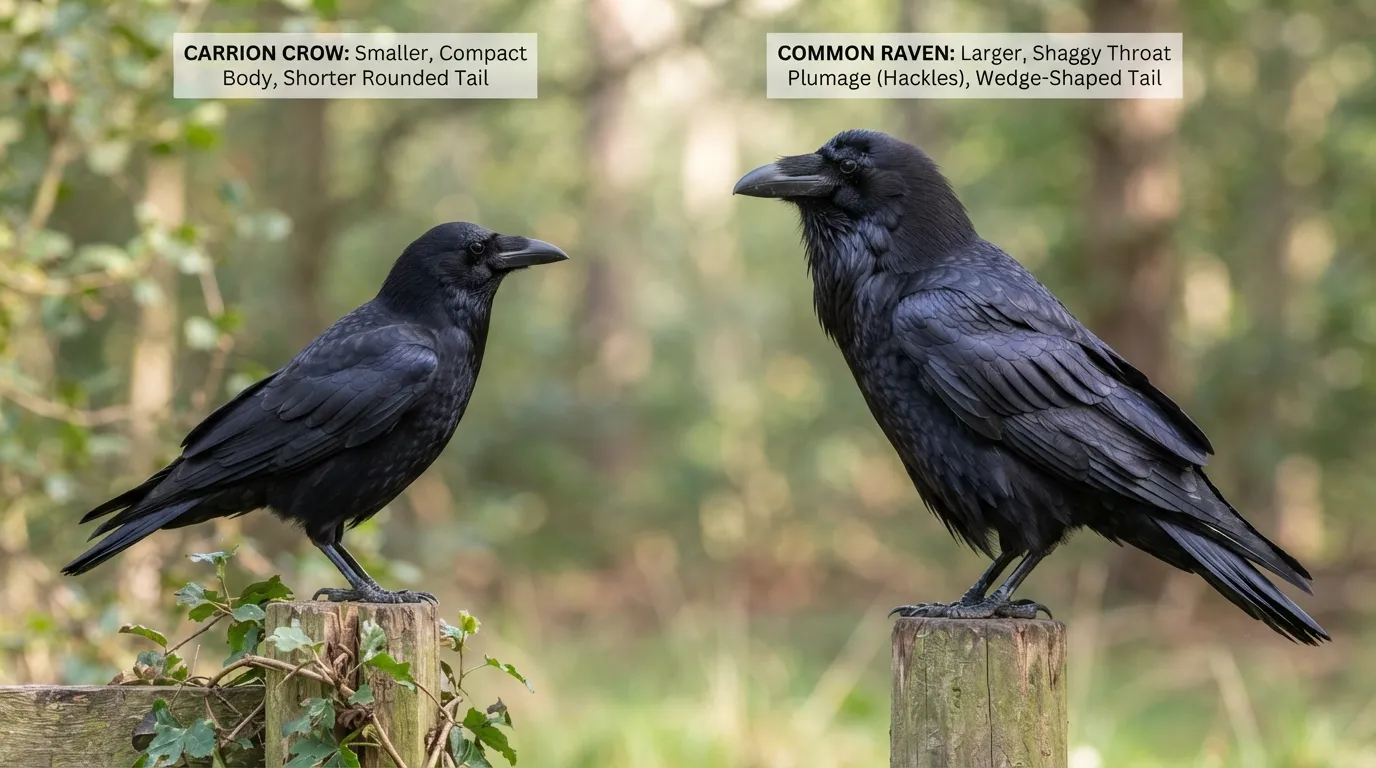
Quick answer: A crow is usually smaller with a flatter bill, while a raven is larger, has a heavier bill, and often has a deeper voice.
Have you ever seen a large black bird sitting on a roof and wondered, “Is that a crow or raven?” You are not alone. Many people use these names as if they mean the same bird.But they are not the same birds.
The words crow or raven are common in bird guides, nature articles, stories, and everyday speech. People search crow or raven because the two birds can look very similar. Their black feathers make them even harder to tell apart from a distance. Size, bill shape, tail shape, flight style, and voice can help you identify them.
Pronunciation
- Crow
- US: /kroʊ/
- UK: /krəʊ/
- Raven
- US: /ˈreɪ.vən/
- UK: /ˈreɪ.vən/
Now, let us look at the main differences step by step.
Difference Between Crow or Raven
1. Size
Ravens are usually much larger than crows. A raven can look closer to a small hawk in size.
Examples:
- A crow sat on the small fence.
- A large raven flew over the field.
2. Bill Shape
A crow usually has a smaller and slimmer bill. A raven has a bigger, heavier bill.
Examples:
- The crow picked up a small seed.
- The raven broke apart a piece of food with its strong bill.
3. Tail Shape
The tail is one of the best clues. A raven often has a wedge-shaped tail. A crow usually has a more rounded or fan-shaped tail.
Examples:
- The raven showed its wedge-shaped tail while flying.
- The crow spread its rounded tail in the air.
4. Throat Feathers
Ravens often have longer feathers around the throat. These feathers can look loose or shaggy.
Examples:
- The raven had long throat feathers.
- The crow looked smoother around the neck.
5. Voice
Crows often make a familiar “caw” sound. Ravens have a deeper and rougher call.
Examples:
- I heard a crow calling from the tree.
- A deep raven call came from the hill.
6. Flight
Ravens often glide and soar. They can use rising air to stay in the sky. Crows often flap their wings more during normal flight.
Examples:
- The raven glided above the mountain.
- The crow flew from one tree to another.
7. Habitat
Crows are very common around towns, farms, roads, and cities. Ravens are often found in forests, mountains, open land, and wild areas.
Examples:
- A crow searched for food near the market.
- A raven lived near the rocky hills.
8. Social Behavior
Crows often live and move in groups. Ravens can also meet in groups, but they are often seen alone or in pairs.
Examples:
- Several crows gathered in a field.
- Two ravens sat on a tall rock.
9. Intelligence
Both birds are highly intelligent. Crows are famous for solving problems and using simple tools. Ravens also show strong problem-solving skills.
Examples:
- The crow used a stick to reach food.
- The raven solved a food puzzle.
10. Common Use of the Names
“Crow” can refer to many birds in the crow group. “Raven” usually refers to larger members of the same family.
Examples:
- The black bird near the road may be a crow.
- The very large black bird may be a raven.
Nature and Behaviour of Crow or Raven
Crow
Crows are active and adaptable birds. They can live close to people and eat many types of food. They may search through fields, gardens, roadsides, and waste areas.
Crows are also social. They can gather in large groups. They communicate through different calls.
Raven
Ravens are also smart and adaptable. They are often associated with wild places. They can live in forests, mountains, deserts, and open areas.
Ravens can glide for long periods. They may play with objects and explore their surroundings.
Why People Get Confused About Crow or Raven
The main reason is appearance. Both birds can have black feathers and similar body shapes. Both belong to the same bird family.
Distance also creates confusion. A raven seen far away may look like a large crow. A crow seen from a poor angle may look like a raven.
The best clues are size, bill, tail, throat feathers, and voice.
Both are intelligent birds. Both are important parts of nature.
The Origin of Crow or Raven
The word crow has a long history in English. It comes from Old English crāwe. It is also linked to the bird’s familiar call.
The word raven comes from Old English hræfn. Similar words appear in other old Germanic languages.
Both names are much older than modern English. People have watched and named these birds for many centuries.
British vs American English
American English:
- I saw a crow in the park.
- A raven flew over the mountain.
British English:
- I saw a crow in the park.
- A raven flew over the mountain.
The main difference is often pronunciation, not spelling.
Which One Should You Use?
Use crow when you mean the smaller bird or when you are not sure about the exact species.
Use raven when the bird is clearly larger and has features such as a heavy bill and wedge-shaped tail.
For US, UK, and global English, the same words are correct. You do not need a different spelling for either word.
Common Mistakes
Mistake 1: Calling Every Black Bird a Crow
Wrong idea: Every black bird is a crow.
Correction: Black color alone does not identify the bird.
Mistake 2: Thinking Ravens Are a Different Family
Wrong idea: Ravens are unrelated to crows.
Correction: Both belong to the Corvidae family.
Mistake 3: Using Size as the Only Clue
Wrong idea: A large bird must always be a raven.
Correction: Use size with bill, tail, voice, and flight style.
Mistake 4: Thinking Crows Are Not Intelligent
Wrong idea: Only ravens are smart.
Correction: Crows are highly intelligent too.
Mistake 5: Treating the Words as Exact Synonyms
Wrong idea: Crow and raven always mean the same thing.
Correction: They are related birds, but they can refer to different species.
Everyday Usage Examples
In an Email
I saw a crow outside the school this morning.
On Social Media
A beautiful raven appeared during my hike today.
In News Writing
A large raven was seen near the mountain road.
In Formal Writing
Crows and ravens belong to the Corvidae family and show advanced problem-solving behavior.
In Daily Speech
Is that a crow or a raven?
Usage Trends
Both words are widely used in English. Crow is especially common in everyday speech because many crow species live near people.
Raven is also common, especially in nature writing, bird watching, folklore, and literature.
Online searches for crow or raven often come from people trying to identify a bird. Pictures can help, but written descriptions are also useful.
Metaphors and Similes
Crows and ravens have many figurative uses.
Crow
A person may be described as “crowing” when they are proudly talking about a success.
Example:
- He was crowing about his victory.
Raven
A raven can be used as a symbol of mystery or darkness.
Example:
- The dark bird looked like a raven from an old story.
Similes
- The bird was black as a crow.
- He was dark and quiet like a raven.
These are literary comparisons. They do not describe every real crow or raven.
Connotative Meaning
The word crow can have neutral, positive, or negative associations.
Neutral:
- A crow sat on the tree.
Positive:
- The clever crow solved the puzzle.
Negative:
- The noisy crows disturbed the morning.
The word raven can also have different associations.
Neutral:
- A raven flew across the valley.
Positive:
- The raven looked powerful and intelligent.
Negative or dark:
- A raven appeared in the gloomy scene.
These meanings often come from culture, stories, and personal feelings.
Idioms and Proverbs
As the Crow Flies
This means the shortest distance between two places, measured in a straight line.
Example:
- The village is five miles away as the crow flies.
Eat Crow
This means to admit that you were wrong or accept embarrassment.
Example:
- After seeing the evidence, he had to eat crow.
There are fewer common English idioms with raven.
Literature and Movies
Literature
Edgar Allan Poe’s “The Raven” is one of the most famous poems connected with the bird. It was first published in 1845. The poem belongs to the Gothic and narrative poetry tradition.
The raven in Poe’s poem creates a dark and mysterious mood.
Movies
Birds such as crows and ravens appear in many films because they can create mystery, suspense, or a wild setting.
Examples include The Crow (1994), an American supernatural film based on the comic book by James O’Barr, and The Raven (2012), an American mystery thriller connected to Edgar Allan Poe.
These fictional uses do not mean that real crows or ravens are evil or frightening.
Why This Difference Matters
Knowing the difference between a crow and a raven helps English learners use the right word. It also helps people describe animals more accurately.
For students, this difference is useful in science and English lessons.
It also shows how language and nature work together. Two related animals can have different names, features, and cultural meanings.
Usefulness in Daily Life
You can use this knowledge when:
- Watching birds in your garden.
- Writing a school assignment.
- Reading a nature article.
- Describing a bird to someone.
- Choosing the right word in a story.
- Identifying birds from pictures.
- Learning new English vocabulary.
A few simple clues can make identification much easier.
Situational Preference
Use crow when the bird is smaller, has a slimmer bill, and makes a typical caw. Use raven when the bird is much larger, has a heavy bill, and shows a wedge-shaped tail. In US and UK English, both words are correct. If you are writing about a bird you cannot identify clearly, avoid guessing. You can simply say black bird or black bird from the crow family. In nature writing, use the exact name when you have enough evidence to identify the species.
FAQs
Is a raven a crow?
A raven is not simply another word for a crow. Both belong to the same bird family, but they can refer to different birds.
Which is bigger, a crow or a raven?
A raven is generally larger than a crow.
Are crows and ravens related?
Yes. Both belong to the Corvidae family.
Can a crow and raven look the same?
They can look similar, especially from far away. Size, bill shape, tail shape, and voice can help.
Are ravens smarter than crows?
Both are highly intelligent. Different studies show impressive problem-solving abilities in both groups.
Is a black bird always a crow?
No. Many different bird species can have black feathers.
What is the easiest way to tell them apart?
Look at size and tail shape first. A large bird with a wedge-shaped tail is more likely to be a raven.
Conclusion
The difference between a crow and a raven can seem small at first. Both birds are black, intelligent, and closely related. But several features can help you tell them apart.
A crow is usually smaller. It has a slimmer bill and a more rounded tail. Crows are also very common around towns, farms, and cities. A raven is usually larger. It has a heavier bill, longer throat feathers, and a wedge-shaped tail. Ravens are often seen in wild and open places.
Their voices can also help. Crows often make a clear caw, while ravens have a deeper and rougher call.
The words are spelled the same in British and American English. Both are useful words in everyday English, science, literature, and nature writing. Once you learn the main clues, the crow or raven question becomes much easier to answer.

I am M.Phil-qualified professional with a strong interest in education, English language, and knowledge sharing. I am passionate about learning, research, and creating useful content that helps people improve their English skills and understanding.






2 thoughts on “Crow or Raven: Simple Differences You Can See and Remember”