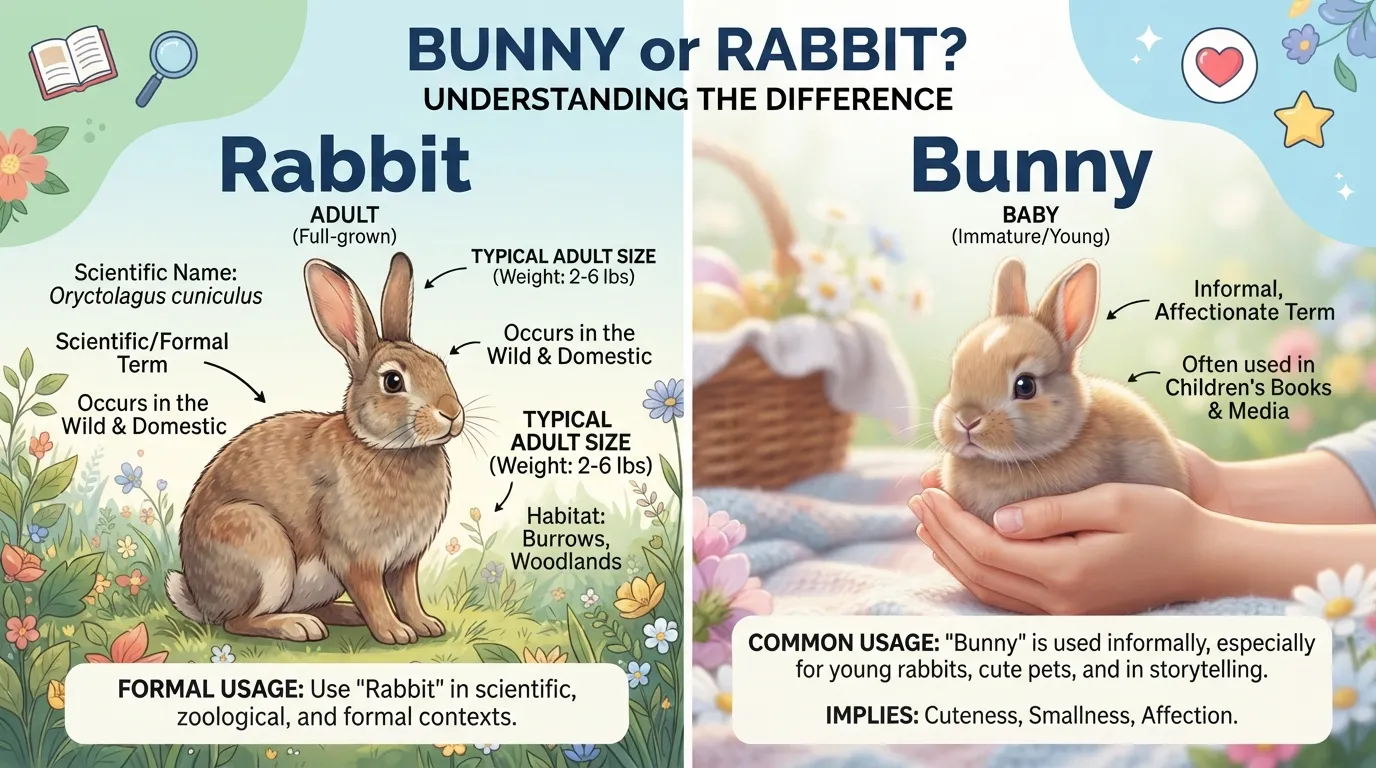
Quick answer: A rabbit is the proper word for the animal, while bunny is a cute and informal word often used for a rabbit.
Imagine a child visiting a farm for the first time. She sees a small animal with long ears and says, “Look at that cute bunny!” Her teacher may call the same animal a “rabbit.” Both words can describe the same animal, so the child is not wrong. This is why many people ask about bunny or rabbit.
The word rabbit is the standard name for the animal. It is common in science, education, news, and formal writing. Bunny is a friendly and informal term. People often use it when talking to children or when they want to show affection.
Pronunciation
- Rabbit
- US: /ˈræbɪt/
- UK: /ˈræbɪt/
- Bunny
- US: /ˈbʌni/
- UK: /ˈbʌni/
Now, let us look at the main differences in simple terms.
Difference Between Bunny and Rabbit
1. Basic Meaning
Rabbit is the standard name for the animal. Bunny is a common informal name for a rabbit.
- The rabbit is eating grass.
- The little bunny is very cute.
2. Formality
Rabbit works well in formal English. Bunny sounds more casual and friendly.
- The farmer bought a rabbit.
- The child hugged her bunny.
3. Scientific Use
Scientists normally use rabbit, not bunny.
- The rabbit belongs to the family Leporidae.
- Scientists studied the rabbit’s behavior.
4. Use With Children
Adults often use bunny when speaking with children.
- Look at the little bunny!
- The bunny has soft fur.
5. Use in Education
School books usually use rabbit because it is the standard term.
- Rabbits eat plants.
- A rabbit has long ears.
6. Emotional Feeling
Bunny often gives a cute or loving feeling. Rabbit is more neutral.
- She has a pet rabbit.
- She loves her little bunny.
7. Age Association
People sometimes use bunny for a young or small rabbit. However, bunny does not always mean a baby rabbit.
- The baby rabbit stayed near its mother.
- The little bunny ran across the garden.
8. Professional Writing
Rabbit is usually better in reports, articles, and academic writing.
- The study examined rabbit health.
- The farmer raises rabbits.
9. Social Media
Bunny is very common on social media because it sounds cute.
- My bunny loves carrots.
- Look at my new bunny!
10. General Animal Name
Rabbit is the safer word when you simply mean the animal.
- We saw a rabbit in the field.
- A rabbit crossed the road.
Nature and Behaviour of Bunny and Rabbit
Rabbit
Rabbits are small mammals with long ears, strong back legs, and soft fur. They are generally herbivores. They eat grass, vegetables, leaves, and other plant material.
Rabbits can be alert and active. They can sprint when they feel danger. Many rabbits also live as pets and can form close bonds with people.
Bunny
Bunny does not describe a separate animal species. It usually refers to a rabbit in a cute, friendly, or informal way.
A pet owner may say, “My bunny is sleeping.” A scientist is more likely to say, “The rabbit is sleeping.”
Why People Get Confused About Bunny and Rabbit
The confusion comes from the fact that both words can refer to the same animal.
A rabbit is the standard term. Bunny is an informal term.
Another reason is that people sometimes believe bunny always means a baby rabbit. This is not true. A bunny can be an adult rabbit too.
The Origin of Bunny and Rabbit
The word rabbit has a long history in English. It came into English through older forms related to French and other European languages. Its use became common in English for the small animal with long ears.
The word bunny developed later as a softer and more affectionate term. It has been used as a pet name and a child-friendly word.
Over time, bunny became strongly linked with cute images of rabbits. This is one reason we often see bunny characters in children’s books, toys, cartoons, and Easter decorations.
British vs American English
In both varieties, rabbit is the standard word for the animal.
- British English: “I saw a rabbit in the garden.”
- American English: “I saw a rabbit in the yard.”
Bunny is also used in both varieties.
- British English: “The children love the bunny.”
- American English: “The children love the bunny.”
The main difference is not spelling or grammar. It is tone and situation. Rabbit sounds neutral. Bunny often sounds cute or affectionate.
Which One Should You Use?
Use rabbit when you want the safest and most standard choice. It works in school, science, news, business, and everyday English.
Use bunny when the situation is casual, friendly, or playful.
For US English, both words are common.
For UK English, both used.
For global English, rabbit is the best choice when you want to be clear and neutral. Bunny is useful when talking about pets, children, or cute animal content.
Common Mistakes
Mistake 1: Thinking Bunny Is a Different Species
Wrong idea: A bunny and rabbit are always different animals.
Correction: Bunny is normally an informal word for a rabbit.
Mistake 2: Using Bunny in Scientific Writing
Less suitable: Scientists studied the bunny.
Better: Scientists studied the rabbit.
Mistake 3: Thinking Bunny Always Means Baby Rabbit
Wrong idea: Every bunny is a baby.
Correction: Bunny can refer to a rabbit of any age.
Mistake 4: Thinking Rabbit Is Too Formal for Daily English
Wrong idea: Rabbit used in formal English.
Correction: Rabbit is perfectly normal in everyday speech.
Mistake 5: Treating Bunny as a Separate Species
Wrong idea: Bunny is the scientific name of another animal.
Correction: Bunny is an informal term.
Everyday Usage Examples
In Emails
Casual:
“My daughter has adopted a new bunny.”
Formal:
“The rabbit requires regular care and a suitable diet.”
On Social Media
“Meet our new bunny!”
“Look at this adorable rabbit!”
In News
“Rescuers found a rabbit near the road.”
In Formal Writing
“The researchers observed the rabbit’s feeding behavior.”
In Daily Conversation
“Did you see that rabbit?”
“Look at that cute bunny!”
Usage Trends
The word rabbit remains the standard term in English. It appears often in education, science, farming, animal care, and general writing.
Bunny is especially popular in informal language.
Online, people often choose bunny because it sounds warm and cute. Pet owners may also use it as a loving name.
So, the choice depends more on context and tone than on the animal itself.
Metaphors and Similes
The word rabbit can appear in figurative expressions.
- “He ran like a rabbit.” This means he ran very quickly.
- “She is as quiet as a rabbit.” This suggests that she is very quiet or careful.
Bunny can also create a cute image.
- “She is as soft as a bunny.” This describes someone or something as very soft.
- “The child was hopping around like a bunny.” This describes playful movement.
These are informal and creative uses.
Connotative Meaning
Rabbit
The word rabbit usually has a neutral meaning.
Example: “The rabbit was sitting in the field.”
It simply identifies the animal.
Bunny
The word bunny often has a positive and cute feeling.
Example: “My little bunny is sleeping.”
It can suggest affection, softness, innocence, or playfulness.
Neither word is normally negative. However, their emotional effect depends on the context.
Idioms and Proverbs
There are several English expressions involving rabbits.
Pull a Rabbit Out of a Hat
This means to produce a surprising solution.
Example: “Our team pulled a rabbit out of a hat and won the game.”
Rabbit Hole
A “rabbit hole” can mean a complicated subject or activity that takes you deeper and deeper.
Example: “I went down a rabbit hole while researching English words.”
Run Like a Rabbit
This informal phrase means to run away very quickly.
Example: “The boy ran like a rabbit when he saw the dog.”
Literature and Movies
Rabbits have a strong place in literature and popular culture.
One famous example is The Tale of Peter Rabbit, a children’s book written by Beatrix Potter and published in 1902. It features Peter Rabbit and remains a classic of children’s literature.
Another famous rabbit character is the White Rabbit from Lewis Carroll’s Alice’s Adventures in Wonderland, published in 1865. The character became one of the best-known rabbits in English literature.
Rabbits also appear in movies. Hop (2011), an American family comedy film, uses a rabbit as its main character. Peter Rabbit (2018), a British-American comedy film, brings Beatrix Potter’s famous character to modern audiences.
Why This Difference Matters
For English learners, understanding rabbit and bunny helps with word choice.
If you write a school assignment, rabbit is usually the better choice. If you talk about your pet, bunny can sound warmer and more natural.
Usefulness in Daily Life
Knowing these words can help when you:
- Talk about pets.
- Write school assignments.
- Read children’s books.
- Watch movies.
- Talk with children.
- Write social media posts.
- Read animal-care information.
- Search for rabbit products.
- Talk about farming.
- Study animal science.
Use rabbit for clear and neutral communication. Use bunny when you want a cute or friendly tone.
Situational Preference
Choose rabbit when you are writing an essay, report, school lesson, news story, or scientific text. It is clear and standard. Choose bunny when you are talking about a pet, speaking to children, writing a cute social media post, or showing affection. In casual conversation, either word can work. If you are unsure which one to use, choose rabbit. It understood everywhere and does not sound strange. For a warm or playful tone, bunny is often the better choice. The best word depends on your audience, purpose, and tone.
FAQs
Is a bunny the same as a rabbit?
Yes. In most everyday English, bunny is an informal and affectionate word for a rabbit.
Is a bunny always a baby rabbit?
No. Bunny can refer to a rabbit of any age.
Which word is more formal?
Rabbit is more formal and neutral.
Can I use bunny in an essay?
You can, but rabbit is usually a better choice for academic or formal writing.
Is bunny used in American English?
Yes. American speakers commonly use both rabbit and bunny.
Is bunny used in British English?
Yes. British speakers also use both words.
Which word should English learners use?
Use rabbit when you are unsure. Use bunny for informal, cute, or affectionate situations.
Conclusion
Rabbit and bunny usually refer to the same animal, but they do not have exactly the same tone. Rabbit is the standard and neutral word. It is suitable for everyday speech, education, science, news, and formal writing. Bunny is an informal and affectionate word. It is especially common when talking about pets, children, and cute animal characters.
The biggest difference is therefore not the animal itself. It is the style and feeling behind the word. A teacher may say “rabbit,” while a child may say “bunny.” Both can be correct.
For English learners, rabbit is the safest choice when formal or neutral language is needed. Use bunny when you want your words to sound warm, playful, or loving.
Once you understand this small difference, choosing between the two becomes easy. When in doubt, remember: rabbit is the standard word; bunny is the cute, informal word.

I am M.Phil-qualified professional with a strong interest in education, English language, and knowledge sharing. I am passionate about learning, research, and creating useful content that helps people improve their English skills and understanding.