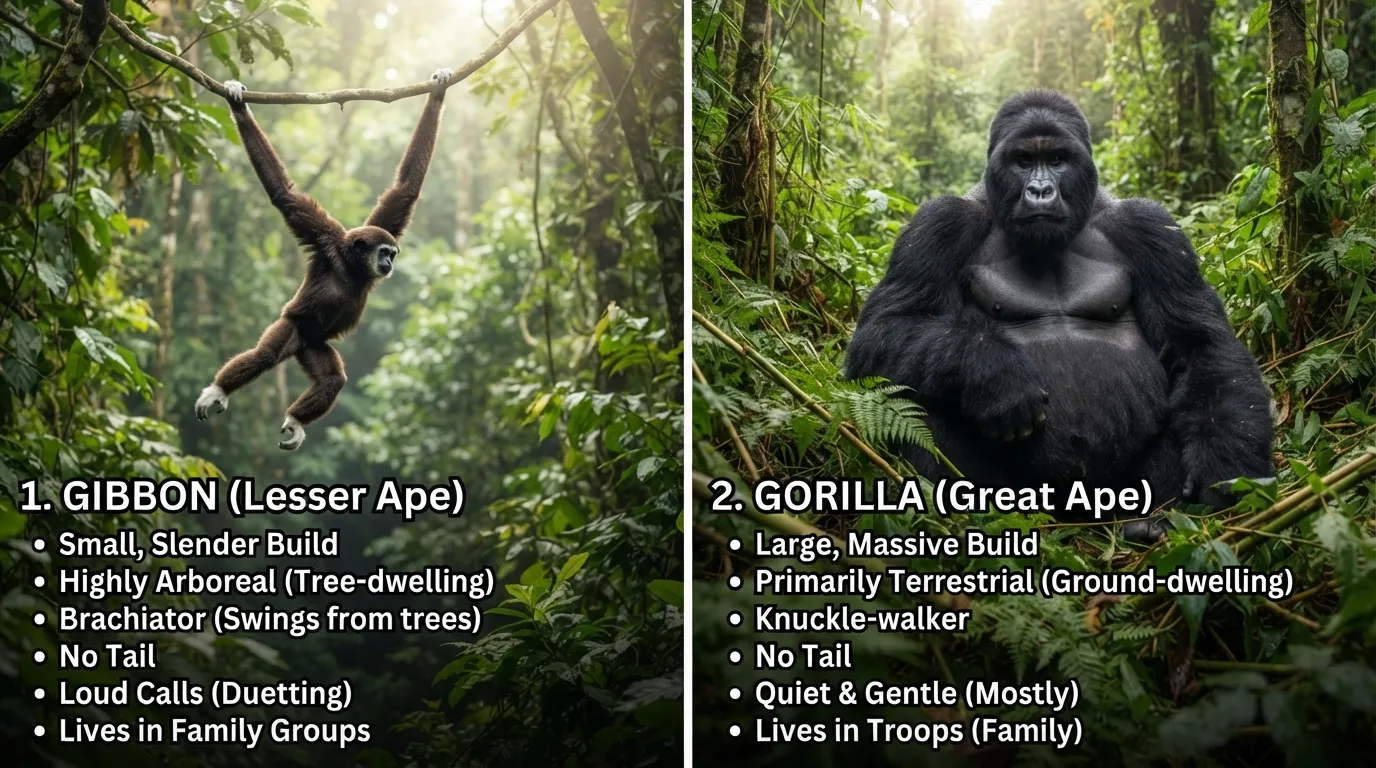
A gibbon is a small, fast tree-dwelling ape, while a gorilla is a much larger great ape that lives in Africa.
Imagine visiting a zoo with a child. You see one ape swinging quickly from branch to branch. Its arms look very long, and it moves with great speed. Later, you see another ape sitting on the ground. It has a large body, broad shoulders, and a powerful look. The first animal is a gibbon. The second is a gorilla.
Both animals are apes, but they are not the same. A gibbon belongs to the family Hylobatidae, often called the lesser apes. A gorilla belongs to the genus Gorilla and is one of the great apes. Gibbons are mainly found in Asia, while gorillas are native to Africa. (ANU Press)
People often search for gibbon or gorilla because both are apes without tails. Their names can appear in animal articles, school books, documentaries, and general English. Understanding gibbon or gorilla helps learners describe these animals correctly. It also makes animal vocabulary easier to remember.
Read more about:https://gatherword.com/crow-or-raven/
Pronunciation
- Gibbon
- US: /ˈɡɪbən/
- UK: /ˈɡɪbən/
- Sounds like: GIB-uhn
- Gorilla
- US: /ɡəˈrɪlə/
- UK: /ɡəˈrɪlə/
- Sounds like: guh-RIL-uh
Oxford gives gibbon as /ˈɡɪbən/. (Oxford Learner’s Dictionaries)
Now, let us look at the main differences between these two fascinating apes.
Difference Between Gibbon and Gorilla
1. Body Size
A gibbon is small and light compared with a gorilla. Gibbons have slim bodies and long arms.
A gorilla is much larger and heavier. It has a broad chest and strong muscles.
Examples:
- The gibbon moved easily through the trees.
- The gorilla looked very large beside the other animals.
2. Type of Ape
Gibbons are called lesser apes. This does not mean they are less important. It mainly describes their biological group.
Gorillas are great apes. Humans, chimpanzees, bonobos, orangutans, and gorillas belong to the great-ape group. (NCBI)
Examples:
- A gibbon is a lesser ape.
- A gorilla is a great ape.
3. Natural Home
Gibbons live in forests across parts of South and Southeast Asia.
Gorillas live in central Africa. Different gorilla populations occur in forest habitats in countries such as Uganda, Rwanda.
Examples:
- The gibbon lives in Asian forests.
- The gorilla lives in African forests.
4. Movement
Gibbons are famous for swinging through trees. They use their long arms to move from branch to branch. This movement is called brachiation. (primate.wisc.edu)
Gorillas spend much more time on the ground. They can climb, but their large bodies make them very different from fast tree-swinging gibbons.
Examples:
- The gibbon swung between branches.
- The gorilla walked across the forest floor.
5. Arms
Gibbons have extremely long arms compared with their bodies. Their long arms help them move through trees.
Gorillas also have long and powerful arms, but their arms are built for strength as well as movement.
Examples:
- The gibbon used its long arms to swing.
- The gorilla used its strong arms while moving on the ground.
6. Speed and Agility
Gibbons are very agile. They can move quickly through the forest canopy.
Gorillas are powerful rather than known for fast tree movement.
Examples:
- The gibbon quickly jumped to another branch.
- The gorilla slowly crossed the open area.
7. Social Life
Gibbons often live in small family groups. Their groups may include parents and young animals.
Gorillas also live in family groups. A group often has a dominant adult male, females, and young gorillas.
Examples:
- A family of gibbons rested in the trees.
- A group of gorillas stayed close together.
8. Communication
Gibbons are famous for their loud songs and calls. Some species use long calls or duets.
Gorillas communicate through sounds, body movements, facial expressions, and other social behaviors.
Examples:
- We heard a gibbon calling from the forest.
- The gorilla made a loud sound when it felt disturbed.
9. Geographic Range
Gibbons are Asian apes.
Gorillas are African apes.
This is one of the easiest facts to remember when learning the difference.
Examples:
- You may find a gibbon in a Southeast Asian forest.
- You may find a gorilla in a Central African forest.
10. Appearance
Gibbons usually have a small body, long arms, and a light build. Their fur can vary by species.
Gorillas have a large body, wide chest, strong shoulders, and thick muscles.
Examples:
- The gibbon had a slim body and very long arms.
- The gorilla had a broad chest and powerful shoulders.
Nature and Behaviour of Gibbons and Gorillas
Gibbon Behaviour
Gibbons are active tree animals. They spend much of their lives above the ground. Their long arms help them swing between branches.
They are also known for their calls. Their songs can travel through dense forests. Gibbon families may use calls to communicate and mark their space.
Gibbons can also walk upright on branches or on the ground for short periods.
Gorilla Behaviour
Gorillas are strong and social animals. They often live in groups called troops or groups. They spend much of their time feeding, resting, moving, and caring for young animals.
Despite their size, gorillas are often described as mostly peaceful animals. They can show strong protective behavior when a group member is threatened.
Their social lives include close family relationships. Young gorillas learn many behaviors by watching older members.
Why People Get Confused About Gibbon and Gorilla
The main reason is simple: both are apes.
Neither animal has a tail. Both have hands, feet, arms, and faces that can look somewhat human. Both are intelligent mammals.
People may also see both animals in zoo videos, documentaries, and wildlife books.
But their differences are easy to remember:
- Gibbon = small, Asian, tree-swinging ape
- Gorilla = large, African, ground-living great ape
Once you remember their size, location, and movement, the difference becomes much easier.
The Origin of the Words
The word gibbon entered English in the late 18th century. It came through French and may have roots in an Indian or Southeast Asian language. The exact earlier source is not completely certain. (Etymology Online)
The word gorilla has a much older recorded story. The term is linked to the Greek form gorillai, which appears in accounts connected with the voyage of the Carthaginian explorer Hanno around the fifth century BCE. The word was later used for the animal known today as the gorilla. (Etymology Online)
Modern scientific use of gorilla dates from the 19th century.
British vs American English
There is almost no spelling difference between British and American English for these animal names.
Both varieties use:
- gibbon
- gorilla
The pronunciation is also very similar.
British English:
- The gibbon lives in Asian forests.
- The gorilla lives in Africa.
American English:
- The gibbon lives in Asian forests.
- The gorilla lives in Africa.
The main difference is not spelling. The words refer to the same animals in both forms of English.
Which One Should You Use?
Use gibbon when you mean the smaller Asian ape known for long arms and tree swinging.
Use gorilla when you mean the large African great ape.
Examples:
- Correct: The gibbon swung from one tree to another.
- Correct: The gorilla walked through the forest.
- Incorrect: The gorilla swung like a small gibbon through the trees. This sentence is not always grammatically wrong, but it can give the wrong picture if you mean normal.
Common Mistakes
Mistake 1: Calling a gibbon a monkey
Incorrect: A gibbon is a type of monkey.
Better: A gibbon is an ape.
Mistake 2: Calling a gorilla a monkey
Incorrect: The gorilla is a large monkey.
Better: The gorilla is a great ape.
Mistake 3: Mixing their homes
Incorrect: Gibbons are native to Africa.
Correct: Gibbons are native to Asia.
Mistake 4: Confusing size
Incorrect: A gorilla is the small tree-swinging ape.
Correct: A gibbon is the smaller tree-swinging ape.
Mistake 5: Using “gibbon” for every ape
Incorrect: Every ape with long arms is a gibbon.
Correct: Gibbon refers to members of the family Hylobatidae.
Everyday Usage Examples
In an Email
The wildlife center has a new gibbon exhibit.
On Social Media
I could watch this gibbon swing through the trees all day!
In News Writing
Wildlife experts are working to protect gorilla habitats.
In Formal Writing
Gibbons are specialized for movement through forest canopies.
In School Writing
The gibbon and gorilla are both apes, but they differ greatly in size and habitat.
Usage Trends
The words gibbon and gorilla are used around the world in English.
Gorilla is especially common in news, wildlife reports, documentaries, conservation articles, and popular culture. The animal has also appeared widely in literature, art, films, and other media. (University of Chicago Press)
Gibbon is common in zoology, wildlife education, conservation, and school materials. Gibbons are also the subject of books and scientific research. (Springer)
The words are not British-only or American-only. They are standard English animal names.
Metaphors and Similes
The word gorilla can sometimes be used figuratively because of the animal’s large size and strength.
Examples:
- He stood like a gorilla at the door.
- The player was built like a gorilla.
Such uses can sound rude when they describe a person. So learners should use them carefully.
The word gibbon is less common as a metaphor. It is mainly used literally for the animal.
Example:
- The gymnast moved like a gibbon through the bars.
Here, the comparison suggests long arms and quick movement.
Connotative Meaning
Gibbon
The word gibbon usually has a neutral meaning. It may suggest:
- agility
- speed
- trees
- long arms
- playful movement
Example:
The child moved like a gibbon on the climbing frame.
Gorilla
The word gorilla can have a neutral meaning when talking about the animal.
It can also suggest:
- strength
- size
- power
In some contexts, calling a person a “gorilla” can sound negative or insulting.
Example:
The security guard looked like a gorilla.
This sentence may describe size, but it can also sound disrespectful.
Idioms and Proverbs
There are no major traditional English idioms built around gibbon.
Gorilla, however, appears in some informal expressions.
800-pound gorilla
This phrase means a very powerful person, company, or group that is difficult to ignore.
Example:
That company is the 800-pound gorilla in the market.
This is a figurative expression. It does not mean a real gorilla.
Gorilla tactics
This informal phrase can refer to forceful or aggressive methods.
Example:
The campaign used aggressive tactics to gain attention.
Literature and Movies
Gorillas have had a strong place in popular literature and film.
Tarzan of the Apes, written by Edgar Rice Burroughs and published in 1912, is a famous adventure novel set in Africa. Gorillas are part of its fictional jungle world.
The famous King Kong story also made the image of a giant ape popular in modern culture. The first major King Kong film was released in 1933 in the United States.
Gorillas have also appeared in later films, including Congo (1995), a US adventure film.
For example, Julie Murray’s Gibbons was published in 2013 as a children’s nonfiction book about these Asian apes. (Open Library)
The 2013 children’s novel The Singing Ape by Justin D’Ath also features a singing gibbon named Caruso. (Penguin Books New Zealand)
It is also important to remember that Gibbon can be a surname. For example, Scottish writer Lewis Grassic Gibbon wrote Sunset Song in 1932. That use of “Gibbon” has nothing to do with the animal. (Google Books)
Why This Difference Matters
It also helps students understand science texts. A sentence about a gibbon may discuss trees, long arms, songs, and Asia. A sentence about a gorilla may discuss African forests, large bodies, family groups, and conservation.
The difference also matters in wildlife education. Each animal has its own habitat, behavior, and conservation needs.
Usefulness in Daily Life
You may use these words when:
- Reading a wildlife article
- Watching a nature documentary
- Visiting a zoo
- Writing a school assignment
- Talking about animals
- Reading children’s books
- Studying biology
- Writing a travel blog
- Discussing endangered animals
- Learning English vocabulary
For learners, the easiest memory trick is:
Gibbon = small + Asia + swinging
Gorilla = large + Africa + strength
Situational Preference
There is no single “better” word because gibbon and gorilla name different animals. Use gibbon when the subject is a small Asian ape with very long arms and strong tree-swinging ability. Use gorilla when the subject is a large African great ape. In a school science report, use the exact animal name. If you are unsure, check the animal’s size, location, and movement before choosing the word.
Frequently asked questions
Is a gibbon a gorilla?
No. A gibbon and a gorilla are different types of apes. Gibbons are lesser apes, while gorillas are great apes.
Is a gibbon a monkey?
No. A gibbon is an ape, not a monkey.
Is a gorilla a monkey?
No. A gorilla is a great ape.
Where do gibbons live?
Gibbons live mainly in forests of South and Southeast Asia. (ANU Press)
Where do gorillas live?
Gorillas are native to Africa, especially forest areas in central Africa.
Which is bigger, a gibbon or a gorilla?
A gorilla is much bigger and heavier than a gibbon.
Can gibbons and gorillas live together?
They can live in the same zoo or wildlife facility under managed conditions. Gibbons are Asian, while gorillas are African.
Conclusion
A gibbon and a gorilla are both fascinating apes, but they are very different animals. The gibbon is a smaller ape from Asia. It has very long arms and is famous for moving quickly through trees. The gorilla is a much larger great ape from Africa. It has a powerful body and spends much of its time on the ground.
The easiest way to remember the difference is simple: gibbon means small, Asian, and tree-swinging; gorilla means large, African, and powerful.. They also help learners understand that “ape” does not mean one single type of animal. Apes have many different forms and behaviors.
So, when choosing between gibbon or gorilla, first think about the animal’s size, habitat, and movement. A small ape swinging through Asian trees is a gibbon. A large African great ape is a gorilla. Once you learn these simple clues, the difference is easy to remember.