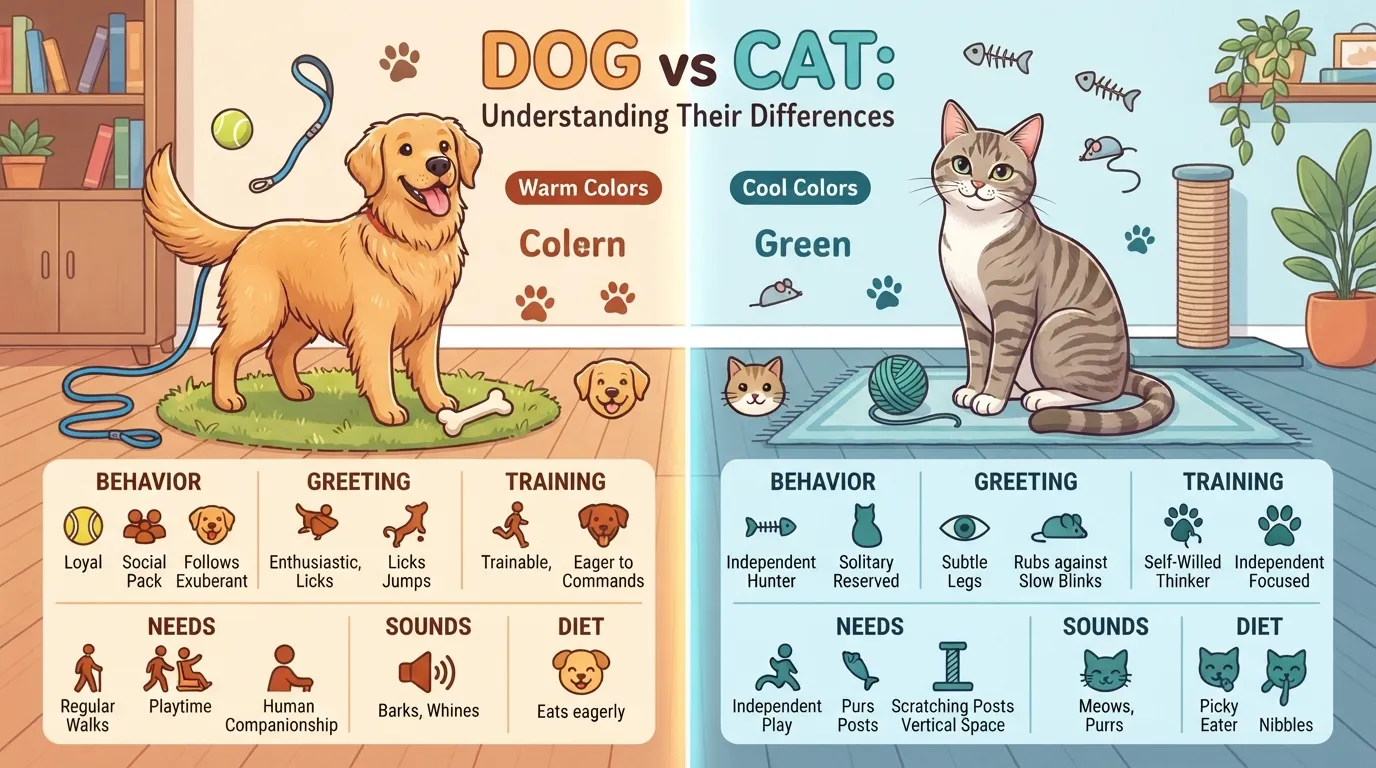
Quick answer: A dog is usually more social, active, and dependent on people, while a cat is often more independent, quiet, and easy to care for.
Imagine you are thinking about getting a pet. Your child wants a dog because dogs are playful and friendly. You, however, like cats because they are quiet and do not need as much attention. This is where the question dog or cat often comes up.
A dog and a cat are both popular pets. Both can live with people and become loving companions. However, they have different needs, habits, and ways of showing affection. A dog often enjoys walks, games, and close contact with its owner. A cat may prefer a calm home and more personal space.
People search for dog or cat when they want to understand these differences. Some want to choose a pet. Others are learning English and want to know how these two common animal words are used. The phrase dog or cat can also appear in questions about behavior, care, cost, and lifestyle.
Pronunciation
WordUS PronunciationUK PronunciationDog/dɔːɡ//dɒɡ/Cat/kæt//kæt/
The main vowel sound in dog can be slightly different in American and British English. Cat is very similar in both varieties.
Now, let us look at the main differences between these two common pets.
Read more about:https://gatherword.com/crow-or-raven/
Difference Between Dog and Cat
1. Social Behavior
Dogs often enjoy being around people. They may follow their owners around the house. Many dogs also enjoy meeting other dogs.
Cats can be social too, but many cats enjoy spending time alone. They may choose when they want attention.
Examples:
- The dog waits by the door for its owner.
- The cat sleeps alone on the sofa.
2. Exercise Needs
Dogs usually need regular exercise. Walking and playing help them stay healthy.
Cats also need exercise, but they can often get it by playing indoors.
Examples:
- I walk my dog every morning.
- My cat plays with a small toy at home.
3. Training
Dogs can usually learn many commands. Owners often train them to sit, stay, come, and walk on a leash.
Cats can also learn simple behaviors, but they may not respond to training in the same way.
Examples:
- The dog learned to sit.
- The cat learned to use its litter box.
4. Living Space
Many dogs need enough space to move and play. Large dogs may need more room.
Cats can often live comfortably in smaller homes if they have safe places to climb, rest, and play.
Examples:
- A large dog needs room for exercise.
- A cat can live happily in an apartment.
5. Attention
Dogs often want regular attention from their owners. They may become excited when people come home.
Cats may enjoy attention but often decide when they want it.
Examples:
- The dog runs to greet me.
- The cat comes to me when it wants to be petted.
6. Grooming
Dogs have different grooming needs depending on their breed and coat.
Cats are known for cleaning themselves. However, some cats still need brushing and other care.
Examples:
- My long-haired dog needs regular brushing.
- The cat cleans its fur every day.
7. Noise
Dogs can bark for many reasons. They may bark when they see strangers or hear unusual sounds.
Cats usually make softer sounds. They may meow, purr, or hiss.
Examples:
- The dog barked at the stranger.
- The cat meowed for food.
8. Daily Routine
Dogs often need a regular routine for walks, meals, exercise, and bathroom breaks.
Cats can often manage more independently, although they still need regular food, water, cleaning, and care.
Examples:
- I take my dog outside twice a day.
- I clean my cat’s litter box every day.
9. Cost and Care
The cost of keeping either animal depends on size, breed, health, food, and other needs.
Dogs may require more spending on walking, training, grooming, and outdoor activities.
Examples:
- A dog may need professional training.
- A cat may need a litter box and cat litter.
10. Emotional Bond
Both dogs and cats can form strong bonds with people.
Dogs often show affection through excitement and physical closeness. Cats may show affection by staying near you, rubbing against you, or purring.
Examples:
- My dog gets excited when I return home.
- My cat sleeps beside me.
Nature and Behaviour of Dogs and Cats
Nature of Dogs
Dogs are often social animals. Many enjoy human company and regular activity. They may be playful, protective, and eager to interact with their owners.
However, dog behavior can vary greatly by breed, age, training, and individual personality.
Nature of Cats
Cats are often more independent. They like to explore, rest, climb, and watch their surroundings.
Some cats are very friendly and active. Others prefer quiet spaces and limited contact.
It is important to remember that every animal is different. A general description cannot explain every dog’s or cat’s personality.
Why People Get Confused About Dog and Cat
People sometimes think that all dogs are friendly and all cats are independent. These are common ideas, but they are not always true.
Some dogs are quiet and enjoy being alone. Some cats are highly social and follow their owners around the house.
The confusion also comes from the fact that both animals can be pets. Both can live with families.
The main difference is not simply that one is friendly and the other is not. Their behavior depends on the individual animal, its environment, training, age, and experiences.
The Origin of Dog and Cat
Dogs and cats have a long history with humans.
Dogs are believed to have developed from ancient wolf populations. Humans and early dogs formed relationships over thousands of years. Dogs later became useful for hunting, guarding, herding, and companionship.
Cats have a different history. Early domestic cats are closely linked to wild cats from the Near East and North Africa. Cats became useful around human settlements because they could hunt rodents.
Over time, both animals became household companions.
The words also have very old histories. Dog comes from Old English docga. Cat entered English through forms related to Latin cattus and other European languages.
British vs American English
Both varieties use:
- dog
- dogs
- cat
- cats
The main difference can be pronunciation.
American English:
- I have a dog.
- My cat is sleeping.
British English:
- I have a dog.
- My cat is sleeping.
The grammar is also the same. The words are used in the same basic way in both varieties.
Some expressions may differ because of culture, but the basic words dog and cat remain the same.
Which One Should You Use?
Use dog when you are talking about a dog.
Use cat when you are talking about a cat.
For example:
- She has a friendly dog.
- He has a black cat.
For US, UK, and global English, the words are the same. You do not need to change the spelling.
If you are choosing a pet, the better choice depends on your lifestyle. Think about your time, space, budget, and ability to provide daily care.
Common Mistakes
Mistake 1: Using “dogs” for one dog
Incorrect: I have two dog.
Correct: I have two dogs.
Mistake 2: Forgetting the article
Incorrect: I have dog.
Correct: I have a dog.
Mistake 3: Using “cat” for more than one cat
Incorrect: There are three cat.
Correct: There are three cats.
Mistake 4: Confusing “dog’s” and “dogs”
Dogs means more than one dog.
Dog’s usually shows possession.
Example:
- The dogs are playing.
- The dog’s food is on the table.
Mistake 5: Treating every animal the same
Incorrect idea: Every dog behaves the same way.
Better: Dogs can have different personalities and needs.
The same is true for cats.
Everyday Usage Examples
In Emails
I will be late because I need to take my dog to the vet.
On Social Media
My cat just found a new place to sleep!
In News Writing
A local dog was rescued after being found alone.
In Formal Writing
Dogs and cats are among the most common companion animals.
In Conversation
Do you prefer dogs or cats?
I like both, but I prefer cats.
These examples show that the words are useful in casual and formal English.
Usage Trends
Dogs and cats are widely kept as companion animals around the world. Their popularity can vary by country, culture, housing type, and lifestyle.
In many cities, people choose pets that fit their available space and daily routine. Cats can be attractive to people who live in apartments because many cats can live indoors. Dogs may appeal to people who enjoy walking, outdoor activities, and more regular interaction.
Online, both animals are also common subjects for videos, photographs, jokes, stories, and social media posts.
The important point is that there is no single global preference. Pet ownership patterns change across countries and communities.
Metaphors and Similes
Both dog and cat appear in figurative English.
Dog
“Work like a dog” means to work very hard.
Example:
She worked like a dog to finish the project.
“Every dog has its day” means everyone may have a successful moment.
Example:
Keep trying. Every dog has its day.
Cat
“Curious as a cat” describes someone who wants to know everything.
Example:
The child was curious as a cat.
“Let the cat out of the bag” means to reveal a secret.
Example:
He let the cat out of the bag about the surprise party.
Connotative Meaning
The words dog and cat can have different meanings depending on context.
Positive Meaning of Dog
A dog can suggest:
- loyalty
- friendship
- protection
- trust
- companionship
Example:
He is as loyal as a dog.
Negative Meaning of Dog
In some expressions, dog can be used negatively to describe a person or situation.
Example:
The old car was treated like a dog.
The meaning depends heavily on context.
Positive Meaning of Cat
A cat can suggest:
- independence
- cleverness
- curiosity
- grace
- calmness
Example:
She moved quietly like a cat.
Negative Meaning of Cat
Some expressions can use cat in a negative or critical way.
Example:
The two people were fighting like cats and dogs.
Again, context decides the meaning.
Idioms and Proverbs
Every Dog Has Its Day
This means everyone can have a time of success.
Example:
Don’t give up. Every dog has its day.
Barking Up the Wrong Tree
This means looking in the wrong place or blaming the wrong person.
Example:
If you think Ali took the book, you are barking up the wrong tree.
Let the Cat Out of the Bag
This means to reveal a secret.
Example:
Sarah let the cat out of the bag about the gift.
Curiosity Killed the Cat
This proverb warns that too much curiosity can cause trouble.
Example:
Don’t open that private file. Curiosity killed the cat.
Fight Like Cats and Dogs
This means to argue or fight often.
Example:
The two brothers fight like cats and dogs.
Literature and Movies
Dogs and cats have appeared in literature for many years.
Literature
The Call of the Wild by Jack London was published in 1903. It is an adventure novel about a dog named Buck. The story explores survival, nature, and the relationship between humans and animals.
The Incredible Journey by Sheila Burnford was published in 1961. It follows two dogs and a cat as they travel through difficult conditions to find their family.
Movies
Old Yeller was released in 1957 in the United States. It tells the story of a boy and a loyal dog.
The Aristocats was released in 1970 in the United States. This animated movie follows a family of cats during an adventure in Paris.
The Secret Life of Pets was released in 2016 in the United States. It explores what pets may do when their owners leave home.
Why This Difference Matters
Understanding the difference between dogs and cats is useful for English learners and pet owners.
For language learners, these are very common words. They appear in conversations, books, articles, advertisements, and social media.
For pet owners, understanding animal behavior can help people make better choices about care. A dog may need regular outdoor exercise. A cat may need safe indoor spaces and a clean litter box.
The comparison also teaches an important lesson: animals should not be judged only by common stereotypes. Individual behavior can be different.
Learning the basic differences helps people communicate more clearly and understand everyday English.
Usefulness in Daily Life
The words dog and cat are useful in many daily situations.
You may use them when:
- talking about pets
- visiting a veterinarian
- discussing animal care
- writing a school assignment
- describing an animal
- talking about a neighbor’s pet
- reading animal news
- watching a movie
- discussing pet food
- choosing a new pet
For example:
- This is my dog.
- Those are my cats.
- The dog’s name is Max.
- The cats are sleeping.
Situational Preference
There is no single answer to which pet is better. A dog may suit someone who has time for walks, training, games, and regular interaction. A cat may suit someone who prefers a quieter pet and has limited space. Older people may prefer a pet whose activity level matches their routine. People who travel often should think about who will care for the animal. The most suitable choice depends on the person’s lifestyle and the individual animal’s needs.
Frequently asked questions
Is a dog easier to care for than a cat?
It depends on the dog, cat, owner, and living situation. Dogs often need more outdoor exercise and direct interaction, while cats can often be more independent.
Are cats less friendly than dogs?
Not necessarily. Cats can form strong bonds with people. Some cats are very social, while others prefer more space.
Do dogs need more exercise than cats?
Many dogs need regular walks and active play. Cats also need exercise, but indoor play can often meet much of their activity needs.
Can cats be trained like dogs?
Cats can learn behaviors and routines. However, their response to training may be different from that of many dogs.
Which is better for an apartment, a dog or a cat?
A cat may fit easily into many apartments, but the answer depends on the individual animal and the building’s rules. Some dogs can also live happily in apartments if their exercise needs are met.
Why do dogs bark and cats meow?
Barking and meowing are forms of communication. Animals use different sounds to communicate with people and other animals.
Can dogs and cats live together?
Yes. Many dogs and cats live together successfully. Their relationship can depend on their personalities, early experiences, introduction, and home environment.
Conclusion
Dogs and cats are both popular companion animals, but they have different needs and behaviors. Dogs are often social, active, and eager to interact with people. Cats are often more independent and can enjoy quiet spaces and indoor play.
However, these are general patterns. Every animal has its own personality. Some dogs are calm and independent. Some cats are highly social and playful. This is why it is better to understand the individual animal instead of relying only on common stereotypes.
For English learners, dog and cat are simple but important words. They appear in everyday conversations, books, movies, news stories, and common idioms. Knowing how to use them correctly can improve basic English communication.
Whether someone chooses a dog, a cat, or both, responsible care is the most important part. Food, safety, exercise, attention, veterinary care, and a suitable home all matter. In the end, the real question is not simply dog or cat. It is which animal fits the person’s lifestyle and can receive the care it needs.

I am M.Phil-qualified professional with a strong interest in education, English language, and knowledge sharing. I am passionate about learning, research, and creating useful content that helps people improve their English skills and understanding.