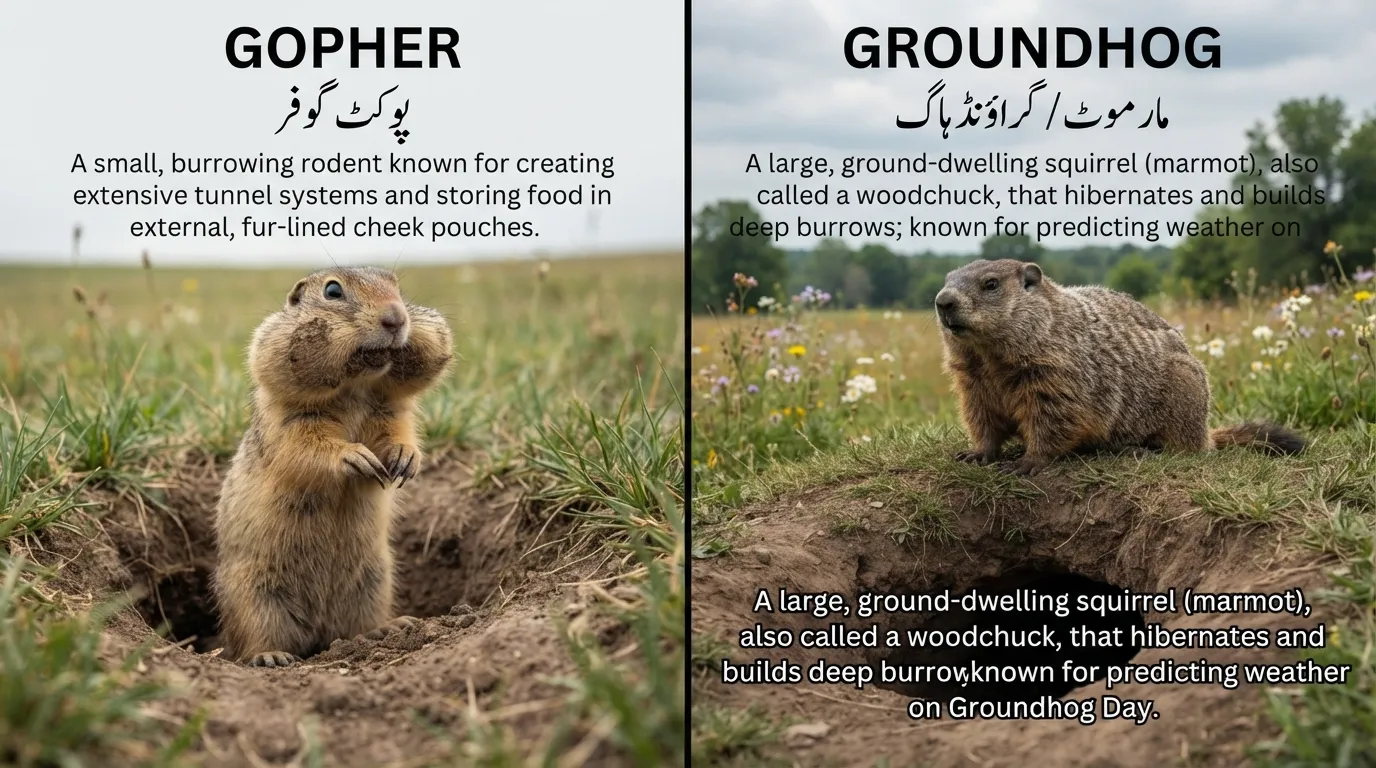
A gopher is a small digging rodent, while a groundhog is a larger rodent also called a woodchuck.
Imagine you are walking near a garden. You see a small animal disappear into a hole. You may call it a groundhog. But it could be a gopher. Later, you see a larger brown animal sitting near a field. You may wonder if it is the same animal. It is not.
The words gopher or groundhog often confuse people because both animals dig burrows and live in North America. They can also damage gardens and farmland. However, they belong to different animal groups. A gopher is usually smaller and spends much of its time underground. A groundhog is larger and often comes above the ground to eat plants.
People search for gopher or groundhog when they see a burrowing animal, read about wildlife, or want to identify an animal in their yard. Understanding gopher or groundhog helps you use the correct name and avoid a common animal-name mistake.
Pronunciation
- Gopher
- US: /ˈɡoʊfər/
- UK: /ˈɡəʊfə/
- Groundhog
- US: /ˈɡraʊndˌhɑːɡ/
- UK: /ˈɡraʊndˌhɒɡ/
Now, let us look at the main differences.
Read more about:https://gatherword.com/gopher-or-gofer/
Difference Between Gopher and Groundhog
1. Animal Family
Gophers and groundhogs are both rodents, but they are not the same animal.
A gopher belongs to the family Geomyidae. A groundhog belongs to the squirrel family, Sciuridae.
Examples:
- The gopher belongs to a family of pocket gophers.
- The groundhog is related to squirrels.
2. Size
Gophers are usually smaller. Groundhogs are much larger.
A gopher may be about 6–12 inches long. A groundhog can reach about 16–20 inches.
Examples:
- The small gopher disappeared into the soil.
- The large groundhog crossed the yard.
3. Appearance
Gophers have small eyes and ears. They have large front teeth and strong claws.
Groundhogs have a wider body, short legs, small ears, and a bushy tail.
Examples:
- The gopher had large front teeth.
- The groundhog had a thick body and short tail.
4. Habitat
Gophers spend most of their lives underground.
Groundhogs also dig burrows, but they spend much more time above ground.
Examples:
- A gopher made tunnels under the garden.
- A groundhog rested beside its burrow.
5. Diet
Both animals mainly eat plants. Their feeding habits are different.
Gophers often eat roots, bulbs, and other plant parts underground. Groundhogs commonly eat grasses, leaves, vegetables, and fruits.
Examples:
- The gopher ate roots under the plant.
- The groundhog ate lettuce from the garden.
6. Tail
A gopher has a small, usually hairless tail.
A groundhog has a short, furry tail.
Examples:
- The gopher had a tiny tail.
- The groundhog’s furry tail was easy to see.
7. Burrows
Both animals make underground homes.
Gopher tunnels can spread through soil near plants. Groundhog burrows are larger and may have several entrances.
Examples:
- The gopher built tunnels under the lawn.
- The groundhog made a large burrow near the field.
8. Activity
Gophers are highly adapted to life underground.
Groundhogs are often seen above ground during the day.
Examples:
- We rarely saw the gopher above the soil.
- We saw the groundhog eating in the afternoon.
9. Hibernation
Groundhogs are famous for hibernating during winter.
Most gophers do not hibernate in the same way. They can remain active underground during cold months.
Examples:
- The groundhog slept through much of winter.
- The gopher remained in its underground tunnels.
10. Cultural Meaning
Groundhogs have a famous place in American culture because of Groundhog Day.
Gophers do not have a similar national tradition.
Examples:
- People watch groundhog events on Groundhog Day.
- Farmers often think about gophers because they can damage crops.
Nature and Behaviour of Gopher and Groundhog
Gopher
Gophers are secretive animals. They spend much of their lives below the soil. Their strong claws help them dig. Their large front teeth help them cut roots and other food.
They often create raised soil mounds around tunnel openings. A garden can suffer when gophers damage plant roots.
Groundhog
Groundhogs are also called woodchucks. They are larger and more visible. They are good climbers and diggers.
Groundhogs usually eat plants. They may visit gardens, farms, and grassy areas. They also build deep burrows where they rest and raise their young.
Why People Get Confused About Gopher and Groundhog
Their names can also seem similar because people often use animal names loosely.
The biggest clue is size and lifestyle. A small animal that spends most of its time underground is more likely to be a gopher. A large animal that looks like a chunky squirrel is more likely to be a groundhog.
Comparison Table
| Feature | Gopher | Groundhog |
| Animal type | Rodent | Rodent |
| Family | Geomyidae | Sciuridae |
| Size | Smaller | Larger |
| Other name | Pocket gopher | Woodchuck |
| Main habitat | Underground | Burrows and open land |
| Tail | Small and less furry | Short and furry |
| Diet | Roots, plants, bulbs | Grass, leaves, fruits, vegetables |
| Hibernation | Generally does not hibernate like groundhogs | Hibernates |
| Above-ground activity | Less common | Common |
| Groundhog Day | No | Yes |
The Origin of the Keyword
The word gopher has a long history in North American English. It is used for several burrowing rodents, especially pocket gophers.
The word groundhog is an English name for the woodchuck. The animal is also scientifically known as Marmota monax. The name describes an animal that lives close to the ground and digs.
The name woodchuck does not mean that the animal actually chucks wood. It comes from an older Indigenous-language name that was adapted into English.
British vs American English
Groundhog is strongly connected with American English and North American wildlife.
In British English, people are more likely to use woodchuck when discussing the North American animal. British speakers may also simply say groundhog when referring to American culture.
Examples:
- US: The groundhog came out of its burrow.
- UK: The American woodchuck is a burrowing rodent.
The word gopher is also used in English outside the United States, especially when discussing the animal.
Which One Should You Use?
Use gopher when you mean a small burrowing rodent, especially a pocket gopher.
Use groundhog when you mean the larger North American rodent also called a woodchuck.
For US audiences, groundhog is the normal word for the animal linked with Groundhog Day.
Common Mistakes
Mistake 1: Calling Every Burrowing Animal a Gopher
Incorrect: The groundhog is a gopher.
Correct: The groundhog and gopher are different rodents.
Mistake 2: Thinking Groundhog Means Any Animal Underground
Incorrect: Any animal living underground is a groundhog.
Correct: A groundhog is a specific animal.
Mistake 3: Using Gopher and Groundhog as Synonyms
Incorrect: A gopher is another name for a groundhog.
Correct: A gopher and groundhog are different animals.
Mistake 4: Confusing Woodchuck With Gopher
Incorrect: Woodchuck and gopher always mean the same animal.
Correct: Woodchuck is another common name for a groundhog.
Everyday Usage Examples
In an Email
“We noticed a gopher near the vegetable garden.”
On Social Media
“I saw a groundhog near the road today!”
In News Writing
“Residents reported seeing a groundhog near the park.”
In Formal Writing
“Pocket gophers can affect plant roots and soil structure.”
In Daily Conversation
“Is that a gopher or a groundhog?”
Usage Trends
The word groundhog is especially common in American discussions around Groundhog Day. It also appears in wildlife articles, gardening content, and local news.
Gopher is common in gardening, farming, wildlife, and pest-control discussions. It often appears when people talk about underground tunnels and plant damage.
Online searches for both words often come from people trying to identify an animal. Searchers may see a hole, mound, or animal and want to know what they found.
Metaphors and Similes
These animal names can sometimes be used in informal comparisons.
Gopher
A person who moves quickly in and out of a place may be compared to a gopher.
Example:
“He popped out of the office like a gopher.”
Groundhog
A person who repeatedly follows the same routine may be compared to a groundhog.
Example:
“Every morning, he appears at the same café like a groundhog.”
These are informal and playful uses.
Connotative Meaning
Gopher
The word gopher can have a neutral meaning when it simply names the animal.
In some gardening contexts, it may have a negative meaning because gophers can damage plants.
Example:
“The farmer is trying to protect the crops from gophers.”
Groundhog
Groundhog is usually neutral.
It can also have a positive or playful feeling because of Groundhog Day.
Example:
“Children enjoyed watching the groundhog on TV.”
Idioms and Proverbs
There are no major traditional English idioms that use gopher and groundhog in the same way as common words such as “busy as a bee.”
However, “groundhog day” is widely used.
It can refer to a situation that feels repetitive.
Example:
“Going to the same meetings every day feels like Groundhog Day.”
The phrase comes from the American holiday and is also strongly associated with the movie Groundhog Day.
Literature and Movies
Literature
Groundhogs and gophers appear in children’s books, wildlife books, nature writing, and American literature.
One notable example is The Adventures of Peter Cottontail, a children’s story tradition that features North American woodland animals. Wildlife books also commonly describe groundhogs and pocket gophers.
Movies
The best-known movie connection is Groundhog Day, a 1993 American comedy directed by Harold Ramis.
The movie uses Groundhog Day as the setting for a repeated-day story. It helped make the phrase “Groundhog Day” widely understood as a metaphor for repetition.
Gophers have also appeared as comic animals in American films and cartoons.
Why This Difference Matters
Knowing the difference between these animals helps English learners use precise vocabulary.
It also matters in gardening, farming, wildlife education, and news writing. Calling one animal by the wrong name can create confusion.
For example, a person asking for help with a garden problem may need to identify the animal correctly. A small underground animal may require a different approach from a large groundhog.
Learning animal vocabulary also helps students understand American culture. Groundhog Day is a famous example.
Usefulness in Daily Life
Knowing these words can help when you:
- Talk about wildlife.
- Describe animals in your yard.
- Read American news.
- Discuss gardening problems.
- Write school assignments.
- Understand Groundhog Day.
- Search for animal information online.
- Speak with farmers or gardeners.
If you see a small animal making underground tunnels, gopher may be the useful word to investigate. If you see a large, chunky animal near a burrow, groundhog may be the better term.
Situational Preference
Use gopher when you are talking about a small burrowing rodent, especially one that lives mostly underground. Use groundhog for the larger North American animal also known as a woodchuck. In American culture, groundhog is the natural choice when discussing Groundhog Day. In British or international writing, you can use groundhog and add “woodchuck” when extra clarity is useful. If you are writing about gardening, identify the animal before choosing the word. The two names should not normally be used as synonyms.
Frequently asked questions
Is a gopher the same as a groundhog?
No. They are different rodents. Gophers are generally smaller and spend more time underground.
Is a groundhog a type of gopher?
No. A groundhog belongs to the squirrel family, while pocket gophers belong to the family Geomyidae.
What is another name for a groundhog?
Woodchuck is another common name for a groundhog.
Are gophers and groundhogs related?
They are both rodents, but they belong to different families.
Do groundhogs hibernate?
Yes. Groundhogs hibernate during winter.
Do gophers live underground?
Yes. Gophers are highly adapted to underground life and make extensive tunnels.
Which animal is bigger, a gopher or a groundhog?
A groundhog is generally much larger than a gopher.
Conclusion
Gophers and groundhogs are both rodents, but they are clearly different animals. A gopher is usually a small burrowing animal that spends much of its life underground. A groundhog is larger and spends more time above ground. Groundhogs are also called woodchucks.
The easiest way to remember the difference is to think about size and lifestyle. Gophers are small and strongly adapted to underground tunnels. Groundhogs are larger, more visible, and famous for hibernation and Groundhog Day.
This difference is useful in everyday English. It helps when talking about wildlife, gardening, farming, school subjects, and American culture. It also prevents a common vocabulary mistake.
If you are writing for an American audience, use groundhog for the North American animal and gopher for the smaller burrowing rodent. When the exact animal matters, avoid using the two words as synonyms. Correct animal names make your writing clearer and easier to understand.








2 thoughts on “Gopher or Groundhog: What Is the Difference?”