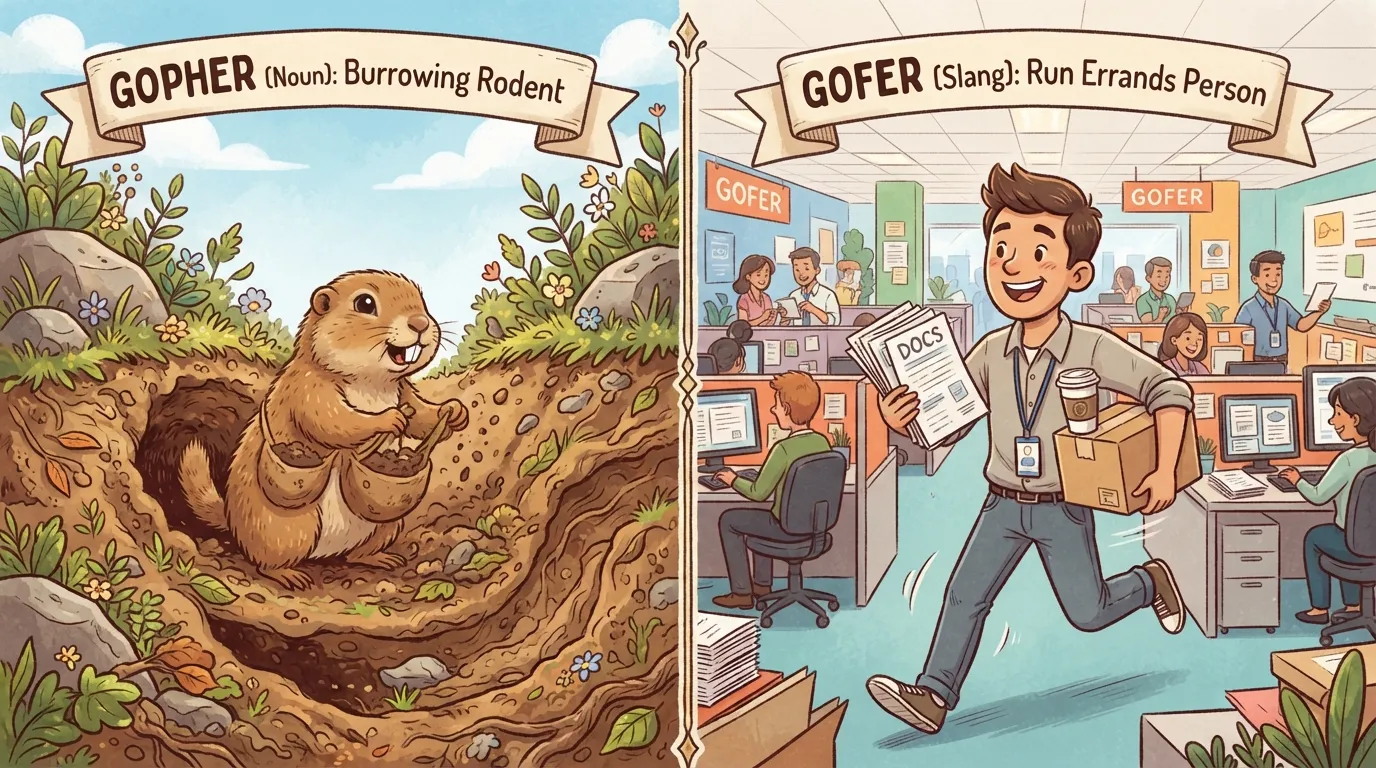
Gopher is usually an animal, while gofer is a person who runs errands or does small tasks for someone else.
Imagine you are reading an English article. You see the sentence, “The gopher made a hole in the garden.” Here, gopher means a small burrowing animal. Later, you read, “The manager asked his gofer to bring some papers.” Now, gofer means an assistant who runs errands.
These two words sound almost the same. That is why many English learners confuse them. The spelling is also very close. The main difference is their meaning and use. A gopher is mainly a small animal that digs tunnels. A gofer is a person who is asked to go and get things or complete simple tasks.
People often search for gopher or gofer because both words sound like “go-for.” Some dictionaries also note that the spelling gopher later developed a second, informal human sense by association with gofer.
Understanding gopher or gofer can help you choose the correct word in writing, schoolwork, emails, and everyday English.
Pronunciation
Gopher
- US: /ˈɡoʊfər/ — “GOH-fer”
- UK: /ˈɡəʊfə/ — “GOH-fuh”
Gofer
- US: /ˈɡoʊfər/ — “GOH-fer”
- UK: /ˈɡəʊfə/ — “GOH-fuh”
The two words are normally pronounced almost the same. This is one major reason for the confusion.
Read more about:https://gatherword.com/dwarfs-or-dwarves/
Now let us look at the differences in detail.
Difference Between Gopher or Gofer
1. Basic Meaning
Gopher usually means a small animal that lives underground.
Gofer means a person who performs small jobs or runs errands.
Examples:
- The gopher dug a hole in the yard.
- The office gofer brought the documents.
2. Type of Word
Gopher is mainly a noun for an animal.
Gofer is a noun for a person.
Examples:
- We saw a gopher near the garden.
- The director hired a gofer for the office.
3. Living Thing vs Person
A gopher is a living animal.
A gofer is a human being.
Examples:
- The gopher disappeared into its tunnel.
- The gofer went to the store.
4. Main Job or Action
A gopher digs and lives in underground tunnels.
A gofer goes to places and gets things for another person.
Examples:
- The gopher made a tunnel under the grass.
- The gofer went to get coffee.
5. Natural World vs Workplace
Gopher is common when talking about animals, gardens, farms, and land.
Gofer is often used in workplaces and service jobs.
Examples:
- The farmer found a gopher hole.
- The production gofer carried equipment.
6. Spelling
The normal animal spelling is gopher.
The person-related spelling is usually gofer.
Examples:
- A gopher can damage a garden.
- A gofer may run office errands.
7. Meaning in American English
In American English, gopher strongly refers to the animal.
Gofer is an informal word for an assistant who does errands.
Examples:
- We need to protect the plants from gophers.
- She worked as a gofer on a film set.
8. Meaning Can Overlap
Sometimes gopher can also be used informally for a person who runs errands. This use comes from the sound and idea of “go for.”
Examples:
- He was the office gopher.
- She worked as a gofer for the producer.
In careful writing, gofer is clearer for the human meaning.
9. Professional Context
Gofer is often connected with low-level assistant work.
A gofer may fetch items, deliver messages, or perform simple tasks.
Examples:
- The movie gofer brought lunch for the crew.
- The young gofer delivered the script.
10. Context Gives the Answer
The surrounding sentence usually makes the meaning clear.
If the sentence mentions holes, tunnels, soil, or gardens, gopher probably means the animal.
If it mentions an office, errands, coffee, or a film set, gofer probably means a person.
Examples:
- The gopher damaged the vegetables.
- The gofer delivered the vegetables.
Nature and Behaviour of Gopher or Gofer
Gopher
A gopher is a burrowing animal. It spends much of its time underground. It digs tunnels and can create holes in gardens, fields, and lawns. Pocket gophers are known for their cheek pouches, which they use to carry food.
Gophers can affect plants because they feed on roots and other plant material.
Gofer
A gofer is a person who performs small tasks for another person or group.
The word is often used for someone who gets things, delivers messages, or completes simple errands. A movie-set gofer, for example, may collect items or help with small production tasks.
Why People Get Confused About Gopher or Gofer
The biggest reason is pronunciation.
Gopher and gofer sound almost identical. Both can sound like “GOH-fer.”
Their meanings are also connected in one informal use. The word gofer comes from the phrase “go for.” The idea is that a person “goes for” something that another person needs.
The spelling gopher can also be used informally for an errand person. This creates even more confusion.
Comparison Table
| Feature | Gopher | Gofer |
| Main meaning | A small burrowing animal | A person who runs errands |
| Type | Noun | Noun |
| Refers to | Animal | Person |
| Common setting | Gardens, fields, nature | Offices, film sets, workplaces |
| Main action | Digs tunnels | Runs errands |
| Common spelling | Gopher | Gofer |
| Pronunciation | Almost “GOH-fer” | Almost “GOH-fer” |
| Formal use | Common | Informal |
| Example | A gopher dug a hole. | The gofer brought coffee. |
| Main confusion | Sounds like gofer | Sounds like gopher |
The Origin of Gopher or Gofer
The two words have different histories.
The animal word gopher has an uncertain origin. Dictionaries record the animal sense in the late 18th century. The exact source of the word is not fully clear.
The word gofer has a clearer story. It comes from the phrase “go for.” A gofer is someone who goes to get something for another person. Dictionary sources date the noun to the 20th century, with Dictionary.com giving the spelling as a respelling of “go for.”
Interestingly, the spelling gopher was later also used for the human meaning because of its similarity to gofer.
British vs American English
Both British and American English use gopher for the animal.
Both varieties can also use gofer for an errand worker.
The pronunciation is slightly different in many accents, but the difference is small.
American English:
- The gopher damaged the lawn.
- She works as a gofer.
British English:
- The gopher dug a hole.
- He was hired as a gofer.
In international English, gofer is usually the clearer spelling when you mean an assistant who runs errands.
Which One Should You Use?
Use gopher when you mean the animal.
Use gofer when you mean a person who performs errands or small tasks.
For example:
- Correct: A gopher lives underground.
- Correct: The gofer brought the papers.
If you are writing for an international audience, gofer is a useful choice for the human meaning because it clearly separates the person from the animal.
Remember this simple rule:
Gopher = animal.
Gofer = errand worker.
Common Mistakes
Mistake 1: Using “gofer” for an animal
Wrong: A gofer dug a hole in my garden.
Better: A gopher dug a hole in my garden.
Mistake 2: Using “gopher” for a worker
Less clear: He works as a gopher in the office.
Clearer: He works as a gofer in the office.
Mistake 3: Thinking both words have exactly the same meaning
They can overlap in informal usage, but their main meanings are different.
Mistake 4: Confusing “gofer” with “go for”
Gofer is a noun.
Go for is normally a verb phrase.
Example:
- I will go for some coffee.
- The gofer will get the coffee.
Everyday Usage Examples
In Emails
Please ask the gofer to bring the files to my office.
On Social Media
A little gopher destroyed part of my garden today!
In News Writing
Local residents reported several gophers near the park.
In Formal Writing
Gophers can affect vegetation in some areas.
For formal writing about an employee, words such as assistant, messenger, or support worker may be more suitable than gofer, depending on the job.
Usage Trends
The animal meaning of gopher remains common in North American English, especially in discussions about gardens, farms, lawns, and wildlife.
The human meaning of gofer is more informal. It often appears in descriptions of offices, entertainment, media, and production work.
The word gofer is especially useful when describing a person whose role includes many small errands. Modern job titles are often more specific, so formal workplaces may use terms such as assistant, production assistant, or office assistant instead.
The two words continue to cause spelling questions because they sound almost identical.
Metaphors and Similes
Gopher as a Metaphor
A person may sometimes be compared to a gopher because of underground work or repeated digging.
Example:
He worked like a gopher, digging through the soil all day.
Gofer as a Metaphor
A person may be called a “gofer” when they are always sent to get things.
Example:
I felt like a gofer because everyone asked me to fetch something.
These uses are usually informal.
Connotative Meaning
Gopher
The word gopher is usually neutral. It simply names an animal.
It can become negative when people are talking about garden damage.
Example:
The gopher ruined several plants.
Gofer
The word gofer is usually informal.
It can sound neutral when describing a job. However, it may sound negative if it suggests that someone only performs simple or low-level tasks.
Neutral example:
He worked as a gofer during the production.
Negative example:
They treated her like a gofer.
Idioms and Proverbs
There are no major traditional English proverbs built around the difference between gopher and gofer.
However, go for is a common English phrase.
Go for It
This means to try something with confidence.
Example:
You have prepared well. Go for it!
Go For
It can also mean to choose or prefer something.
Example:
I would go for the blue shirt.
Remember that go for is different from the noun gofer.
Literature and Movies
The word gofer appears in modern literature and entertainment because errands are common in office and production settings.
A clear literary example is The Making of Another Major Motion Picture Masterpiece, a 2023 novel by Tom Hanks. The story includes a film production and a gofer production assistant among its characters. The book is literary fiction and focuses heavily on filmmaking and American culture.
The word also appears in film-related writing. For example, the 1991 American film Billy Bathgate, based on E. L. Doctorow’s 1989 novel, describes its main character as serving as a gofer for Dutch Schultz.
These examples show how gofer is often linked with assistants, errands, and behind-the-scenes work.
Why This Difference Matters
Knowing the difference helps English learners write clearly.
Imagine writing about a garden. If you write gofer, readers may think you mean a person.
Now imagine writing about an office. If you write gopher, readers may think you mean an animal.
The difference is small in spelling but large in meaning.
This is also useful for students, bloggers, teachers, translators, and content writers. Choosing the right spelling makes a sentence easier to understand.
A simple spelling choice can prevent a funny misunderstanding.
Usefulness in Daily Life
You may see gopher when reading about:
- Gardens
- Farms
- Wildlife
- Lawns
- Animals
- Underground tunnels
You may see gofer when reading about:
- Offices
- Film production
- Entertainment
- Small errands
- Assistants
- Workplace tasks
Learning both words makes reading easier. It also helps you avoid spelling mistakes.
Situational Preference
Use gopher when you are talking about the animal. This is the safest choice in nature, gardening, farming, and wildlife contexts. Use gofer when you mean a person who runs errands. This spelling is especially clear in informal American English and entertainment contexts. In formal workplace writing, however, assistant or a specific job title may be better. If your readers are from different countries, choose the spelling that makes the meaning obvious from the context. When in doubt, remember: gopher is mainly the animal, while gofer is mainly the person.
Frequently asked questions
Is a gopher an animal?
Yes. A gopher is a small burrowing animal that lives mainly underground.
What is a gofer?
A gofer is a person who runs errands or performs small tasks for another person or group.
Are gopher and gofer pronounced the same?
They are usually pronounced almost the same, especially in American English.
Can gopher mean a person?
Yes. Gopher can sometimes be used informally for an errand worker because of its association with gofer. However, gofer is clearer for the human meaning.
Is gofer a formal word?
No. Gofer is generally informal. In formal writing, assistant or a specific job title may be more appropriate.
Is gopher American English?
The animal word gopher is strongly associated with North American English, especially because gophers are common there. The word is also recognized more widely.
Which spelling should I use for a person?
Use gofer when you mean someone whose job is to run errands or fetch things.
Conclusion
The difference between gopher and gofer is simple once you know their main meanings. A gopher is usually a small animal that digs underground tunnels. A gofer is a person who runs errands or performs small tasks for someone else.
The two words are easy to confuse because they sound almost identical. Their spellings are also very close. However, the context usually gives you the answer. Gardens, soil, holes, and tunnels point to gopher. Offices, errands, coffee, and film production often point to gofer.
The word gofer comes from the idea of “go for,” meaning someone who goes to get something for another person. The animal word gopher has a less certain origin. The two spellings later became linked because of their similar sound.
For everyday writing, remember one easy rule:
Gopher = animal. Gofer = person.
That simple rule can help you avoid confusion in school, work, blogging, emails, and everyday English.









1 thought on “Gopher or Gofer: What Is the Difference?”